

Marriott International has carried a sturdy set of second-quarter numbers through the lobby, backed by stronger fees, resilient travel demand and a development pipeline now large enough to resemble a small nation of hotel rooms.
All financial figures are in US dollars. Adjusted measures are Marriott’s non-GAAP figures.
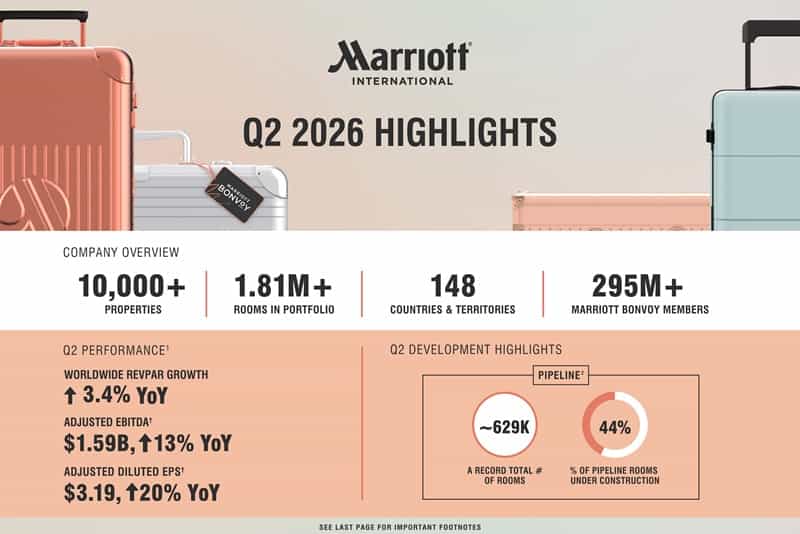
The hotel heavyweight reported adjusted net income of US$844 million for the three months ended 30 June 2026, up 15.9 per cent from US$728 million a year earlier. Adjusted diluted earnings per share reached US$3.19, compared with US$2.65 in the same quarter of 2025, while adjusted EBITDA climbed 13 per cent to US$1.592 billion, according to Marriott’s official second-quarter results.
Those are handsome figures. Yet the more useful story for hotel owners, travel advisers and the wider tourism trade sits beneath the polished brass: Marriott is collecting more fees, adding rooms at pace and leaning harder on its vast Bonvoy membership base, even as conflict in the Middle East puts a sizeable dent in international performance.
Demand holds firm, but geography matters
Worldwide revenue per available room, or RevPAR, rose 3.4 per cent year on year. The result was powered by a 5 per cent gain in the United States and Canada, while international RevPAR slipped 0.5 per cent.
Marriott President and Chief Executive Officer Anthony Capuano said: “We delivered another quarter of excellent results, reflecting strong travel demand, the power of our brands, and sustained development momentum. Global RevPAR increased 3.4 percent in the second quarter, with continued ADR strength. In the U.S. & Canada, RevPAR rose 5 percent, driven by broad-based increases across chain scales and customer segments.”
Marriott’s quarterly filing with the US Securities and Exchange Commission also attributes part of the North American strength to demand generated by the FIFA World Cup in June. That is a useful reminder that mega-events do not merely fill stadiums; they also fill hotels, restaurants and airport queues. Average daily rate, known as ADR, increased 3.5 per cent worldwide, implying that global occupancy was broadly steady.
The international map was far less even. RevPAR across Europe, the Middle East and Africa fell by more than 5 per cent. Europe grew, but the gain was overwhelmed by a 43 per cent fall in the Middle East as regional conflict disrupted travel.
Capuano said: “International RevPAR declined 0.5 percent in the quarter, as headwinds from the conflict in the Middle East more than offset solid RevPAR growth across our other international regions.”
Asia provided a brighter counterweight. Asia Pacific excluding China, which Marriott calls APEC, delivered RevPAR growth of more than 5 per cent, driven by solid leisure demand and robust intra-regional travel. Greater China rose more than 3 per cent, helped by luxury hotels and stronger trading in Hong Kong, Taiwan and Hainan.
Following the better-than-expected quarter, Marriott lifted its full-year forecast for worldwide RevPAR growth to between 3 and 3.5 per cent. It is confident, certainly, but not careless. Conflict remains a live operational risk, and the company’s SEC filing indicates the impact in the Middle East continued into the third quarter.
Fees do the heavy lifting
Marriott’s asset-light model again showed why hotel companies have spent years favouring management and franchise contracts over owning every chandelier themselves.
Franchise and base management fees jumped 14 per cent to US$1.366 billion, driven by higher co-branded credit-card fees, room growth and improved RevPAR. Incentive management fees increased from US$200 million to US$212 million. Stronger contributions from the United States and Canada offset weaker results in EMEA, while internationally managed hotels still generated more than half of the quarter’s incentive fees.
The clean upward line becomes a little more crooked under reported accounting. Operating income edged down from US$1.236 billion to US$1.229 billion, and reported net income was virtually flat at US$766 million, against US$763 million a year ago. Reported diluted EPS nevertheless improved from US$2.78 to US$2.90, partly reflecting a lower share count.
Two material items help explain the gap between the reported and adjusted results. Marriott recorded a US$68 million impairment charge linked to the sale of a hotel in the United States and Canada. It also booked a US$27 million property-related litigation accrual, with a US$20 million after-tax effect, equal to US$0.08 a share. Footnotes rarely receive chocolates on the pillow, but these ones deserve to be read.
General and administrative expenses rose by US$10 million to US$220 million, largely due to higher compensation costs and timing. Net interest expense climbed to US$201 million from US$191 million, reflecting higher debt balances, partly offset by increased interest income.
A record Marriott hotel pipeline
Growth is arriving both through new construction and the increasingly important conversion of existing hotels to Marriott brands.
The company added about 17,900 net rooms during the quarter, including roughly 11,000 outside the United States and Canada. Its global system passed 10,000 properties and reached nearly 1.814 million rooms. Net room growth was 4.5 per cent compared with the end of the second quarter of 2025.
At quarter-end, the Marriott hotel pipeline stood at a record 4,186 properties and about 629,000 rooms, almost 7 per cent more than a year earlier. More than half of those proposed rooms were in international markets. Some 1,757 properties, representing more than 279,000 rooms or 44 per cent of the pipeline, were under construction, including hotels being converted into the Marriott system.
Conversions are no longer a side entrance to growth. They represented more than one-third of signings and 40 per cent of openings during the first half of 2026. For owners, a conversion can offer faster access to Marriott’s distribution, technology, and loyalty machinery than building a property from the ground up. For Marriott, it can deliver new fee income without waiting years for the last coat of paint.
There is, however, an important qualifier. The pipeline includes 253 properties with more than 34,000 rooms approved for development but not yet covered by signed contracts. A pipeline is a statement of opportunity, not a room key already cut.
Bonvoy becomes an even bigger booking engine
Marriott Bonvoy surpassed 295 million members by the end of the quarter. Marriott’s hotel-development platform says members account for half of total sold room nights. Its scale gives Marriott a formidable direct-marketing channel and helps owners reach repeat guests across a portfolio spanning luxury, premium, select-service and longer-stay brands.
Capuano said: “The Marriott Bonvoy loyalty program, which grew to more than 295 million members at quarter-end, continues to drive demand, deepen member engagement and create value across our global portfolio.”
Marriott also signed new long-term US co-branded credit-card agreements with JPMorgan Chase and American Express. The arrangements matter well beyond the points collector deciding whether breakfast or a late checkout is the finer civilising influence. Credit-card fees are now a meaningful contributor to Marriott’s franchise economics, and they helped drive the quarter’s fee growth.
Shareholders collect, while debt rises
Marriott repurchased three million shares for US$1.1 billion during the quarter. By 29 July, it had bought back 6.2 million shares for US$2.2 billion in 2026 and returned about US$2.6 billion to shareholders through buybacks and dividends.
The balance sheet warrants equal attention. Total debt rose to US$16.9 billion at quarter-end from US$16.2 billion at the end of 2025, while cash and equivalents increased from US$400 million to US$500 million. The company’s confidence is clear; so is the need for disciplined execution as borrowing costs, geopolitical risk and development timing move about the board.
For the travel trade, Marriott’s second-quarter result says demand has not packed its bags. North America is performing strongly, Asia is providing momentum, and Bonvoy is growing into an ever-larger commercial flywheel. The Middle East decline is severe, however, and it stops the result from becoming an uncomplicated victory lap.
Even so, Marriott enters the second half with higher guidance, stronger adjusted earnings and a record global pipeline. In hotel terms, the group has plenty of rooms on the books and even more under discussion. The task now is the oldest one in hospitality: turn a grand promise at reception into a stay that guests and owners are happy to pay for.
By: Yves Thomas – © 2026.
Read Time: 6 minutes.
Author Bio:
 There’s a quiet pull about Yves Thomas, the kind you only notice after a moment. It comes from having lived travel from both sides of the reception desk. A graduate of Bangkok University International, she stepped straight into Thailand’s tourism industry, learning early how much care goes into making someone else’s holiday feel effortless.
She worked with some of the country’s best destination management teams, polishing the details most travellers never see but always remember. Eventually, the road began calling louder than meetings and schedules. Yves packed a bag and went looking again, trading conference calls for compass points.
Somewhere between Chiang Mai and Copenhagen, she started writing it down. Those reflections became a blog, warm and observant.
Now based in Hua Hin and writing for Global Travel Media, Yves shares travel not as a publicist, but as a traveller attentive, thoughtful, and deeply human.











