

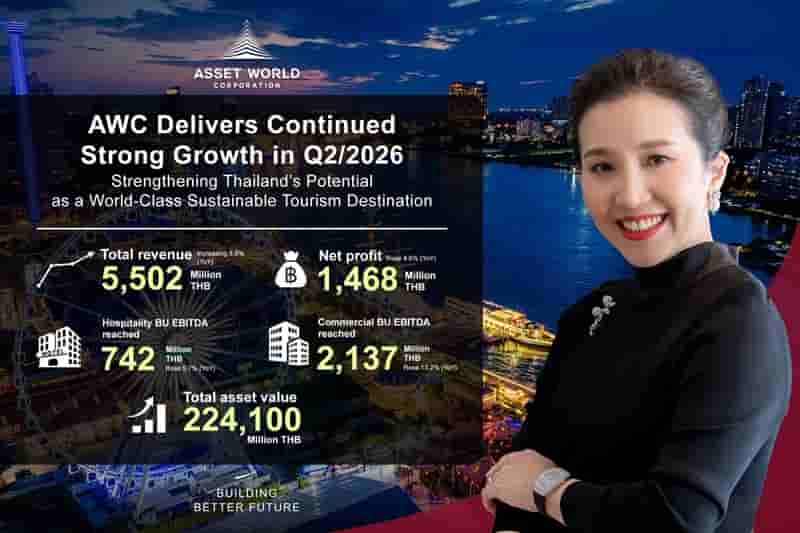
Asset World Corp delivered another quarter of solid growth, with recovering Bangkok hotels, buoyant luxury resorts, and blockbuster riverside attractions helping push second-quarter revenue to THB5.502 billion. Now, the Thai property heavyweight is considering a real estate investment trust worth up to THB50 billion to help finance its next act.
Asset World Corp Public Company Limited, better known as AWC, reported total revenue growth of 5.6 per cent year on year for the three months to June 2026. Net profit rose 4.6 per cent to THB1.468 billion, while earnings before interest, tax, depreciation and amortisation reached THB2.850 billion, also up 4.6 per cent.
Those figures tell a straightforward story: AWC’s two-engine model of hospitality and commercial property continues to deliver growth, even when the wider tourism landscape is anything but straightforward.
Hotels supplied the glamour, commercial assets provided much of the muscle, and Bangkok’s riverside attractions demonstrated that dinosaurs, giant swings and immersive entertainment can be surprisingly serious business.
The company released its official Q2 2026 announcement in Bangkok on 14 August 2026.
Bangkok hotels return to the growth itinerary
AWC’s hospitality business generated revenue of THB2.761 billion, an increase of 5.7 per cent compared with the corresponding quarter in 2025.
Hospitality EBITDA climbed at the sharper rate of 9.7 per cent to THB742 million. Its EBITDA margin consequently improved from 25.9 per cent to 26.9 per cent, suggesting that the division did more than fill additional rooms: it converted revenue into earnings more efficiently.
That distinction matters. Occupancy can make a hotel look busy, but margins reveal whether all that bustle is actually paying the bills.
A recovery across AWC’s Bangkok hotels and continued growth among luxury properties in Thailand’s principal leisure destinations supported the result. Revenue from assets under normal operation increased 7.4 per cent year on year, indicating that established properties, not merely recent additions, contributed to the advance.
Pattaya produced the most dramatic RevPAR movement, soaring 169 per cent as two hotels opened during 2025 continued to build their trading base. Such a comparison naturally benefits from the properties’ early ramp-up period, but the scale of the increase nevertheless points to strengthening demand and growing market penetration.
Chiang Mai recorded RevPAR growth of 31 per cent, while Koh Samui advanced 10 per cent as its luxury market continued to attract higher-spending travellers.
Across AWC’s broader hospitality portfolio, average RevPAR was THB3,173 per night, up 3.2 per cent year on year.
Food and beverage also earned its place at the table. Quarterly revenue from the division increased 7.3 per cent to THB900 million. EA Rooftop at The Empire contributed THB116 million, an impressive rise of 32.3 per cent.
A lofty view, it seems, can lift more than the spirits.
AWC Chief Executive Officer and President Wallapa Traisorat said: “Our performance this quarter reflects our business plan focused on driving continued growth through the Sustainable Growth-led Strategy.”
She said the company remained focused on creating lifestyle destinations and strengthening partnerships that can support Thailand’s standing as a world-class tourism and lifestyle destination.
Asiatique turns entertainment into commercial momentum
AWC’s commercial business was the quarter’s pace-setter, generating revenue of THB2.517 billion, up 13.4 per cent. EBITDA increased 13.2 per cent to THB2.137 billion.
The performance reflects the company’s “Lifestyle Destination” strategy, under which it is reworking conventional commercial properties into places that combine retail, dining, tourism, culture and entertainment.
The strategy is designed to keep visitors on-site longer, encourage greater spending, and improve opportunities for tenants. It is the commercial-property equivalent of ensuring guests do not merely pass through the lobby.
Asiatique The Riverfront Destination was central to that effort. Its expanding attraction line-up includes Jurassic World: The Experience, the towering SkyFlyers: Wings of Garudapterus ride and the Better World Better Future educational entertainment concept at Hatch Dome.
According to AWC, visitor numbers at Asiatique increased 36 per cent year on year. Average rental revenue rose 6.3 per cent, while occupancy increased 1.8 per cent compared with the same quarter last year.
Those results provide tangible evidence that the destination strategy is converting foot traffic into revenue not always a guaranteed feat in retail, where crowds can occasionally demonstrate an Olympian ability to browse without buying.
AWC’s community shopping centres also recorded improvement following changes to their positioning and tenant mix. Occupancy increased 13.3 per cent year on year, while average rental revenue rose 5.4 per cent. Office revenue advanced 2.8 per cent.
Fairmont and Moxy lead a substantial development pipeline
AWC is preparing to open Fairmont Bangkok Sukhumvit during the second half of 2026. The property will be Thailand’s first hotel operating under Accor’s Fairmont brand and will expand the upper-luxury offering in Bangkok’s fiercely competitive accommodation market.
The company is also working with Marriott International on Moxy Pattaya The Aquatique, bringing the hotel group’s youthful lifestyle brand into AWC’s large-scale Aquatique development.
These openings form part of a much wider pipeline that increasingly blends accommodation with attractions and cultural experiences.
AWC and Universal Destinations & Experiences are collaborating on a Kung Fu Panda attraction in Bangkok’s Yaowarat district and a DreamWorks-branded water park beside Pattaya Beach.
At Asiatique, AWC and EMM Williams Productions plan to introduce Avatar: Guardians of EYWA, THE MAGIC WALK™ in 2027. The project is scheduled to become the experience’s Southeast Asian debut.
The company is also progressing two ambitious Chao Phraya River projects: what AWC describes as the world’s first sustainable cross-river themed cable car and MONA Bangkok, developed with Tasmania’s Museum of Old and New Art.
AWC Riverside Journey will connect 11 company-operated lifestyle destinations along the river, combining hotels, restaurants, cultural venues, retail attractions and leisure experiences.
It is a sizeable bet on experiential tourism, the increasingly influential idea that travellers want a destination to offer more than a bed, breakfast and politely presented bill at departure.
Proposed AWC REIT could unlock new growth capital
The quarter’s most consequential announcement may be the one attracting fewer holiday photographs.
AWC is studying the establishment of a real estate investment trust that could initially receive assets valued at up to THB50 billion. The proposed transfer would represent no more than 25 per cent of AWC’s total assets, based on its second-quarter financial statements.
The board has approved establishing Asset World Corp REIT Co Ltd as the proposed trust manager. It has also granted in-principle approval for the company to continue its study and prepare the platform’s operating and governance structure.
Under the proposed arrangement, AWC could transfer mature hotels and commercial assets with recurring-income potential to the REIT. Domestic and international investors would gain access to a portfolio of established Thai real estate, while AWC could recycle capital into new developments.
In broad terms, the model would allow AWC to develop, improve and stabilise assets before placing suitable properties into the trust. The REIT could then hold income-producing investments while AWC directed capital and expertise towards its next generation of destinations.
That could improve financial flexibility, increase the efficiency of AWC’s capital structure and create an ongoing channel between property development and long-term investment.
However, the proposal remains under study. The eventual structure, assets, timetable and transaction size will depend on due diligence, market conditions and approval from the relevant regulators and authorised parties.
In other words, the REIT may be taking shape, but nobody should start engraving the brass plaque just yet.
Sustainability credentials support the investment story
AWC frames its expansion through its “Building Better Future” mission and the 3BETTERs framework: Better Planet, Better People and Better Prosperity.
The framework integrates sustainability into property development, operations and community engagement. It also plays an important role in the company’s pitch to institutional investors, for whom environmental, social and governance performance remains closely tied to risk, finance and long-term asset value.
AWC was included in the Fortune Southeast Asia 500 for a second consecutive year. It also reported a Top 1 per cent sustainability ranking for the fourth year running, inclusion in the Dow Jones Best-in-Class Emerging Markets Index for a fourth consecutive year and recognition in the S&P Global Sustainability Yearbook 2026 for the fifth year.
The company also achieved a 100 per cent score in Thailand’s 2026 AGM Checklist for the fifth consecutive year.
These credentials do not remove the risks attached to an ambitious development pipeline. New hotels require time to mature, major attractions depend on sustained visitor demand, and the proposed REIT will remain exposed to regulatory and market conditions.
They do, however, reinforce AWC’s case that sustainability is being treated as part of asset management and corporate governance, rather than as a decorative paragraph tucked near the back of the annual report.
A confident wager on Thailand’s tourism future
AWC enters the second half of 2026 with rising revenue, improving hotel margins and stronger commercial-property performance. More importantly, it has assembled a pipeline designed to connect hospitality, entertainment, dining, art and riverside transport.
For Thailand’s travel trade, that investment could create new reasons to package Bangkok, Pattaya and other major destinations more ambitiously. Hotels would become components of broader precinct experiences, giving agents, wholesalers and event planners more material to build itineraries around.
The proposed THB50 billion REIT adds a financial mechanism to sustain that development cycle, provided the final structure wins the necessary approvals and investor support.
AWC’s quarter was therefore about more than a 5.6 per cent rise in revenue. It was evidence of a company attempting to turn Thailand’s tourism growth into a connected portfolio of places where people can stay, dine, shop, play and, commercially speaking, linger.
By: Supaporn Pholrach – © 2026.
Read Time: 6 minutes.
Author Bio:
 Supaporn Pholrach came up in advertising when deals were sealed with a handshake, and deadlines lived on scraps of paper, not dashboards. She learned early that people mattered more than process, and it stuck. With solid training and a stubborn work ethic, she built a reputation for delivering results without turning hard or hollow.
Fifteen years at Bangkok Shuho would test anyone’s stamina. Supaporn stayed the distance. These days, as Sales Manager at Global Travel Media, she helps tourism brands cut through the noise with common sense, good humour and genuine warmth.
She doesn’t chase quick wins. She earns trust, builds loyalty and keeps her word. In an industry that rarely slows down, Supaporn is someone you’re quietly glad to have on your side.











