

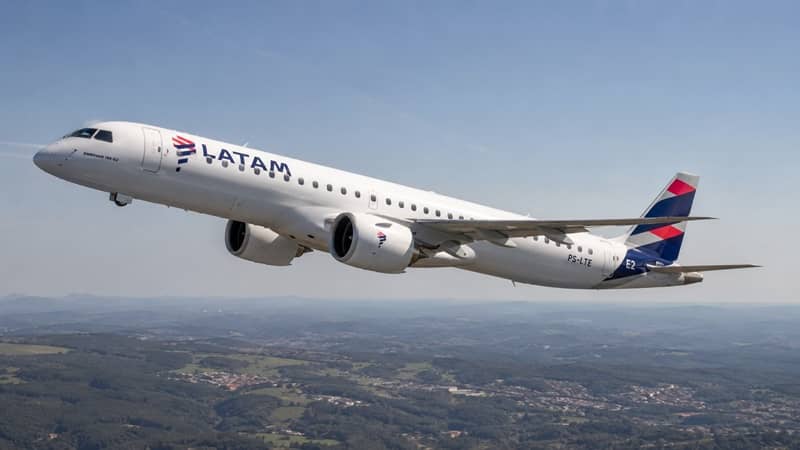
LATAM Airlines Group has emerged from one of the more bruising fuel quarters in recent aviation history still firmly in the black, posting second-quarter net income of US$125 million while preparing a significant Embraer-powered expansion across Brazil.
There is, however, no disguising the cost of keeping the tanks full.
Fuel-related costs surged 93.1 per cent compared with the second quarter of 2025, reaching US$1.7 billion. The average all-in jet fuel price, including hedging, climbed 81.3 per cent to US$194.50 a barrel. Against that rather inhospitable backdrop, LATAM still produced an adjusted operating margin of 5.4 per cent and adjusted EBITDA of US$713 million.
Revenue was the brighter headline. Total operating revenue reached US$4.183 billion, up 27.6 per cent year on year, according to LATAM’s official Q2 results.
In other words, fuel gave the accounts a rather vigorous shake, but it did not knock LATAM off its feet.
There is an important qualification. Net income fell 48.2 per cent from US$242 million in Q2 2025, according to LATAM’s regulatory financial results. So this is less a story about soaring profit than about maintaining profitability during an extraordinary escalation in the airline industry’s most unforgiving variable cost.
Passengers keep coming
Demand offered LATAM some considerable protection.
The group carried 21.1 million passengers during the quarter as consolidated capacity rose 8.9 per cent. International capacity increased 11.8 per cent, LATAM Airlines Brazil’s domestic capacity grew 5.7 per cent, while domestic operations among affiliates in Chile, Colombia, Ecuador and Peru rose 5.3 per cent.
Load factor remained a healthy 81.8 per cent.
More importantly for the accountants downstairs, passenger revenue increased by 27.9 per cent, while cargo revenue rose by 21.8 per cent.
Premium customers are also becoming increasingly valuable. LATAM said the premium segment accounted for 29 per cent of passenger revenue during the quarter, while its enormous LATAM Pass loyalty program reached 56 million members.
LATAM Pass members now generate 67 per cent of passenger revenue, and the number of Elite members rose 26 per cent year on year.
That is not merely an impressive membership roll. It gives LATAM a considerable base of customers already connected to its brand, network, and loyalty ecosystem, which is particularly useful when volatile costs force airlines to become more inventive with revenue.
LATAM Airlines Group CFO Ricardo Bottas said the results demonstrated “the group’s structural strength, the value proposition offered to customers and its ability to operate in a volatile and uncertain environment”.
He added: “The group remains firmly committed to the disciplined execution of a profitable growth strategy. LATAM’s diversified business model – which includes revenue from the Premium segment, integrated cargo and loyalty businesses, and a strong financial position – provided the foundation for maintaining profitability even during a seasonally weaker quarter and amid unprecedented fuel-price pressures that had a significant impact on the group’s costs.”
The balance sheet gives that confidence some substance.
LATAM generated US$473 million in adjusted operating cash flow and finished June with about US$2.7 billion in cash and cash equivalents. With committed undrawn revolving credit facilities included, total liquidity stood at approximately US$4.2 billion.
Adjusted net leverage was 1.5 times, comfortably below the company’s stated financial-policy ceiling of 2.0 times.
Shareholders have also approved a share buyback program covering up to five per cent of outstanding shares over as many as five years, although its commencement and execution remain subject to Board decisions and Chilean regulations.
Embraer opens new Brazilian doors
While the financial figures attracted the headlines, the more tangible news for travellers comes from Brazil.
LATAM Airlines Brazil has unveiled the first operating phase for its new Embraer E195-E2 fleet.
Between November 2026 and March 2027, as many as 14 E195-E2s are expected to enter service across 42 Brazilian domestic routes.
Four destinations join the LATAM map: Cabo Frio and Macaé in Rio de Janeiro state, Ji-Paraná in Rondônia and Rondonópolis in Mato Grosso.
The new aircraft will support eight new routes during the initial deployment, alongside additional frequencies and more flexible fleet allocation across established markets.
It is an important piece of network arithmetic.
LATAM Airlines Brazil expects its domestic network to reach 67 destinations, up from 44 in 2019, the largest Brazilian network in its history.
The group finished Q2 with 383 aircraft after receiving another nine during the quarter, including two wide-bodies.
And Brazil’s expansion may only be getting started. LATAM is assessing around 18 possible additional destinations for a second stage as further Embraer aircraft arrive in 2027. Reuters reports that the E195-E2s are intended to help LATAM develop markets with strong corporate demand, including agribusiness and oil-producing regions.
For a country the size of Brazil, additional regional connectivity is not a decorative flourish. It can determine whether a market is commercially accessible at all.
LATAM raises its sights for 2026
Perhaps the clearest measure of management’s confidence is the reinstatement of LATAM’s full-year guidance.
The group now forecasts capacity growth of 9 to 10 per cent in 2026 and adjusted EBITDA of US$4.1 billion to US$4.4 billion. That EBITDA range is an upgrade from the US$3.8 billion to US$4.2 billion guidance issued in May.
Year-end liquidity is expected to be at least US$4.7 billion, while adjusted net leverage is forecast at no more than 1.6 times.
The revision reflects an improvement in LATAM’s jet fuel expectations for the second half. Reuters reported that the company was working on the assumption of around US$150 per barrel for Q3 and US$130 per barrel for Q4, still substantially above the roughly US$90 level assumed before the latest fuel-price shock.
For travel sellers and the wider tourism business, that matters. Financially resilient airlines are better equipped to maintain schedules, invest in aircraft and develop new destinations when the economic weather turns decidedly unfriendly.
LATAM’s second quarter was certainly no victory lap: profit almost halved, and fuel swallowed substantially more money.
Yet the airline remained profitable, filled more than eight in ten available seats, expanded capacity, lifted revenue by nearly 28 per cent, and pressed ahead with a sizeable expansion of its Brazilian network.
Sometimes in aviation, keeping altitude when the headwinds arrive is an achievement in itself.
By: Bridget Gomez – © 2026.
Read Time: 5 minutes.
Author Bio:
 Bridget has never been built for stillness. Of Portuguese heritage, she began as a nurse, tending veterans at the Repatriation Hospital, listening to stories as colourful as the life she was yet to live. It was worthy, steady work, but wanderlust, as always, proved louder than routine.
So, she traded starch for a backpack and disappeared for a year, chasing trains, sunsets and the occasional regrettable glass of wine. She wrote everything down: the dust, the laughter, the missteps, the magic. Those notebooks became a travel blog, then a habit, then a calling.
Eventually she found Global Travel Media, or perhaps it found her.
Today Bridget writes with heart, humour and a dash of mischief, still travelling, just now with words.











