

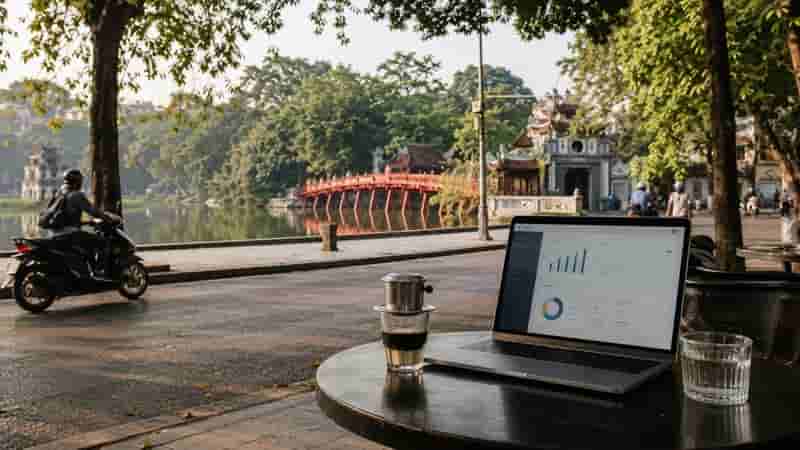
Hanoi has beaten Bangkok, Ho Chi Minh City and every other city in a new global workcation study, while Australia has suffered the sort of clean sweep it would rather not frame for the pool room.
The 2026 Compare the Market Workcation Hotspots study puts Hanoi first in the Australia-and-Asia field with a score of 73.9. More strikingly, the Vietnamese capital also tops the entire 100-city international study.
At the other end of the regional table, Canberra finished last on 11.6, followed by Perth on 15.3 and the Gold Coast on 19.3. For a country that has spent years selling sunshine, lifestyle and the enviable prospect of answering emails within reach of a flat white, it is not exactly postcard material.
But the result deserves more than a cheap gag about Canberra being quiet after dark. The index is really a contest between cost, connectivity, places to work, and things to do when the laptop finally shuts down. On those measures, Asian cities have a formidable hand.
Hanoi: low costs, plenty to do
Hanoi’s victory was powered by affordability and an extraordinary volume of things to do. Compare the Market counted 9,038 TripAdvisor attraction listings for the city, the highest number in its analysis.
It also found the cheapest available accommodation for a one-month period at just US$71, while a regular cappuccino cost US$1.84.
That accommodation figure needs an asterisk the size of a carry-on bag: it is not the average monthly rent in Hanoi.
The researchers used the cheapest accommodation on Booking.com available for a specific stay from 1 September to 1 October 2026. In other words, it is an index input, not a promise that every roaming executive can rent a charming Old Quarter bolthole for loose change.
Still, Hanoi’s broader proposition is compelling. A working traveller can spend the day connected to colleagues and the evening amid one of Asia’s most characterful capitals, where food, history, cafés and street life are hardly in short supply.
Bangkok took second place with 67.17 out of 100. Its cheapest one-month accommodation in the study came in at US$93, while fixed broadband download speed was recorded at 286.11 Mbps. The Thai capital also notched up 5,416 TripAdvisor attractions.
Ho Chi Minh City completed the regional top three with a score of about 62.2. It recorded the cheapest regular cappuccino in the study at US$1.78, while the lowest accommodation option identified for the month was US$100.
Vietnam, then, has two cities on the podium. That is a fairly persuasive double act for tourism operators hoping to turn longer stays into more local spending.
Canberra gets the wooden laptop
Canberra’s 11.6 score looks brutal, but the ingredients explain much of it.
Compare the Market identified 52 TripAdvisor attractions and 21 coworking spaces, while its cheapest month-long accommodation option was US$1,107, the highest among the Australian cities in the dataset.
Australia also carried a connectivity handicap in the study. Across the Australian destinations assessed, the average fixed broadband download speed was 157.56 Mbps, and the average mobile download speed was 115.07 Mbps.
Those numbers are perfectly capable of handling many ordinary remote-work tasks, but they were less competitive in an index that gives fixed broadband alone a 25 per cent weighting.
Perth’s 15.3 score reflected a similar cost problem. The cheapest month-long stay identified was US$970, while a cappuccino averaged US$4.23. The city had 233 TripAdvisor attraction listings.
Perth remains one of Australia’s most appealing leisure cities, of course; the index simply asks a narrower question about the economics and infrastructure of combining a job with a trip.
The Gold Coast, on 19.3, found itself third from bottom despite possessing something most office windows conspicuously lack: kilometres of beach.
It had 237 attraction listings but only 13 coworking spaces, the fewest among the Australian destinations examined. A regular cappuccino came in at US$3.78.
Surfers Paradise has survived worse indignities than a spreadsheet, and nobody seriously expects holidaymakers to abandon Queensland because Hanoi has cheaper coffee. What the findings do show is how the value equation changes when a visitor is staying for weeks rather than a long weekend.
A workcation is not simply a holiday with Outlook open
The business opportunity is worth watching.
Flexible work can allow travellers to stay longer, spread their spending beyond traditional holiday periods, and consider destinations that might otherwise lose out in the annual-leave lottery.
Hotels with proper desks, reliable Wi-Fi, laundry facilities, and sensible long-stay rates are especially well-placed. So are serviced apartments, coworking operators and travel advisers able to package the practical bits with the pleasurable ones.
Compare the Market’s Adrian Taylor, Chief Executive – General Insurance, summed up the balancing act neatly:
“Choosing the right destination can help you strike a balance between productivity and adventure.”
That quotation has been checked against Compare the Market’s published research and is reproduced accurately.
There is, however, a less glamorous side to taking the office overseas.
Travellers should check their employer’s remote-work policy, cybersecurity requirements, tax position, visa or immigration conditions and insurance before booking. A tourist entry permission does not automatically confer a right to work.
Australia illustrates the point clearly. The Department of Home Affairs says a Visitor visa or Electronic Travel Authority does not allow a non-citizen to work in Australia.
Conditions differ between countries and individual circumstances, so travellers should seek destination-specific information rather than assuming “remote” means regulation-free. Australian travellers should also consult Smartraveller for current destination advice before departure.
Insurance deserves more than a last-minute tick-box, too. Compare the Market advises travellers to read the relevant Product Disclosure Statement and Target Market Determination and to understand the limits, exclusions, and restrictions. Anyone intending to work while travelling should establish whether their planned activities are covered.
The fine print behind the rankings
The methodology matters.
Compare the Market selected 100 cities: 40 in Europe, 40 across the United States and Canada, 10 in Australia and 10 in Asia. Data were normalised and weighted to build the final scores.
Fixed broadband received the heaviest weighting at 25 per cent. Attractions, coworking spaces, and accommodation each accounted for 20 per cent, while mobile download speed and coffee price each accounted for 5 per cent in the methodology published online.
Interestingly, the webpage’s introductory list also mentions beer prices, although its detailed weighting table does not assign beer a weighting a small methodological inconsistency worth keeping in mind when interpreting the index.
The underlying data came from sources including Speedtest, TripAdvisor, Coworker, Booking.com and Numbeo. Compare the Market says currencies were converted on 9 July 2026 and the dataset was correct as at 16 July 2026.
That makes this a useful comparative snapshot, not holy writ.
Attraction counts can reward larger tourism inventories; the cheapest accommodation listing may bear little resemblance to what most business travellers would actually book; and citywide internet figures cannot guarantee the Wi-Fi in room 1408 will behave itself five minutes before a board presentation.
Even so, the message for the travel trade is hard to miss.
Remote work is turning connectivity, workspace and long-stay affordability into destination assets alongside food, culture, beaches and beds. Destinations that can bundle those ingredients convincingly have an opportunity to turn the humble laptop into a surprisingly effective tourism generator.
For Hanoi, that combination has delivered the crown. For Canberra, Perth and the Gold Coast, the spreadsheet has been rather less charitable.
Then again, Australia still has one considerable advantage: when the laptop lid closes, nobody has ever needed an index to explain the appeal of a sunset, a cold drink and being gloriously off the clock.
By: Yves Thomas – © 2026.
Read Time: 5 minutes.
Author Bio:
 There’s a quiet pull about Yves Thomas, the kind you only notice after a moment. It comes from having lived travel from both sides of the reception desk. A graduate of Bangkok University International, she stepped straight into Thailand’s tourism industry, learning early how much care goes into making someone else’s holiday feel effortless.
She worked with some of the country’s best destination management teams, polishing the details most travellers never see but always remember. Eventually, the road began calling louder than meetings and schedules. Yves packed a bag and went looking again, trading conference calls for compass points.
Somewhere between Chiang Mai and Copenhagen, she started writing it down. Those reflections became a blog, warm and observant.
Now based in Hua Hin and writing for Global Travel Media, Yves shares travel not as a publicist, but as a traveller attentive, thoughtful, and deeply human.











