

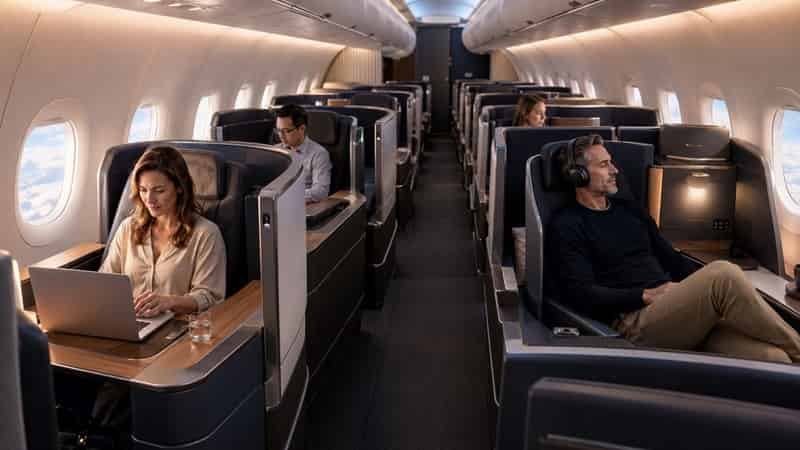
International Business Class bookings by Australian small and medium-sized enterprises have climbed 19 per cent in the first half of 2026, adding fresh evidence that the pointy end of the aircraft is becoming less of a corporate trophy and more of a travelling office.
The increase, covering January to June and measured against the same period in 2025, comes from Corporate Traveller, Flight Centre Travel Group’s specialist SME business. It arrives as airlines pour serious money into premium cabins, introducing direct aisle access, privacy doors, revamped lounges and, increasingly, fare families that make Business Class itself a menu rather than a single product.
Tom Walley, Global Managing Director of Corporate Traveller, said the change goes well beyond a more elaborate seat.
“Business class used to be about the seat, but now it’s about the whole experience – end-to-end – and the airlines know it, and they are responding to it,” said Walley.
“What we’re seeing is airlines treating the front of the plane less like a status symbol and more like a genuine product line, with different tiers, different price points and different trade-offs.
“For travellers, flying Business Class is seen as a major productivity hack. The comfort and convenience buy you back the day you’d otherwise lose to jet lag, and many companies have worked out that’s cheaper than it looks on the invoice.”
That last point may be the most important.
For an SME sending an executive from Australia to Europe or North America, a cheaper fare is not necessarily cheaper if the traveller spends the first working day impersonating a pot plant. Productivity, sleep and the ability to arrive ready for business now sit more clearly in the value equation.
Emirates takes the corporate crown
Corporate Traveller’s latest Travel Manager Survey also asked corporate bookers to nominate the best long-haul Business Class experience from Australia.
Emirates led the field, rated best by 72 per cent of respondents, followed by Qatar Airways on 67 per cent and Singapore Airlines on 62 per cent.
“It’s telling that the airlines topping this list are the ones that have been most aggressive about reinvesting in their cabins. Travel managers aren’t rating marketing, they’re rating what their travellers actually experience on board, and that’s a much easier thing to prove,” said Walley.
The investment is certainly visible.
Emirates is deep into a multi-billion-dollar fleet retrofit. Its refurbished Boeing 777 replaces the old 2-3-2 Business Class arrangement with a 1-2-1 layout, giving every passenger direct aisle access. Retrofitted aircraft entered service in Beirut on 6 January 2026 and in Beijing on 1 February.
On 20 May, Emirates also completed the first conversion of one of its two-class A380s into a three-class aircraft.
The refurbished jet, operating between Dubai and Birmingham, carries 76 Business Class seats, 56 Premium Economy seats and 437 Economy seats.
Emirates says the next phase of its retrofit program covers another 60 A380s and 51 Boeing 777s, beginning in August 2026.
Privacy becomes premium currency
Malaysia Airlines is another carrier putting a door between the business traveller and the aisle.
Its new-generation A330neo has 28 Business Class suites with privacy doors, fully flat beds and direct aisle access. The aircraft has been progressively deployed on Australian services as the carrier expands its new-generation fleet.
Across the Tasman, Air New Zealand’s first completely retrofitted Boeing 787-9 entered passenger service on 19 May 2025, initially flying Auckland-Brisbane before continuing long-haul to San Francisco.
The makeover introduced redesigned Business Premier and four Business Premier Luxe seats. Luxe adds a full-closing door, a larger bed, and enough additional space for two people to dine together.
Air New Zealand says all 14 of its 787-9s are due to receive the new cabin layout by the end of 2026.
Business Class gets the unbundling treatment
Yet the premium revolution is not simply an arms race in doors, bedding and ever-larger screens. Airlines are also borrowing a well-worn economy-cabin trick: unbundling.
Delta Air Lines began selling Basic Business on 8 July 2026 as part of its expanded fare structure, while retaining the core Delta One onboard experience, including the lie-flat seat. The cheaper tier pares back flexibility and benefits compared with higher fare options.
There is an important detail for travellers booking now.
Contrary to suggestions that lounge access disappeared immediately, Delta says Basic Business customers retain access to the Delta One Lounge and Delta Sky Club for travel through 18 January 2027. The lounge exclusion takes effect for travel from 19 January 2027.
That distinction matters when comparing fares; the headline price is only useful once the inclusions have been put under the microscope.
Tomorrow’s cabins remain tomorrow’s cabins
Some of the industry’s most talked-about products remain firmly in the departure lounge of the future.
Qatar Airways unveiled Qsuite, Next Gen at the Farnborough International Airshow in July 2024, promising greater space and privacy, movable 4K OLED screens and reworked Quad and Companion Suites.
It is intended for the Boeing 777-9, but Boeing said in July 2026 that it is working towards certification and first delivery in 2027.
Singapore Airlines, meanwhile, is investing S$1.1 billion to install new long-haul cabin products across 41 Airbus A350-900 aircraft, including next-generation Business Class throughout the retrofit fleet and First Class on its seven ultra-long-range variants.
The debut, originally expected in the second quarter of 2026, has been pushed to the first quarter of 2027 due to supply chain constraints and seat certification delays.
“Not every airline is moving at the same pace – it’s worth knowing that if you’re planning ahead. Some of the most talked-about seats on the market right now still aren’t in the sky,” said Walley.
For travel managers, that is the practical lesson behind the glossy cabin photographs. Aircraft type, retrofit status, fare rules and lounge benefits can now alter the Business Class proposition materially, even on the same airline.
The 19 per cent increase in bookings suggests businesses are willing to pay when they can see a return in comfort, time, and productivity. But premium travel is also becoming more complicated. The smartest corporate buyers will look beyond the cabin label and price the whole journey.
After all, Business Class may be moving up in the world, but nobody wants to discover at check-in that the bargain came with an asterisk.
By: Prae Lee – © 2026.
Read Time: 4 minutes.
Author Bio:
 You can tell a great deal about a person by how they meet a Bangkok morning. Prae Lee doesn’t charge into it; she glides, unhurried, as if time itself has agreed to behave. There is a calm assurance about her, the sort earned by knowing both your roots and your destination.
A graduate of Chulalongkorn University, she earned her business degree with quiet pride, then further honed it in Singapore and Australia. Travel didn’t change her. It refined what was already there: curiosity, discipline, grace.
Back in Bangkok, she slipped modern life into the family business, mastering social media with an instinct for listening and selling with Thai gentleness.
Prae never seeks attention, yet everything she touches grows brighter.
Now with Global Travel Media, she writes with authenticity, drawing on culture, travel and a rare, steady confidence.











