

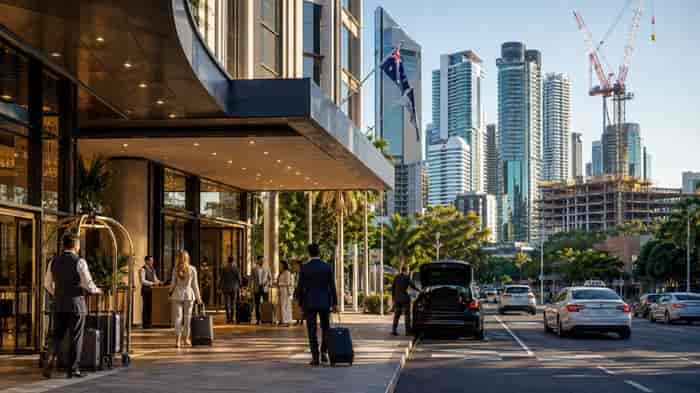
Australia’s hotel market has developed a profitable problem.
Travellers are returning. Major events are filling rooms. Daily rates are firm. Investors have also rediscovered their cheque books. Yet the flow of new hotel rooms is slowing just as the visitor economy gathers speed.
For established hotel owners, it is a fine position. For travellers, event organisers and tourism planners, it carries a warning. Australia may soon have more demand than well-located rooms.
Tourism Research Australia’s detailed International Visitor Survey recorded 8.5 million international trips in the year ending March 2026. That was up 10 per cent. Those visitors spent $40.9 billion in Australia, an increase of 20 per cent. Total trip spending, which also includes costs outside Australia such as international airfares, reached $57.6 billion.
Domestic travel remained substantial, although it was not racing at the same pace. Australians made 113.1 million overnight trips in the year ending March 2026, down 2.3 per cent. Spending edged 0.7 per cent higher to $107.6 billion. Incoming international airline capacity reached 28.1 million seats in the year ending January 2026. That was up 7 per cent.
The guests, then, are arriving. The cranes are not keeping up.
Demand returns with its suitcase packed
CBRE says international arrivals reached about 92 per cent of pre-pandemic levels during 2025. Domestic travel remained resilient, while corporate travel and the meetings, incentives, conferences and exhibitions sector strengthened.
Hotel performance rose with that demand. Revenue per available room, or RevPAR, increased by more than 8 per cent in most major cities. Sydney and Brisbane led the market. Melbourne still achieved 7 per cent growth while absorbing more supply.
Major events added heat. CBRE found that peak periods for sport, culture and business events lifted rates sharply. Average daily rates were usually about 40 per cent above normal trading levels.
That is excellent news for the accounts department. It is rather less charming for the traveller who assumed a Tuesday night would be harmless.
Concerts, major sporting events, exhibitions, and citywide conferences can quickly fill a market. When supply is tight, those peaks move prices at impressive speed.
The question is no longer whether hotel demand has returned. It is whether the right rooms will be available in the right places.
Australia is building, but not fast enough
Australia has not stopped building hotels. That claim would be dramatic, but wrong.
The real concern is that the active pipeline is becoming smaller, more selective and harder to finance.
CBRE counted 2,034 rooms delivered during 2025 and the opening months of 2026. Another 5,143 rooms were under construction nationally. Beyond 2027, however, only three projects totalling 828 rooms were under construction when its outlook was prepared.
CBRE forecasts that hotel supply will run 41 per cent below historic delivery levels for the rest of the decade. It also expects supply growth to sit about 35 per cent below forecast demand growth. The firm points to high construction costs, labour shortages and tighter finance.
In plain English, demand is taking the stairs while supply is waiting for the lift.
Colliers reached a similar conclusion in a separate study of Australia’s ten major accommodation markets. It recorded 2,339 new rooms in 2025. That lifted total supply by only 1.3 per cent to 135,579 rooms.
The CBRE and Colliers totals use different market coverage, definitions and reporting dates. They should not be compared as if they were the same dataset.
Colliers identified about 7,272 rooms under construction and due to open through 2028. Around 30 per cent of that pipeline is outside core CBD hotel markets. Much of it is in metropolitan Adelaide, Brisbane, Melbourne and Sydney.
Those hotels may work very well. They may serve airports, suburban business areas and new mixed-use precincts. They will not always ease a CBD shortage on the night of a grand final, major convention or stadium concert.
Melbourne added more than 1,014 rooms in 2025, the largest net increase. Sydney’s metropolitan markets and CBD followed. Many recent openings were design-led hotels tied to wider precincts and urban renewal.
The modern hotel project now needs more than beds, bathrooms and a tasteful bowl of apples in the lobby. It often needs a broader development story before lenders will take it seriously.
Feasibility applies the brakes
Strong demand does not make every new hotel viable.
Developers face high construction costs, labour constraints, difficult funding terms and large holding costs. CBRE also points to high land values and competition from other uses. It says added regulatory burdens are another barrier to hotel delivery.
Colliers says an upscale, multi-storey hotel in Sydney now costs more than $830,000 per room. That figure combines construction with furniture, fittings and equipment.
Karen Wales, Colliers’ Head of Hotels, Transaction Services, summed up the problem: “Feasibility is now the real handbrake on new hotel supply.”
She said construction prices, funding terms and holding costs were stopping many proposed projects, even where demand was strong.
That point matters. A busy market does not guarantee a sound return. A developer must still buy land, secure approval, borrow money and build the hotel.
Hotel plans may also compete with housing and other property uses for sites and capital. A hotel may help a city for decades. The development spreadsheet, sadly, has never been known for sentiment.
Existing owners receive the upside
Slow supply growth helps established hotels, especially in CBD and inner-city areas.
Less competition can support occupancy, daily rates and RevPAR. High replacement costs can also encourage owners to refurbish existing hotels rather than build from scratch.
Colliers says these conditions support the medium-term outlook for well-located assets and make existing hotels more valuable where new supply is constrained.
Investors have noticed. Colliers reported $2.7 billion in Australian hotel transactions during 2025, with 67 assets changing hands. Offshore buyers represented 49 per cent of deal flow.
CBRE also recorded about $2.7 billion in transactions, calling it the strongest result on record. Its method produced a higher offshore share of 78 per cent.
That difference is another reminder that property reports do not always count the market in the same way. Both firms, however, found renewed overseas appetite for Australian hotel assets.
Buyers are not merely purchasing marble foyers, rooftop bars and the right to charge handsomely for breakfast. They are buying scarce sites, proven income and high barriers to new competition.
When replacing a hotel costs a fortune, the existing one begins to look rather fetching after a refurbishment.
A shortage can become too much of a good thing
The supply gap favours owners, but a visitor economy cannot live by room-rate growth alone.
Higher prices may lead some leisure travellers to shorten their stays, change dates or choose another destination. Large events may also find it harder to secure enough rooms close to venues.
These are risks, not confirmed national outcomes, but they become more likely as supply tightens.
The pressure is clearest during major events. One full hotel is a commercial success. A whole city with little affordable availability can become a competitive weakness.
Regional destinations need attention too. Many are attracting more food, wine, nature, wellness and event tourism. Some still lack sufficient modern, accessible, or centrally located accommodation to handle larger visitor flows.
Australia must distinguish between a profitable shortage and a damaging one. The first rewards investment. The second sends business elsewhere.
A proposed room is not a room key
On paper, Australia still has a large accommodation pipeline.
Tourism Research Australia’s 2024–25 Tourism Investment Monitor listed 155 standalone accommodation projects worth $11.3 billion. They had the potential to add 21,300 rooms.
It also identified 184 mixed-use developments worth $83.6 billion that could add another 33,000 rooms.
Those figures need care.
The monitor includes projects worth at least $20 million at proposed, planning and construction stages. Its position was measured at the end of June 2025.
The accommodation category can also include major renovations. It does not mean that every proposed room is funded, approved or certain to open.
That explains the apparent contradiction. Australia can have a large development pipeline on paper while having far fewer hotels under construction.
A proposal is an intention. A funded construction site is evidence. Between the two sit planning, finance, tenders, design changes and the occasional glossy rendering that quietly disappears.
What Australia should do next
The market needs a practical response, not another round of optimistic pipeline totals.
Governments should treat hotels as visitor-economy infrastructure. They support airlines, business events, restaurants, shops, attractions and jobs.
Clearer planning rules and more certain approval times could reduce risk without lowering proper standards.
Industry will also need flexible development models. Adaptive reuse, conversions, mixed-use schemes and staged precincts may work better than a standard standalone tower in some markets.
Hotel operators and brands may need to offer stronger commercial support where a project is sound but difficult to fund. Owners, lenders and governments should also link accommodation planning with airport capacity, major events and transport investment.
For travel advisers, the lesson is simple. Book early around major events. Watch citywide compression dates. Warn clients that Australian hotel rates are likely to remain firm.
The old last-minute bargain may still appear. Building a holiday around it is becoming less of a strategy and more of a prayer.
Australia’s hotel outlook remains positive. International spending is growing. Air capacity is expanding. Events are lifting demand. Investors are returning.
But success needs somewhere to sleep.
Australia has not stopped building hotel rooms. It is building too few, too slowly and, in some cases, too far from the places where demand is tightest.
Unless feasibility improves, the next tourism boom may receive a warm welcome and a splendid view. It may also find a “fully booked” sign at reception.
By: Michelle Warner – © 2026.
Read Time: 7 minutes.
Author Bio:
 Michelle Warner has always carried stories the way others carry passports lightly, faithfully, and with purpose. She learned her craft in newsrooms, shaping sentences with care, before swapping deadlines for departures as a flight attendant with some of the world’s great airlines. Years aloft sharpened her eye for character and deepened her fondness for the small, dignified rituals of travel, the quiet kindness of strangers, the poetry of arrival, the patience learned between time zones.
Now grounded by choice, Michelle has come home to writing with the same calm authority she once brought to turbulent cabins. Her prose blends an editor’s discipline with a traveller’s wonder, tinged with humour and reverence for the golden age of travel. Each piece feels like a handwritten boarding pass, gracious, observant, and unmistakably alive.











