

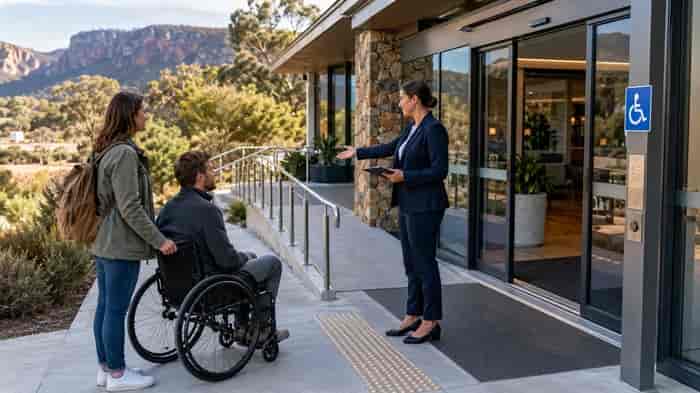
“Accessible” may be the hardest-working word in travel.
It appears beside hotel rooms, tours, transfers, attractions and even beaches. Yet its meaning can range from a well-tested guest experience to a ramp near reception and a cheerful shrug.
That gap is no small matter. For a traveller with disability, a false access claim can wreck a holiday before the first bag is unpacked. A narrow door, a high bed, a shower lip, or a broken lift or van without a suitable hoist can undo months of careful planning.
The industry needs a plain rule: test the claim, not the brochure.
Too valuable to dismiss as a niche
Accessible tourism is not a kind extra to consider when time and funds allow. It is a large part of Australia’s visitor economy.
Tourism Research Australia estimates that travellers with access needs made 70.5 million trips in Australia during 2024. That was 22 per cent of all trips. Their total spend reached $29.2 billion, or 17 per cent of all traveller spending.
The research group includes people who identified as having a disability or long-term health condition. It also includes people who travelled with someone who did. Domestic figures cover travellers aged 15 and over.
This market also matters well beyond the capital cities. Fifty-eight per cent of the nights and day trips linked to travellers with access needs were spent in regional Australia. The figure for other travellers was 44 per cent.
For regional hotels, attractions and tour operators, that is not a footnote. It is a large market at the front door, often with family, friends or carers travelling too.
Tourism Australia’s 2024 Consumer Demand Project also found that about 12 per cent of its High Yield Traveller Target Audience had access needs. This is good service, sound business and basic fairness rolled into one.
A label is not proof
The main fault is simple. Too many firms treat access as a yes-or-no box. Real life is rarely so tidy.
A room may have step-free entry but a bed that is too high for a safe transfer. A bathroom may have grab rails but no usable space beside the toilet. A restaurant may welcome assistance animals but place its tables so close together that a mobility aid cannot pass between them. An attraction may offer easy entry, while its main experience sits at the top of a staircase.
The brochure still says “accessible”. The guest may choose a sharper word.
Different guests need different facts. The Australian Tourism Industry Council’s Accessible Tourism Program checks businesses across five support categories: cognitive or autism, limited mobility, wheelchairs and scooters, low hearing, and low vision.
That approach matters. One wheelchair symbol cannot answer every question. Nor can it explain sensory, hearing, sight or cognitive needs.
Good firms publish proof. They provide recent photos and useful measures. They list door widths, bed heights, slopes, lift sizes and turning space. They explain the layout of the toilet and shower. They state how a guest enters the pool, boards the vehicle or reaches the viewing deck.
Just as importantly, they say what cannot be reached or used.
Honesty may cost one booking that was never a good fit. A vague promise can cost trust, repeat business and a good name.
Agents must test the whole journey
Travel advisers should never accept “wheelchair-friendly” as a full answer. It is a claim, not a plan.
The check must cover the whole journey. How will the guest travel from the airport, station or car park? Is the right room guaranteed or only requested? Can the guest reach the restaurant, pool, meeting room and emergency exit? Will the mobility aid fit in the vehicle? Is there a safe place to store and charge it? Who is responsible when a chair or scooter changes hands?
Recent photos should show the actual room and route, not merely a room of the same type. A stock image of a smiling traveller gazing at a sunset proves only that the photographer found a sunset.
Measures should be kept on file. Phone assurances should be confirmed in writing and stored with the booking.
That is not needless red tape. It is sound retail work, risk control and proper customer care.
The final question is whether the product suits the guest. A feature that works well for one person may be of no use to another. Advisers should ask clients what they need. They should not guess from age, diagnosis or mobility aids.
The traveller remains the leading expert on the traveller.
Put the framework to work
Austrade’s WELCOME Framework asks tourism firms to review access across their entire operations. Its seven parts are Welcome, Environment, Links, Communication, Operations, Marketing and Experience.
The guide calls for clear access facts, good communication, suitable spaces, trained staff and a trip that works from the first web search to the day of departure.
Staff knowledge is vital.
An accessible bathroom is of little use when no one can explain how to reach it. A hearing loop achieves little when staff do not know how to switch it on. A portable ramp hidden behind six cartons of pinot gris is not an access feature. It is storage with ambitions.
Businesses should test the guest route during a normal trading day. Staff should check doors, lifts, paths, signs and key gear. They should know what happens during a power cut, a fire alarm, a gear fault, or a shift change.
People with lived experience should be paid to test products, review access guides and train staff. Nothing improves a theory quite like letting real life into the room.
Upkeep matters too. An access guide written three years ago may be wrong after a refit, furniture move or gear fault. Each guide should show its review date and name a staff member who can answer detailed questions.
The Australian Tourism Industry Council’s program gives each business a detailed Accessibility Information guide to share with visitors. It also provides the business with an internal report highlighting areas for improvement.
That is far stronger than a loose claim in an advertisement.
The law expects more than goodwill
Australian tourism firms also have legal duties.
The Disability Discrimination Act 1992 makes disability discrimination unlawful in areas including access to goods, services, facilities, and public premises. A failure to provide a reasonable adjustment may amount to direct or indirect unlawful discrimination. An adjustment may not be required when it would impose unjustifiable hardship.
The Act also covers public transport. Airlines, airports and other transport firms must meet disability-discrimination law, while the Disability Standards for Accessible Public Transport 2002 set binding requirements for relevant transport operators and providers.
New rules for air travel are also being developed. The proposed Aviation Disability Standards aim to clarify the rights of passengers with disability and the duties of airlines and airports. Plans include better coordination, passenger-assistance profiles, clearer information, and stronger staff training.
Three co-design workshops held in July and August 2025 set four guiding principles: include people with disability in design; provide consistent service; deliver regular and effective training designed and delivered with people with disability; and explain policies, duties and assistance clearly.
As at 2 August 2026, the standards were still under development and were not in force. The Department of Infrastructure said options were being prepared ahead of broad public consultation. Government consideration, an exposure draft and parliamentary steps would then follow.
Consumer law also applies
There is a plain consumer-law point as well.
The Australian Competition and Consumer Commission says claims about goods and services must be accurate, truthful and based on reasonable grounds. A business must be able to prove any claim it advertises.
The rule covers images, descriptions, websites, social media, quotations and facts given by staff, either verbally or in writing. Omitting a key limitation can also create a misleading impression.
Businesses should prove their access claims and state any limit that could shape a traveller’s decision. Calling a product accessible without proof is not bold copywriting. It is poor governance wearing a marketing lanyard.
Turn the promise into a product
Australia has a large accessible tourism market, fine places to visit and skilled travel staff. What it now needs is less fog around the word “accessible”.
Tourism firms should test the whole guest journey. They should involve people with lived experience, publish useful photos and measurements, train staff and state limits in plain terms.
Travel advisers should check each claim, match the product to the person and keep the proof in writing.
A glossy brochure can make almost anything look easy. The true test begins when the guest arrives.
Accessible tourism works when the promise survives contact with the traveller.
Everything else is merely typesetting.
By: Sandra Jones – © 2026.
Read Time: 6 minutes.
Author Bio:
 Sandra has spent a working lifetime quietly rescuing journeys, one itinerary, one anxious caller, one impossible connection at a time. Years in Australia’s finest travel agencies taught her the art of calm, how to find a flight in a fog of cancellations, how to soothe a traveller when luggage wanders, how to turn nine frantic days in Europe into something resembling sense. Qualified, seasoned, endlessly patient, she learned that good travel advice is part logistics, part listening.
But the storyteller in her was always waiting its turn. Writing offered a new map, a way to turn experience into reflection, detail into delight. At Global Travel Media, Sandra now writes the truths only insiders know: the mishaps, the laughter, the grace found between gates and goodbyes. She reminds us that travel, for all its fuss, is still one of life’s better ideas.











