

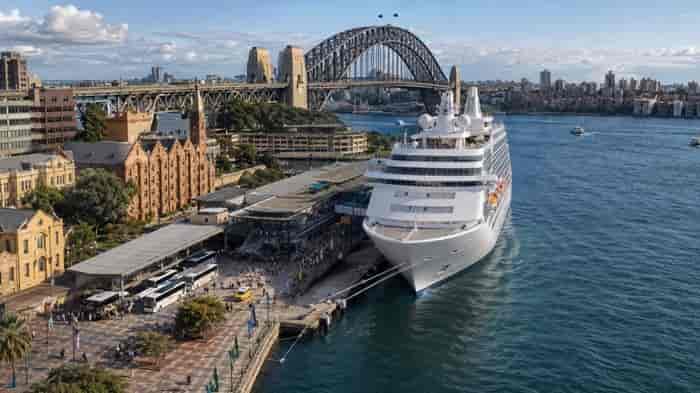
Australia has fallen head over heels for cruising again. The trouble is that some of the ships are beginning to admire us from a safer distance.
A record 1.45 million Australians took an ocean cruise during 2025, up 9.5 per cent from 1.32 million a year earlier. That result passed the previous national record of 1.35 million set in 2018 and kept Australia in fourth place among the world’s largest cruise source markets.
Globally, the tide is just as strong. Ocean cruising attracted 37.2 million passengers in 2025, a 7.5 per cent increase, and Cruise Lines International Association forecasts the number will reach 38.3 million in 2026 and 42.1 million by 2029.
Those figures should have Australian ports ordering more gangways and polishing the welcome signs.
Instead, the local industry is confronting an awkward contradiction. Australians are cruising in record numbers, yet cruise tourism’s economic contribution at home has fallen as fewer ships operate in local waters.
The passengers are ready. The ships have choices.
Record demand meets fewer local options
Most Australian cruisers still prefer to sail close to home. During 2025, 1.16 million Australians cruised within Australia, New Zealand and the South Pacific, an increase of 8 per cent. That represented 80.3 per cent of the Australian market.
Shorter itineraries played a major role. The average Australian ocean cruise fell from 8.0 days in 2024 to 7.5 days in 2025. Cruise lines offered more short breaks, allowing ships to carry a greater number of passengers across repeated departures.
That change has made cruising easier to fit around school holidays, annual leave and household budgets. A three- or four-night sailing no longer requires the logistical planning of an Antarctic expedition, although packing for formal night can still inspire one.
The passenger base is also becoming younger. The average Australian cruiser was 47.3 years old in 2025, down from 48.4 a year earlier. More than one-third, or 34.2 per cent, were aged under 40.
Cruising is no longer marketed only as a long retirement reward. Families, younger couples, multigenerational groups and first-time passengers are helping to fill ships.
Globally, 89.7 per cent of previous cruisers say they are likely to cruise again, while 75.6 per cent of people who have never cruised would consider doing so.
Demand, in other words, is not the weak link.
Australia’s economic wake grows smaller
The harder figures sit on the other side of the ledger.
Cruise tourism generated A$7.32 billion in total economic output across Australia during 2024–25 and supported 22,720 full-time-equivalent jobs. It also generated A$2.36 billion in total supported wages.
Those are substantial numbers. Yet total economic output fell by A$1.11 billion, or 13.2 per cent, from the record result recorded during 2023–24.
Supported employment fell 13.8 per cent, while total wages generated through the sector declined 16.9 per cent.
The economic assessment was prepared by AEC Group for CLIA and the Australian Cruise Association, so it is an industry-commissioned study.
Its underlying warning is nevertheless difficult to ignore: strong consumer demand does not guarantee strong Australian economic returns when local ship deployment declines.
Australia recorded 1,700 ship-visit days across 56 ports and destinations during 2024–25. Ship-visit days fell 2.7 per cent and produced 4.1 million passenger-visit days.
The number of cruise ships operating in Australian waters fell 9.3 per cent to 68.
Passengers still spent A$1.82 billion on shore, averaging A$440 a day. That money reached hotels, restaurants, tour companies, retailers, transport operators and entertainment businesses.
Cruise-line expenditure added another A$1.50 billion.
A ship entering an Australian port is therefore not merely a handsome addition to the harbour view. It is a floating supply chain with a taste for fuel, food, repairs, transport, excursions, accommodation and local labour.
When a deployment disappears, the lost business spreads well beyond the terminal.
The price of calling Australia home
CLIA and the Australian Cruise Association argue that regulatory uncertainty and high operating costs are weakening Australia’s ability to compete for ships.
The industry’s 2024–25 assessment found that cruise lines paid A$331 million to ports and governments in fees and charges. That represented 22.1 per cent of their Australian expenditure.
Fuel and other operating costs accounted for A$598.4 million, or 39.9 per cent.
Not every fee is unreasonable, nor should safety, security or environmental standards be treated as optional extras.
Ports require investment. Terminals require staff. Channels must be maintained, passengers processed and local communities protected from noise and congestion.
The question is whether Australia’s combined costs and rules deliver a competitive and predictable operating environment.
Cruise lines allocate ships years in advance. A vessel can sail in the Mediterranean, Caribbean, Alaska, Asia or the South Pacific. Each region competes for the same expensive asset.
A ship does not possess patriotic feelings. It follows demand, yield, cost and operational certainty.
CLIA Executive Director in Australasia Joel Katz said, “The number of Australians cruising is at record levels,” before warning that regulatory uncertainty and rising costs were making Australia less competitive as a destination.
Passengers increasingly fly to the ship
Australians are not waiting patiently for every ship to come to them.
The number taking cruises outside Australia, New Zealand and the South Pacific reached 286,000 in 2025, an increase of 17 per cent. The long-haul share of the market rose from 18.5 per cent to 19.7 per cent.
The Mediterranean remained the leading overseas cruise region for Australians, followed by Asia, Alaska, the Caribbean and Northern Europe.
For travel advisers and airlines, that trend creates valuable fly-cruise business. It brings international airfares, pre- and post-cruise hotels, transfers, insurance and touring into the booking.
For Australian destinations, however, it can shift spending overseas.
An Australian traveller flying to Singapore, Barcelona or Seattle to board a ship remains an Australian cruise success. The economic benefits of the voyage simply begin landing elsewhere.
That does not mean local cruising is collapsing. More Australians cruised within the region in 2025, and domestic-only cruising rose strongly.
It does mean the Australian source market is growing faster than the country’s ability to secure its full economic prize.
Ports carry more than passengers
The effect is especially important beyond Sydney and Brisbane.
Cruise ships generated economic activity across 56 Australian ports and destinations during 2024–25. Many regional communities cannot rely on daily international flights or a constant stream of major conventions.
A cruise call can place thousands of visitors within walking distance of shops, museums, markets and tour vehicles in a single morning.
That arrival also creates pressure. Roads become busy, popular sites fill, and local operators must staff for a sharp burst of demand. Poorly managed tourism can test community patience.
The answer is not to dismiss cruise visits or wave every ship through without scrutiny. It is to plan calls that produce a genuine local return.
Regional ports need reliable schedules, suitable berths, trained guides, accessible transport and shore experiences that encourage passengers to spend beyond the terminal.
Cruise lines need confidence that infrastructure, fees and operating rules will not change after itineraries have been sold.
Communities need evidence that the visitor economy is worth the disruption.
Sydney’s capacity question remains
Sydney remains Australia’s principal cruise gateway and the largest contributor to the sector’s national economic value. Its appeal is obvious.
Few arrival experiences compete with sailing between the Heads and parking beside the Opera House.
The infrastructure is less romantic.
The Port Authority of New South Wales says Sydney-based ships have consistently arrived full or close to capacity during peak periods. It expects larger vessels to be deployed over time and is working on terminal improvements, regional cruise development and a long-term engineering solution at the Overseas Passenger Terminal.
The NSW Government has also established an independent Cruise Industry Advisory Panel to identify alternative locations for a third terminal or other viable options for long-term cruise growth.
These are necessary discussions.
Modern ships are growing larger, and many international vessels cannot pass beneath the Sydney Harbour Bridge to reach White Bay Cruise Terminal.
A destination can possess the world’s best postcard and still lose business if the ship cannot find a suitable berth.
Sustainability brings another bill and an opportunity
Environmental performance is also reshaping deployment decisions.
Ports and cruise lines face pressure to reduce local air pollution, cut emissions, improve waste management and invest in shore-power systems.
These measures carry high upfront costs, but delay carries its own price through community opposition, tighter rules and lost social licence.
The Port Authority of New South Wales is installing shore power at White Bay Cruise Terminal and says it is working towards delivery by December 2026.
The system is intended to allow compatible ships to turn off their onboard diesel generators and auxiliary engines while berthed and draw electricity from the landside supply.
Infrastructure of this kind can help Australia compete, but only when ships can use it, electricity supply is reliable, and charges remain commercially workable.
The green transition cannot be delivered by placing the bill on one party and congratulating everyone else.
A national cruise plan needs more than a slogan
CLIA has called for federal, state and territory governments to work under a national action plan intended to improve regulatory certainty and restore Australia’s competitiveness.
That proposal has merit, provided it produces practical decisions rather than another glossy strategy photographed beside calm water.
Australia needs transparent and predictable fees, consistent regulation, long-term berth planning and stronger coordination between ports, tourism bodies, transport agencies and local councils.
It also needs a clearer view of the type of cruise market it wants.
Large resort ships bring scale. Premium and luxury vessels bring higher yields. Expedition ships can reach regional and remote destinations.
Short cruises broaden the customer base, while long voyages generate hotel stays and higher pre- and post-cruise spending.
There is room for all of them, but not every port can serve every ship.
Policy should follow realistic regional strengths rather than a national desire to be everything to every funnel.
The travel trade has a valuable role
Travel advisers are well placed to benefit from the boom, whether the ship sails locally or overseas.
Cruise bookings are becoming more complex. Passengers must compare cabin categories, packages, gratuities, drinks, shore excursions, insurance, air connections and cancellation terms.
Fly-cruise travellers also need enough time between the aircraft and the ship.
The cheapest fare is not always the best value.
A slightly dearer itinerary departing from Australia may remove international flights, hotel nights and the risk of missing embarkation. An overseas sailing may offer a newer ship or better route but carry a much higher total-trip cost.
A professional adviser can put the whole holiday on one page rather than admiring the cruise fare in splendid isolation.
Australia must keep the ships in sight
The cruise industry’s Australian paradox is now plain.
More Australians are cruising than ever. The global passenger market is expanding. Loyalty remains strong, younger travellers are coming aboard, and shorter itineraries are widening the market.
Yet Australia’s domestic economic contribution has fallen as local deployment and the number of ships operating in Australian waters have declined.
The available industry data points not to weak Australian demand, but to a deployment and competitiveness problem driven, according to CLIA and the Australian Cruise Association, by rising costs, regulatory uncertainty and competition from other regions.
Governments should not remove sensible safety or environmental rules to win deployments. Nor should the industry expect ports and communities to subsidise every arrival.
But costs must be transparent, regulation must be stable, and infrastructure must match the ships Australia hopes to attract.
The country has the scenery, the customers and one of the world’s strongest cruise cultures.
What it needs now is a commercial setting that persuades vessels to stay long enough to spend some money.
Australians have already come aboard.
Australia must make certain the ships do not quietly sail away.
By: Michelle Warner – © 2026.
Read Time: 9 minutes.
Author Bio:
 Michelle Warner has always carried stories the way others carry passports lightly, faithfully, and with purpose. She learned her craft in newsrooms, shaping sentences with care, before swapping deadlines for departures as a flight attendant with some of the world’s great airlines. Years aloft sharpened her eye for character and deepened her fondness for the small, dignified rituals of travel, the quiet kindness of strangers, the poetry of arrival, the patience learned between time zones.
Now grounded by choice, Michelle has come home to writing with the same calm authority she once brought to turbulent cabins. Her prose blends an editor’s discipline with a traveller’s wonder, tinged with humour and reverence for the golden age of travel. Each piece feels like a handwritten boarding pass, gracious, observant, and unmistakably alive.











