

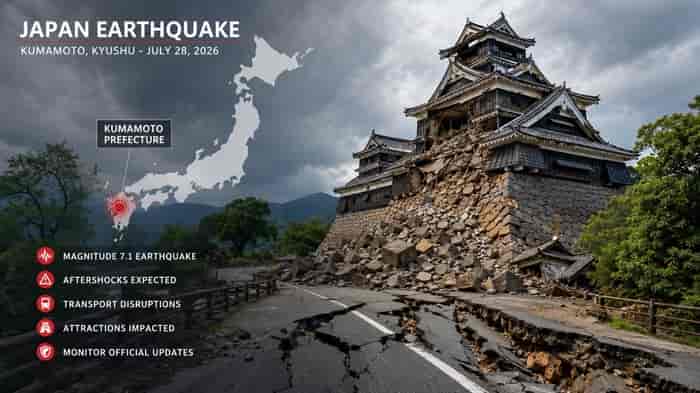
Powerful Kumamoto quake damages transport, attractions and hospitality infrastructure as travellers face aftershock warnings.
Japan’s tourism industry is confronting a serious regional disruption after a powerful earthquake struck Kumamoto Prefecture on the southern island of Kyushu on Tuesday, 28 July 2026.
The Japan Meteorological Agency measured the earthquake at magnitude 7.1, while other agencies initially issued slightly different assessments. The violent shaking damaged buildings, roads and communications infrastructure, caused fires and power outages, and prompted an extensive search-and-rescue operation across affected communities.
A tsunami advisory was issued following the earthquake but was subsequently lifted. Authorities have nevertheless warned residents and visitors to remain alert for strong aftershocks, landslides and further structural failures, particularly around already damaged buildings.
For Japan’s travel industry, the earthquake has delivered an immediate reminder that even the world’s most meticulously prepared tourism destination cannot negotiate with geology.
Kyushu Tourism Faces an Abrupt Detour
The most serious disruption is concentrated in Kumamoto and surrounding areas of Kyushu rather than across Japan as a whole.
Rail operations were interrupted, including Kyushu Shinkansen services, while flights at Aso Kumamoto Airport were affected. Roads, bridges and local transport networks also sustained damage or required emergency inspections. A train reportedly derailed at Yatsushiro Station, underlining the scale of the transport challenge facing authorities.
That disruption presents an immediate problem for travellers with tightly timed rail connections, regional touring programs, hotel transfers and domestic flights.
Tour operators and travel advisers should avoid treating “Japan” as one uniform operational picture. Tokyo, Osaka, Kyoto, Hiroshima, Hokkaido and other destinations outside the affected area have not been reported as facing comparable earthquake damage from this event. The practical response is therefore not wholesale cancellation, but careful regional assessment.
In other words, Japan has not closed the front door. One part of the house, however, requires a very thorough engineering inspection.
Kumamoto Castle Damage Strikes at Tourism’s Heart
Among the most significant tourism-related losses is further damage to Kumamoto Castle, one of Kyushu’s best-known cultural attractions.
The castle’s stone walls reportedly sustained fresh damage during the earthquake. The site was already undergoing a long and painstaking restoration following the destructive Kumamoto earthquake sequence of 2016.
Kumamoto Castle is not simply another attraction on a coach-tour checklist. It is an emblem of the prefecture and a powerful driver of accommodation demand, dining, retail spending and guided tourism.
Any extended closure would consequently affect businesses well beyond the castle gates. Local hotels, ryokan, restaurants, transport providers, guides and souvenir retailers all depend upon confidence in the destination and reliable access to its principal attractions.
Kyushu’s broader visitor appeal remains considerable, spanning hot-spring resorts, volcanic landscapes, historic cities, beaches and distinctive regional cuisine. However, travellers intending to visit Kumamoto or neighbouring affected districts should verify whether attractions, accommodation and transport services are operating before setting out.
Hotels and Hospitality Operators Begin Assessments
The full extent of damage to Kyushu’s hospitality infrastructure remains unclear.
Hotels, traditional inns and tourism businesses in affected districts are assessing buildings, utilities, staffing and access routes. Some properties may remain operational, while others could close temporarily for structural inspections, repairs or because surrounding transport and essential services have been disrupted.
There is currently insufficient authoritative evidence to declare broadly that hotels have been converted into evacuation centres. Any such arrangements should be reported only when confirmed by individual properties, municipal authorities or emergency agencies.
The immediate operational burden is nevertheless substantial. Even an undamaged hotel cannot function normally without electricity, water, communications, staff access, food deliveries and safe transport connections.
Hospitality operators must also balance commercial responsibilities with something far more important: the safety and welfare of employees, guests and local communities.
Travel Warnings Put Preparedness Before Panic
Australia’s Smartraveller advice states that Japan is prone to earthquakes, tsunamis and other natural hazards. Travellers are instructed to follow local authorities, observe emergency signage and move immediately to higher ground when in a coastal area following a major earthquake.
The earthquake does not automatically make every part of Japan unsafe. It does, however, demand heightened caution for anyone travelling through affected areas of Kyushu.
Travellers should check directly with airlines, railway operators, tour companies and accommodation providers rather than relying upon an itinerary prepared before the earthquake. They should also monitor information from the Japan Meteorological Agency, local government authorities, the Japan National Tourism Organisation and Australia’s Smartraveller service.
Comprehensive travel insurance is essential, but policyholders should examine the fine print carefully. Cover for natural disasters, delays, additional accommodation, missed connections and cancellations varies considerably between insurers.
Travellers already in the region should keep phones charged, carry identification and essential medication, retain access to emergency funds and follow evacuation instructions without delay. Coastal visitors should never wait for a formal tsunami alert if local authorities order them to move to higher ground.
Nuclear Facilities Report No Abnormalities
Authorities reported no abnormalities at nuclear facilities near the affected region following initial inspections. That finding offers important reassurance, although official monitoring should continue as emergency assessments progress.
Japan’s strict building regulations, seismic engineering, public-warning systems and emergency procedures remain central to its disaster resilience. Yet preparedness does not make earthquakes harmless. It reduces risk; it does not abolish it.
Tourism Recovery Will Require Precision, Not Rumour
The tourism industry’s greatest responsibility now is to provide accurate, geographically specific information.
Overstating the danger could unnecessarily damage destinations hundreds of kilometres from the affected zone. Understating it could place travellers in disrupted or unsafe areas and add pressure to emergency services.
Japan has repeatedly demonstrated its capacity to repair infrastructure and restore tourism following major natural disasters. However, confidence tends to return only when visitors can see that transport, accommodation and attractions are safe, accessible and properly supported.
Kyushu’s tourism recovery will therefore depend upon transparent damage assessments, dependable transport updates, responsible travel advice and the reopening of attractions only when authorities are satisfied they are safe.
For now, the message is straightforward: Japan remains a major and broadly operational tourism destination, but travel into earthquake-affected parts of Kyushu requires vigilance, flexibility and respect for official warnings.
The Japanese have long understood that resilience is not loud. It is methodical, disciplined and usually wearing a hard hat.
By: Jill Walsh – © 2026.
Read Time: 6 minutes.
Author Bio:
 Jill Walsh has always kept a pen close and a suitcase closer. She started out on media releases, then learned the trade properly by escorting press trips around the world, discovering which stories travel well and which need a sharper edit.
Before long, she wasn’t just promoting destinations; she was representing them, translating civic ambition and local pride into words people actually wanted to read. These days, semi-retired and happily so, Jill has traded departure boards for deadlines, joining old friend and colleague Stephen at Global Travel Media on a casual basis.
Her patch is the business end of wanderlust: balance sheets, route maps, tender wins and the numbers that quietly decide where travellers go. She writes with dry humour, clean prose and an old-school respect for facts a steady voice when the market starts shouting.











