

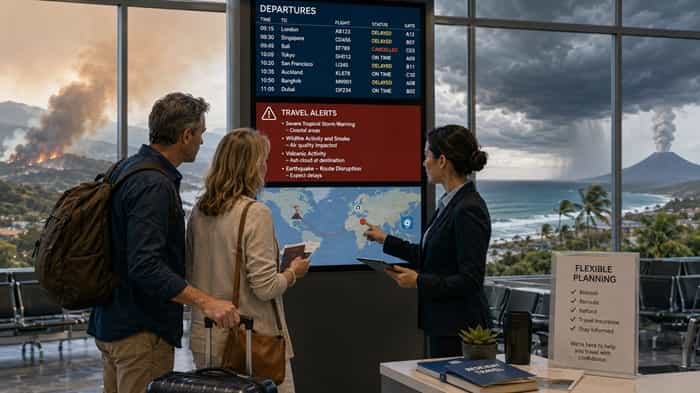
Mother Nature has muscled her way onto the modern travel itinerary. She is not taking bookings, either.
A new Global Rescue Traveller Sentiment and Safety Survey shows natural disaster risks are now shaping international travel planning. It found that 44 per cent of experienced international travellers fear a natural disaster could affect a future trip. One in three, or 33 per cent, says a wildfire, hurricane, earthquake, volcanic eruption or other natural event has already disrupted an overseas journey.
The message is blunt. Natural hazards are no longer seen as rare events that happen to somebody else. They now sit beside airfares, passports and insurance on the pre-flight checklist.
“Natural disasters have become an expected possibility of international travel planning rather than a remote one,” said Dan Richards, CEO of The Global Rescue Companies and a member of the US Travel and Tourism Advisory Board at the US Department of Commerce. “When one out of every three experienced travelers has already had a trip disrupted by a wildfire, hurricane, earthquake or volcanic eruption, it’s understandable that many now factor these risks into every stage of planning.”
Concern is higher outside the United States
The survey found that 44 per cent of all respondents were extremely, very or somewhat concerned about natural disasters. Another 33 per cent were slightly concerned. The remaining 23 per cent were not concerned.
Among US-based travellers, 43 per cent were at least somewhat concerned. That figure rose to 48 per cent among people based outside the United States.
The gap is not huge, but the signal is clear. Travellers still want to travel. They simply want more choice, better advice and a sound Plan B.
For airlines, hotels, cruise lines and travel advisers, this changes the sale. Flexible terms and fast updates are no longer nice extras. They are part of the product. A traveller may forgive bad weather. Silence from a travel supplier is another matter.
One event can close an entire journey
A natural disaster can strike several links in a trip at once. Airports may close. Roads may be blocked. Power and phone networks may fail. Hotels can be cleared, while local rescue teams face heavy demand.
Australian Government guidance warns that bad or severe weather can delay or cancel flights during any season. It advises travellers to check forecasts for both their departure point and destination before travelling.
Smartraveller also urges Australians to research the natural hazards at their destination, subscribe to official updates and follow the orders of local authorities. During a crisis, that includes acting quickly on any evacuation order.
Richards said travellers could no longer assume a destination would work as normal simply because it was calm when they booked. His advice is practical: watch conditions, allow room to change plans and know where to seek help.
The travel trade should take the same view. A clear emergency plan can protect guests, staff and reputation. It can also turn a chaotic day into a managed delay.
Insurance must be bought before trouble starts
Travel insurance remains vital, but timing matters.
Smartraveller says natural disasters are covered more often than not, although some policies exclude them. It also warns that an event may become a “known event” once it appears in the news or on an official government website. A policy bought after that point may not cover related losses.
Travellers should buy suitable cover when they book. They should check cancellation, delay, medical, emergency stay and evacuation benefits.
The Product Disclosure Statement may not be beach reading, but it is far better read at home than argued over beside a closed airport gate.
Preparation keeps disruption from becoming crisis
The survey does not show that experienced travellers are giving up on the world. It shows they are planning with their eyes open.
They are checking forecasts. They are watching official advice. They are choosing bookings that can change. They are also keeping emergency contacts and key documents close.
“Preparation is what separates a travel disruption from a travel crisis,” Richards added. “Experienced travelers recognize that while they can’t prevent natural disasters, they can prepare for them.”
That is the soundest lesson in the report. No traveller can bargain with a volcano, move a cyclone or ask an earthquake for a late checkout.
But a flexible booking, strong insurance and a tested contact plan can stop a serious delay from becoming a personal disaster.
For further information about travel safety, emergency assistance and evacuation services, visit Global Rescue.
By: Alison Jenkins – © 2026.
Read Time: 3 minutes.
Author Bio:
 Alison Jenkins has lived most of her working life in the slipstream of aviation, where timetables matter, and people matter more. In airline sales, she built a reputation the old-fashioned way: by knowing her clients, her routes, and never missing the human detail.
Quick with a smile, quicker with a solution, she made deals with warmth and kept her edge intact.
Trade shows, FAM trips, airport lounges, and hotel lobbies became her second address. And somewhere along the way, notebook in hand, she began writing the journeys rather than selling them. Her reports grew lively, observant, full of the small truths only travellers notice.
That was the moment it dawned on her: she wasn’t simply travelling. She belonged in its stories.











