

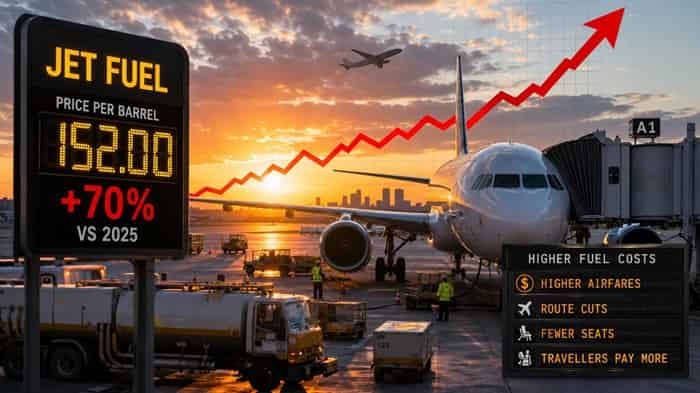
The airline industry has barely finished putting the furniture back after the pandemic, and already someone has set fire to the fuel bill.
A sharp escalation in jet fuel prices is forcing carriers worldwide to raise fares, reduce marginal services, squeeze more revenue from every seat and reconsider which routes deserve to survive. For travellers, particularly Australians already accustomed to long distances and correspondingly long airfares, the message is becoming painfully clear: cheap flying may not disappear, but it is becoming considerably harder to manufacture.
The International Air Transport Association expects global airline fuel costs to surge from US$252 billion in 2025 to US$350 billion in 2026. Jet fuel is forecast to average US$152 a barrel this year, almost 70 per cent above the 2025 average of US$90. Fuel is consequently expected to swallow 31.4 per cent of airline operating expenses, up from 25.4 per cent last year.
That is not a modest rise tucked discreetly into an accountant’s spreadsheet. It is a financial thunderclap.
Airlines Reach for the Restructuring Toolkit
When fuel prices leap, airline executives generally have four immediate options: increase fares, cut capacity, improve aircraft utilisation or find additional revenue elsewhere. In 2026, carriers appear to be trying all four before breakfast.
IATA forecasts passenger ticket yields will rise by seven per cent this year, while passenger ticket revenue is expected to reach US$839 billion. Ancillary and other revenue, including seat selection, baggage, upgrades and fare flexibility, is forecast to climb 12.6 per cent to US$165 billion as airlines attempt to recover more from each customer.
This explains why the modern airfare increasingly resembles the opening bid at an auction rather than the final cost of a journey. The seat may be advertised first, but bags, meals, preferred seating, flexibility and occasionally one’s remaining dignity are added later.
Airlines are also becoming more surgical about capacity. United Airlines said in July that it expected nearly US$6 billion in additional fuel expenditure during 2026 compared with its estimate at the beginning of the year. It indicated that fourth-quarter capacity would be lower than previously published schedules and said it was prepared to moderate flying further if fuel prices remained elevated.
The carrier recovered about half of its second-quarter fuel increase through higher revenue and expected to recover between 80 and 90 per cent of the current increase during the third quarter. That is pricing power in action or, from the passenger’s side of the counter, another reason to grip the credit card firmly.
Australian Travellers Already Feeling the Squeeze
Australia is not watching this upheaval from a comfortable distance.
The Australian Competition and Consumer Commission reported in June that local airlines had increased fares and reduced capacity on selected routes as jet fuel costs rose. Jet fuel prices were more than 40 per cent higher in early June than in mid-February, while the refining margin between Brent crude and jet fuel had risen by 64 per cent over the same period.
According to the ACCC, the Qantas Group and Virgin Australia reduced or suspended several domestic services, increased some fares and continued targeted sales on price-sensitive routes. Virgin Australia reportedly lifted domestic economy and business fares by about five per cent from March, while Qantas did not disclose the size of its increase.
Services affected included Adelaide–Mount Gambier, Alice Springs–Brisbane and Darwin–Gold Coast, demonstrating that restructuring is not merely a boardroom expression. For regional communities, it can mean fewer seats, fewer departure choices and a considerably more complicated journey.
The impact is particularly serious in Australia because domestic aviation is highly concentrated. The Qantas Group and Virgin Australia operated 98.5 per cent of passenger flights at the time of the ACCC’s report. When capacity is removed from a concentrated market, travellers cannot always sidestep the increase by choosing one of six competing carriers. Sometimes the alternative is another airline; sometimes it is Tuesday.
Fare Families Become Revenue Engines
Airline restructuring is not confined to route maps and aircraft schedules. Fare structures themselves are being rebuilt.
JetBlue announced an overhaul of its fare options in July, giving customers different combinations of seating, change conditions and refundability. The strategy reflects a broader industry movement towards segmented pricing, allowing airlines to attract customers with a lower entry fare and then encourage them to purchase greater comfort or flexibility.
United, Delta and Alaska Airlines have also reported generating additional revenue through fare increases, while Southwest and Delta have expanded tiered products designed to encourage customers to trade up. Reuters reported that US airfare increases associated with the fuel shock had averaged around 20 per cent, although those increases had still not fully recovered the cost surge.
This is a structural shift worth watching. Airlines are no longer simply selling economy, business and first class. They are selling a ladder of increasingly tolerable conditions, with each rung carrying a price.
For travel advisers, this makes fare comparison more valuable and more difficult. The cheapest published fare may not be the lowest practical fare once baggage, seat allocation, meals, changes and cancellation conditions are considered.
Fuel Hedging Offers Protection, Not Immunity
Major airlines frequently hedge part of their future fuel requirements, purchasing financial protection against price movements. Qantas and Virgin Australia had both locked in some fuel costs before the latest increases, according to the ACCC. Smaller operators may not possess the same financial capacity or scale. Rex, for example, told the regulator that it did not hedge jet fuel prices.
Globally, airlines have hedged about one-third of their expected 2026 fuel consumption. However, IATA cautions that hedging smooths short-term volatility rather than eliminating exposure to a sustained increase. Some carriers also hedge crude oil rather than jet fuel itself, leaving them exposed when refining margins widen sharply.
In plain English, the umbrella works for a shower. It is rather less impressive in a cyclone.
Older Aircraft Add Another Layer of Pain
The fuel crisis is arriving while airlines are already contending with delayed aircraft deliveries and constrained fleet renewal.
IATA says aircraft production remains below the level required to overcome the delivery shortfall accumulated since the pandemic. Airlines have responded by extending the lives of existing aircraft, increasing daily utilisation and operating at higher load factors. Lease rates have reached record levels, while older fleets are generating additional maintenance costs.
New-generation aircraft such as the Airbus A350, Boeing 787 and Airbus A320neo family are therefore becoming even more commercially important. Greater fuel efficiency can soften an airline’s exposure, but only if the aircraft is delivered. An efficient jet sitting in a manufacturer’s backlog burns no fuel, carries no passengers and earns precisely nothing.
Will Airfares Keep Rising?
The direction is upward, although not every route will behave identically.
Airlines with strong demand, limited competition and high load factors will have the greatest ability to pass fuel costs to travellers. Routes with weaker demand may instead lose frequencies or be suspended altogether. Highly competitive leisure markets may continue to feature sales, but the cheapest seats are likely to become scarcer and more conditional.
IATA expects the global airline load factor to reach a record 84 per cent in 2026. With fuller aircraft and restrained capacity, airlines have less incentive to offer widespread discounting, particularly during school holidays, major events and peak European or North American travel seasons.
Passengers should not panic-buy the first fare that appears on a screen. They should, however, recognise that waiting for a dramatic last-minute bargain now carries greater risk.
Booking early, travelling outside peak periods, comparing the complete trip cost and retaining some date flexibility remain the most sensible defences. Travel advisers should also monitor schedule changes closely, as capacity reductions can affect connections long after the original ticket has been issued.
The Industry’s Uncomfortable New Reality
Airlines have survived terrorism, recessions, volcanic ash, border closures, pandemics and the occasional executive presentation promising that everything is proceeding according to plan.
The present fuel shock is different because it collides with several existing weaknesses: restricted aircraft supply, high maintenance costs, concentrated markets, geopolitical disruption and passengers whose household budgets are already under strain.
IATA expects airline revenues to grow by 9.4 per cent in 2026, but operating expenses are forecast to rise by 13 per cent. Industry-wide net profitability is projected to fall to US$23 billion, roughly half the previous level despite higher fares and record load factors.
That neatly captures the problem. Travellers are paying more, yet airlines are not necessarily becoming richer. Much of the additional money is disappearing through the wing before the aircraft has even left the runway.
Airlines will restructure because they must. Routes will be trimmed, fares will be segmented, aircraft will work harder, and passengers will be asked to contribute more.
The age of abundant capacity and casually discounted seats may not be over. It has, however, received a fairly brutal fuel surcharge.
By: May Marclay – © 2026.
Read Time: 7 minutes.
Author Bio:
 May Marclay’s career hasn’t followed a straight line, and she’s better for it. She began in real estate, then moved into hospitality, finding her rhythm with Centara in the Maldives. There, she worked the Asian markets the old-fashioned way: building trust, closing deals, and turning conversations into lasting business.
The UAE sharpened its focus. At IHG, supporting an Area General Manager, she saw the machinery of a major travel hub from the inside, no gloss, just how things actually get done.
Now, with her sights set on healthcare, May brings a broader lens than most. She speaks three languages, reads widely, travels with intent, and writes with the calm assurance of someone who understands both the detail and the bigger picture without needing to say so too loudly.











