

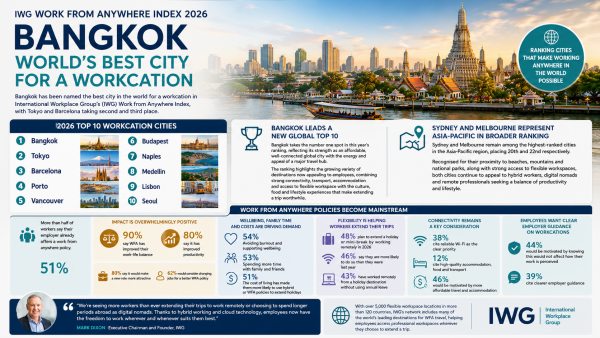
Bangkok has been named the best city in the world for a workcation in International Workplace Group’s (IWG) Work from Anywhere Index, with Tokyo and Barcelona taking second and third place.
The annual index ranks cities against a range of criteria designed to assess how well they support remote working while travelling, including climate, broadband speed, accommodation, transport, food, culture and the availability of flexible workspaces.
It comes as new research from IWG, the world’s largest platform for work and provider of flexible workspace demonstrates the growing popularity of work-from-anywhere policies, enabled by hybrid working and access to workspaces around the world.
Now in its fourth year, IWG’s Index has previously been topped by Barcelona, Budapest and Tokyo, with Bangkok taking the top spot in 2026.
2026 top 10 workcation cities
- Bangkok
- Tokyo
- Barcelona
- Porto
- Vancouver
- Budapest
- Naples
- Medellin
- Lisbon
- Seoul
Bangkok leads a new global top 10
Bangkok takes the number one spot in this year’s ranking, reflecting its strength as an affordable, well-connected global city with the energy and appeal of a major travel hub. Tokyo, Barcelona, Porto and Vancouver round out the top five, while Budapest, Naples, Medellin, Lisbon and Seoul also feature in the 2026 list of leading destinations for workers combining travel with remote working.
The ranking also highlights the growing variety of destinations now appealing to employees, from major Asian hubs and European city-break favourites to long-haul locations such as Vancouver and Medellin. Its mix of cities underlines how successful workcation destinations need to offer more than holiday appeal alone, combining strong connectivity, transport, accommodation and access to flexible workspace with the culture, food and lifestyle experiences that make extending a trip worthwhile.
Sydney and Melbourne represent Asia-Pacific in broader ranking
While Asia and Europe dominate the top 10 this year, Sydney and Melbourne remain among the highest-ranked cities in the Asia-Pacific region, placing 20th and 22nd respectively. Recognised for their proximity to beaches, mountains and national parks, alongside strong access to flexible workspaces, both cities continue to appeal to hybrid workers, digital nomads and remote professionals seeking a balance of productivity and lifestyle.
Work from anywhere policies become mainstream
New research1 commissioned by IWG,, found that more than half of (51%) of workers say their employer already offers a work from anywhere policy.
The 2026 ranking comes against a backdrop of more established work from anywhere policies, with employees increasingly looking for destinations that can support them professionally as well as personally. Access to flexible workspace at the destination is an important part of that decision, cited by 38% as a key factor when choosing where to work remotely while travelling.
Impact is overwhelmingly positive
Its impact is overwhelmingly positive: 90% say WFA has improved their work-life balance, and 80% say it has improved productivity. The policy is also shaping career decisions, with 80% saying it would make a new role more attractive and 62% saying they would consider changing jobs for a better WFA policy.
Wellbeing, family time and costs are driving demand
Avoiding burnout and supporting wellbeing is the biggest reason workers want to extend trips through remote working, cited by 54%. This is closely followed by spending more time with family and friends (53%) and making annual leave go further (52%). Financial pressures are also influencing behaviour, with 51% saying the cost of living has made them more likely to use hybrid or WFA policies to extend holidays.
Flexibility is helping workers extend their trips
Almost half (48%) of workers plan to extend a holiday or mini-break by working remotely in 2026, and 46% say they are more likely to do so than they were last year. The trend is already well underway, with 43% having worked remotely from a holiday destination without using annual leave.
Connectivity remains a key consideration
When choosing where to work remotely while travelling, reliable Wi-Fi is the clear priority, selected by 38% of respondents, ahead of high-quality accommodation, food and transport at 12%. More affordable travel and accommodation would motivate 46% to extend a trip by working remotely, underlining the importance of destinations that can combine practical working needs with value for money.
Employees want clear employer guidance on workcations
While appetite for WFA travel is growing, the data suggests employees still want reassurance that working remotely while travelling is accepted and supported by their employer. Clear guidance and confidence around expectations could help more workers make the leap, with 44% saying they would be motivated by knowing this would not affect how their work is perceived and 39% citing clearer employer guidance.
Mark Dixon, Executive Chairman and Founder of IWG, said: “We’re seeing more workers than ever extending their trips to work remotely or choosing to spend longer periods abroad as digital nomads. Thanks to hybrid working and cloud technology, employees now have the freedom to work wherever and whenever suits them best – whether that’s a local flexible workspace or a co-working centre on the other side of the world. For many, the days of long daily commutes are over, and there is more freedom to work in new locations.
This trend is here to stay, with many companies adopting flexible working and WFA policies, particularly over the summer months for the long term, which not only improves work-life balance and reduces burnout but also delivers significant productivity gains.”
With over 5,000 flexible workspace locations in more than 120 countries, IWG’s network includes many of the world’s leading destinations for WFA travel, helping employees access professional workspaces wherever they choose to extend a trip.











