

Melbourne’s boarding call has just become much louder.
The Qantas Group and Melbourne Airport have struck a deal that could reshape Victoria’s main air gateway for decades. It covers more flights, a major terminal expansion, a larger Qantas Business Lounge, better check-in and baggage facilities, and support for a third runway.
This is not a quick coat of paint and a few new chairs. It is a long-term growth pact between the Qantas Group and the nation’s largest 24-hour airport. It also comes as Qantas prepares for a new age of very long flights.
At the heart of the deal is Melbourne Airport’s $4.5 billion international terminal expansion. The program includes five more gates for widebody aircraft. That will give the airport more room for large jets and new long-haul services.
Gates may not stir the soul, but airlines cannot grow without them. There is little value in buying aircraft that can cross the world if there is nowhere to park them on arrival.
The deal also includes a 15-year Qantas Group commitment to Melbourne Airport’s third runway. The runway is due to open in 2031. That support is a strong vote of confidence in the project and in Melbourne’s future as a global aviation hub.
Passengers should see some benefits well before 2031.
Qantas lounge prepares for a growth spurt
Qantas is planning a new International Business Lounge above Terminal 2. It will offer broad views across the airport and could be up to one-third larger than the present lounge. Work and the final fit-out are expected to be finished by 2029.
Premium travellers will welcome the extra room. Airport lounges, much like overhead lockers, can look generous until everybody turns up at once.
The terminal plan also aims to make check-in faster and simpler. It includes premium check-in zones, upgraded automatic bag drops and better baggage handling. Melbourne Airport has already commissioned a new baggage system and an early baggage storage facility.
Arrivals are also on the list. The airport plans to expand the baggage reclaim hall and provide more room for Australian Border Force staff. These changes may lack the glamour of a new aircraft, but they can shape the final view of a journey.
A polished lounge loses some shine when passengers spend an hour watching an empty carousel.
Jetstar gains room to spread its wings
Jetstar is set to gain as well. Melbourne is already the airline’s largest port. It operates almost 1,000 flights a week in busy periods, while about 45 per cent of its domestic passengers pass through the airport. More space will give Jetstar room to add flights and strengthen Melbourne’s role in the wider Qantas Group network.
Qantas Group Chief Financial Officer Rob Marcolina said the deal would “unlock growth for both Qantas and Melbourne Airport and improve the travel experience for millions of our customers every year”.
He also said: “Basing some of our new A350-1000LRs in Melbourne will unlock a range of new destinations that aren’t possible today.”
That is where the agreement becomes more than an airport building program.
Qantas plans to base some Airbus A350-1000LR aircraft in Melbourne. Their range could open routes that are hard to serve with the airline’s current fleet. Qantas and Jetstar now fly from Melbourne to 17 overseas destinations. The group expects that number to grow.
Project Sunrise touches down at the perfect moment
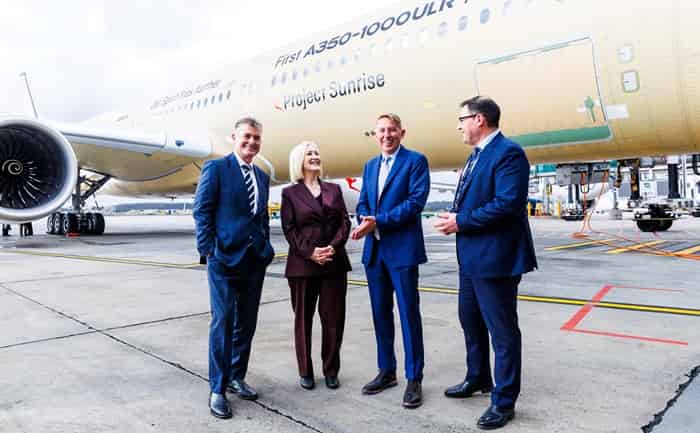
The news also comes at a well-timed moment. A Qantas Project Sunrise test aircraft has flown direct from Toulouse, France, to Melbourne. The flight showed the ability of the specially modified Airbus A350-1000ULR, which is being developed for some of the world’s longest passenger routes.
Project Sunrise aircraft are designed for flights of up to 22 hours. Qantas plans to use them on non-stop Sydney–London and Sydney–New York services. Airbus says the aircraft has an extra 20,000-litre rear centre fuel tank. Qantas has chosen a roomy 238-seat layout with First, Business, Premium Economy and Economy cabins, plus a wellbeing zone.
There is an important difference between the two fleets. The A350-1000LR plan for Melbourne is part of Qantas’ wider long-range growth. The A350-1000ULR is the specialised Project Sunrise jet. Together, they show how Qantas may build new routes from Melbourne while Sydney first hosts the main Sunrise flights.
RMIT Aviation Academy Senior Manager Justin Brownjohn said Project Sunrise changes the contest between airlines.
“Airlines have historically competed on network and frequency, but project Sunrise competes on time. Cutting up to four hours off the journey from Sydney to London and removing the connection entirely is a different product, not an improved version of the existing one.”
That is the business case in plain terms. A non-stop flight will not replace every one-stop service through hubs such as Singapore, Dubai, Doha or Hong Kong. It gives travellers another choice. The main market will be people who value time, fewer points of failure and no mid-journey transfer.
Brownjohn said, “these services won’t replace one-stop flying, they’ll sit alongside it”. The old Kangaroo Route is not being pushed into a museum. It is simply getting an express lane beside it.
Time becomes the premium product
For travel advisers and corporate travel buyers, this changes more than the aircraft name on a booking screen. Non-stop flights affect fare checks, duty of care, trip planning and stopover sales.
They also create a clear premium pitch: save several hours and avoid a transit airport.
The competitive pressure will not fall only on rival airlines. Major Middle Eastern and Asian hubs have long built their Australia–Europe business around the connection itself. As aircraft range grows and fuel use improves, more travellers may be able to choose between a traditional one-stop itinerary and a direct service carrying a higher fare.
The hub airlines will retain scale, frequency and broad networks. Qantas will be selling something different: time.
Comfort also becomes central on a flight of this length. Qantas has developed features such as body-clock lighting, menus timed to the destination and a wellbeing zone. Brownjohn summed it up neatly:
“Twenty hours is not a longer flight, it is a different physiological event.”
That line deserves attention from the travel industry. On an ordinary flight, comfort can be promoted as an upgrade. On a 20-hour service, comfort, sleep and personal wellbeing become essential parts of the product.
Melbourne makes a bid for aviation growth
Melbourne Airport Chief Executive Officer Lorie Argus called the program the most significant upgrade in the airport’s history. She said the airport’s spending on key infrastructure, matched with Qantas Group investment in aircraft and customer service, would create new opportunities for travellers and Victoria’s economy.
The wider case is clear. More overseas capacity can support tourism, business travel, freight and jobs. It can also help move more international visitors beyond central Melbourne and into regional Victoria.
Yet the full result will depend on delivery.
Qantas and Melbourne Airport still plan to sign the final agreements in the coming months. The terminal, lounge and runway also have separate work programs, deadlines and construction risks. Aviation history has taught us that drawings are patient, budgets are less so, and concrete has never once read a media release.
Even so, the direction is hard to miss.
Melbourne Airport is preparing for more aircraft, more passengers and longer flights. Qantas is building a fleet that can reach places that were once out of practical range. Jetstar is being given room to grow. Travellers are being promised fewer terminal hold-ups and, in time, fewer stops in the air.
For Melbourne, this is more than another grand airport plan with a glossy drawing and a far-off date. It is a serious bid for a larger share of Australia’s future overseas travel market.
The third runway may not open until 2031.
The race for the next era of long-haul travel has already begun.
By: Michelle Warner – © 2026.
Read Time: 5 minutes.
Author Bio:
 Michelle Warner has always carried stories the way others carry passports lightly, faithfully, and with purpose. She learned her craft in newsrooms, shaping sentences with care, before swapping deadlines for departures as a flight attendant with some of the world’s great airlines. Years aloft sharpened her eye for character and deepened her fondness for the small, dignified rituals of travel, the quiet kindness of strangers, the poetry of arrival, the patience learned between time zones.
Now grounded by choice, Michelle has come home to writing with the same calm authority she once brought to turbulent cabins. Her prose blends an editor’s discipline with a traveller’s wonder, tinged with humour and reverence for the golden age of travel. Each piece feels like a handwritten boarding pass, gracious, observant, and unmistakably alive.











