

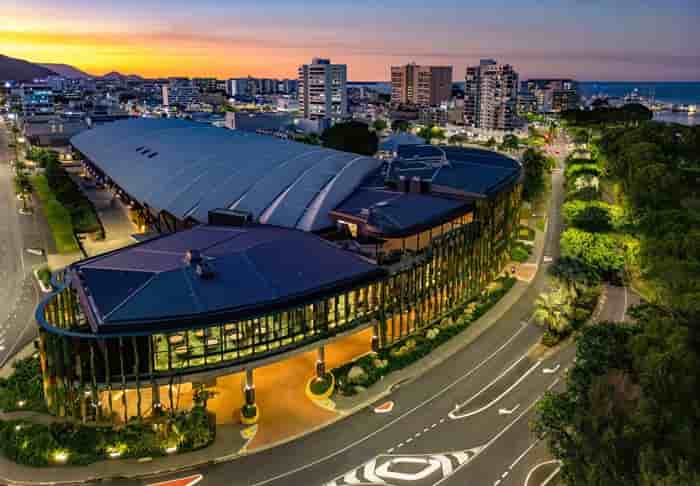
CAIRNS has turned a once-bold regional bet into a $1.67 billion business events success story. Thirty years after its convention centre opened, the figures make a strong case for long-term public investment and for backing regional cities with more than a postcard and a cheerful slogan.
Economic impact data released by the Cairns Convention Centre for its 30th anniversary says the venue has welcomed about three million delegates. They attended more than 2,500 conferences and events and generated 2.9 million room nights. The Centre puts the direct benefit to Tropical North Queensland at $1.67 billion.
A bold regional bet pays off
That result goes well beyond one venue. It shows how business events can help a regional economy through the whole year. Delegates fill hotel rooms, book tours, dine out, hire transport and spend with local firms. They also tend to stay longer and spend more than many leisure visitors.
In 1996, Cairns was already a famous holiday city. Yet it remained exposed to seasons, airline capacity and shifts in leisure demand. The new Centre was designed to widen the city’s economic base. It gave Cairns a way to chase meetings that were usually held in Sydney, Melbourne, Brisbane or other capitals.
Official records confirm the Cairns Convention Centre opened in 1996. It has since won major national and global industry awards, including being named the World’s Best Congress Centre in 2004 and 2014.
General Manager Janet Hamilton said the original decision was far from timid.
“Thirty years ago, backing a world-class convention centre in regional Australia was considered a bold gamble. Today, the results speak for themselves,” Ms Hamilton said.
They certainly speak loudly. The Centre’s anniversary data points to a steady stream of delegates, room nights and local trade.
It also points to a broader prize. Conferences can bring research links, new clients, investment talks and fresh ideas into a region. A major event is not just a hall full of lanyards and heroic urns of coffee. Done well, it is a temporary marketplace for knowledge and business.
Why Cairns works for conferences
This is where Cairns has built a clear edge. The city offers a compact visitor experience. The airport, hotels, restaurants and convention venue sit within easy reach of each other.
Cairns Airport lists a wide domestic network and direct international routes across the Asia-Pacific. These include services to destinations in Singapore, Japan, New Zealand, Indonesia, Papua New Guinea, Fiji and Hong Kong.
Then there is the setting.
Cairns is the main gateway to the Great Barrier Reef and the Wet Tropics of Queensland. Both are UNESCO World Heritage-listed areas. Few conference cities can place world-class meeting space beside two natural assets of such global standing.
That mix matters when organisers are trying to lift attendance. Delegates may travel for the program, but the destination often helps close the sale.
Cairns can offer a serious venue, easy movement around the city and a strong pre- and post-event holiday pitch. In plain English, it gives people a business reason to visit and a very good reason to stay.
A $176 million expansion lifts capacity
The Queensland Government doubled down on that appeal with a $176 million refurbishment and expansion.
The 10,500-square-metre project reached practical completion in July 2023. It added new meeting areas, exhibition space, a banquet room, terraces and updated technology. The larger venue can now host bigger events or several gatherings at the same time.
Peter Loxton, Chief Operating Officer, Asia Pacific and Middle East for Legends Global, said the venue had delivered lasting value.
“Cairns and Queensland’s Far North have been well served by the Cairns Convention Centre which has delivered $1.67 billion in direct economic impact, over 2,500 events welcoming 3 million delegates which generated 2.9 million room nights,” Mr Loxton said.
Legends Global now manages the Queensland Government-owned Centre. That management structure is confirmed on the venue’s official website.
The Centre’s next task is to turn its larger footprint into stronger sector gains. It is targeting conferences in health, science, education, agribusiness, renewable energy, tourism, aviation and the creative industries.
These fields fit the region’s strengths. They can also bring specialists and decision-makers into direct contact with local firms, researchers and institutions.
This is an important point. The best business events leave more behind than visitor spending.
They can create partnerships, attract future investment and raise a region’s profile in key industries. A medical congress may support links with local health teams. A clean-energy meeting may introduce project owners to regional suppliers. An agribusiness event may open a path to new markets.
Local partnerships deepen the impact
Cairns is also sharpening its case as a responsible events destination.
Its Innovate Reconciliation Action Plan 2026–2028 was developed with guidance from Gimuy Walubara Yidinji leadership. The plan aims to strengthen First Nations relationships, cultural recognition and business opportunities.
The Centre says it also buys from more than 270 regional suppliers and producers. That local supply chain helps keep event spending in Tropical North Queensland. It gives the economic impact a wider reach, from food and beverage producers to trades, transport firms and service providers.
Ms Hamilton said teamwork across Cairns had been central to the Centre’s record.
“Our success has come from the entire destination working together, hotels, tourism operators, local businesses, government and the community united by a shared ambition to showcase Cairns to the world,” Ms Hamilton said.
A regional lesson with national weight
That may be the real lesson from the past 30 years.
A convention centre cannot thrive as a grand building in splendid isolation. It needs air access, good hotels, skilled staff, local suppliers, government support and a city that understands the value of working together.
Cairns built that network and kept faith with it. The result is a $1.67 billion business events economy, millions of room nights and a far stronger year-round visitor market.
What began as a regional gamble has become a national case study. Cairns no longer needs to ask whether it belongs on the global conference map.
It is already there with the Reef out front, the rainforest behind it and the welcome mat firmly in place.
By: Octavia Koo – © 2026.
Read Time: 5 minutes.
Author Bio:
 Octavia Koo arrived in Australia in the early eighties with little fuss and a good eye. Sydney suited her. At UNSW, she studied Arts, then found her footing in graphic design before drifting, quite naturally, into the digital side of things, building websites and shaping words that made people want to stay.
Singapore followed, and with it, the fast pace of tourism platforms and ITB Asia. Long before SEO became a buzzword, Octavia understood how stories travelled online. That’s where she met Stephen, and the seed for something more was planted.
A few years later, she joined Global Travel Media.
Today, Octavia works with quiet assurance, blending art, instinct and experience to produce stories that don’t shout; they simply work and linger.











