

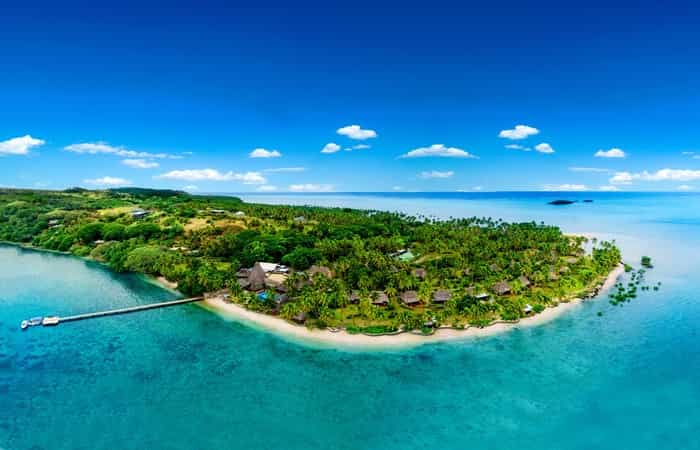
Fiji did not need a committee or a catchphrase to invent slow travel. It had the idea sorted long before the tourism trade began selling “presence” by the package.
Across the islands, time moves to a gentler beat. Meals are shared. Stories are allowed to finish. The day is not treated like a spreadsheet, with sunset pushed into the last cell.
That rhythm now has real sales value. Travellers want calmer and more meaningful breaks. Advisers also need products with depth beyond the pool deck. Fiji offers both. These Fiji slow travel resorts show how.
Here, slow travel does not feel bolted on. At the best resorts, culture, nature, food and warm service shape the whole stay.
Jean-Michel Cousteau Resort Fiji
On Vanua Levu, Jean-Michel Cousteau Resort Fiji is a clear model of eco-luxury. Its Fijian design uses local and renewable materials. An organic garden also helps supply fresh produce.
Guests can join reef walks, snorkelling trips, waterfall hikes and village visits. Marine talks add useful detail without turning a holiday into homework. Many of these nature and cultural activities are included within the resort package.
The result is refined but never stiff. Luxury is present, of course, but it does not spend all week introducing itself. The real draw is a close bond with the reef, local culture and the people who care for both.
Barefoot Manta Island Resort
Barefoot Manta takes a simpler road in the Yasawa Islands. Beachfront bures, three beaches and easy reef access put nature first.
Its dedicated Marine Conservation Centre gives guests a closer look at reef health and ocean care. Talks and conservation projects make the work easy to understand and rather harder to forget once the holiday photographs have been filed away.
From May to October, reef manta rays often feed in the channel between Drawaqa and Naviti islands. A sighting is never promised; wildlife has yet to read the brochure, but it can make the trip.
Turtle Island Fiji
Turtle Island has welcomed guests since the late 1970s and remains one of Fiji’s best-known private island stays. Its modern tourism story developed around the production of The Blue Lagoon, with the first guest bures built around that period.
The resort has just 14 bures and 12 private beaches. That gives couples and families space to slow down without feeling cut off a useful distinction on any private island.
Solar power and long-term care for the island support its environmental goals. Yet the main appeal is personal service. Days can be shaped around each guest, not a fixed timetable. A quiet beach and a shared meal can matter as much as any tour.
Waidroka Bay Resort
Waidroka Bay shows that slow travel need not mean lying still for a week. The Coral Coast resort mixes surfing, diving and adventure with a deliberately small guest list.
It hosts no more than 30 people. It also operates a PADI dive centre and a fleet of five boats serving its diving and surfing programs.
The mood remains easy. Guests can chase a wave or dive a reef, then return for Fijian dishes, fresh local produce and an evening by the sea. It is active travel without the stopwatch.
Castaway Island, Fiji
Castaway Island turned 60 in July 2026. It first opened on 6 July 1966 and is now one of Fiji’s longest continually operating beachfront resorts.
That long run matters. Travel brands often call a new cushion a “relaunch”. Castaway has kept the parts that made it work: thatched bures, white sand, family fun and warm Fijian care.
The resort has 65 freestanding bures and holds Green Key certification. Its work includes reef care, coral planting, water and energy conservation, and guest education. Fijian customs also remain part of island life.
The plan is simple and sound: good food, kind service and no urgent need for shoes.
The Remote Resort Fiji
Near the Rainbow Reef, The Remote Resort does what the name says. Its eight villas sit among tropical growth on a private peninsula, with spacious decks and private plunge pools.
Diving, snorkelling and kayaking bring the action. Fresh produce, local seafood and flexible dining bring the reward.
Guests may eat on their villa deck, by the beach, beside the fire or beneath the stars. It is a fair reminder that a dining room is not always improved by walls.
Kokomo Private Island Fiji
Kokomo sits at the top end of Fiji luxury. Yet its slower style is based on more than large villas and private pools.
The resort operates a 5.5-acre organic farm. Island-grown and locally sourced produce is used across three distinct restaurants, backed by farm-to-table and Dock-to-Dish programs.
Food sits beside diving, spa time, coral restoration, mangrove work and other conservation projects. Guests are urged to stay, taste and notice. Those three verbs rarely survive a rushed trip.
The business case for slowing down
For travel advisers, Fiji slow travel resorts offer a clear sales edge. They are not seven copies of the same beach break.
Each has its own story. One leads with reef care. Another suits families. Others focus on privacy, action, food or high-end wellness.
That helps advisers match the right resort to the right client. It can also support a longer stay and a stronger conversation about value. A slow holiday may have fewer check-ins, but it often leaves better memories.
Fiji has not just found slow travel. It has watched the rest of the world arrive, slightly out of breath and carrying too much hand luggage. The islands were already there, moving at the right speed.
By: Christine Nguyen – © 2026.
Read Time: 4 minutes.
Author Bio:
 Christine’s story is one of quiet courage, told without fuss and lived with remarkable grace. She arrived in Australia as a young refugee from Vietnam, carrying little more than hope, family, and a curiosity that refused to be extinguished. Sydney became home, built patiently, brick by careful brick.
She studied Tourism at TAFE and soon found her place in inbound travel, working with one of the city’s leading destination companies. Christine loved showing visitors the Australia that lives beyond postcards, warmer, truer, and far more interesting.
When the sea began to whisper, and life asked for a gentler rhythm, she listened. Designing brochures, writing blogs, she discovered storytelling waiting quietly inside her.
Today, at Global Travel Media, Christine writes with warmth and wisdom, reminding us, softly and persuasively, why travel still matters.











