

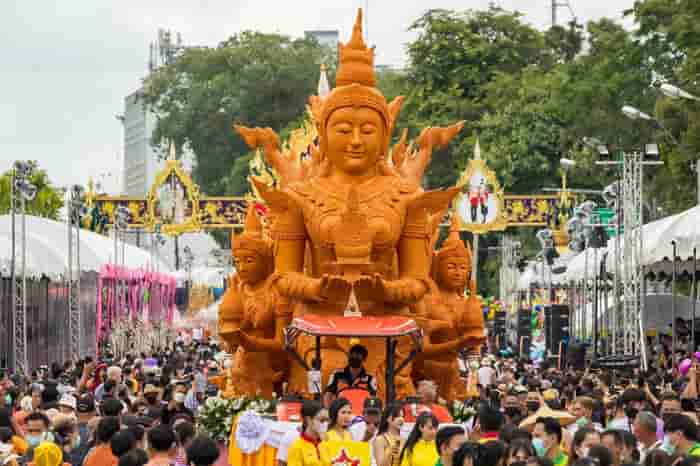
There are festivals that fill a calendar, and there are festivals that define a place. Ubon Ratchathani’s Candle Procession belongs firmly in the second camp. This July, the grand old celebration marks its 125th anniversary and steps onto a larger stage as a Signature Thailand Event.
The Tourism Authority of Thailand (TAT), Ubon Ratchathani Province and public and private partners are presenting the festival at Thung Si Mueang from 25–31 July 2026. The main programme runs from 28–30 July. It will retain the ceremony, faith and craft that built its reputation, while adding stronger night-time staging, visitor activities and a touch of modern Thai pop culture.
That balance matters. A heritage festival should never be treated like an old display cabinet: admired, dusted and left alone. It must remain useful to the community that owns it. Ubon’s procession has survived because temples, artisans, schools, families and local authorities have kept its skills alive, one careful layer of wax at a time.
The custom is tied to Buddhist Lent and the offering of candles to temples. Over generations, those offerings grew into vast sculptural works, elaborate floats and processions rich in music and dance. TAT’s own account traces the festival’s organised development to the early 20th century, when it began taking shape as Ubon Ratchathani’s leading provincial celebration.
TAT Governor Ms Thapanee Kiatphaibool said, “The Ubon Ratchathani Candle Procession has earned its standing through the faith, craftsmanship and collective effort behind it. TAT is giving this living heritage a stronger platform by pairing its cultural foundations with contemporary presentation and meaningful participation. This will broaden international awareness, encourage longer stays and channel greater tourism value to local communities, artisans and businesses.”
It is a sound tourism argument. The finest cultural events do more than produce impressive photographs. They keep visitors in a destination for longer, spread spending beyond a single attraction and give local makers a reason to continue demanding work that cannot be learnt in an afternoon.
In an age of quick content and even quicker attention spans, that is no small achievement.
Forty-seven candles and thousands of performers
The Candle Gathering on 28 July will bring together 47 major works: one showcase candle and 46 competition entries. They will represent Ubon Ratchathani’s three principal styles: traditional candles, moulded-wax works and carved-wax creations.
On 29 July, the royally bestowed Buddhist Lent candle and monastic bathing cloth will begin their procession at 8.29 am. Candle floats, folk performances and dance troupes will follow.
The official opening on 30 July also starts at 8.29 am, with a second parade and the Phanom Phra boat procession from Surat Thani.
More than 37 dance troupes from temple communities and educational institutions will perform across the two days. Organisers will provide more than 5,000 free seats at five viewing points: Wat Si Ubon Rattanaram, Lan Khwan Mueang, U Hotel, Siam Commercial Bank and the Bangchak service station.
The evening programme gives the festival a second life after sunset.
On 29 July, the “Amazing Light of Isan: Stunned” production and illuminated candle displays begin at 7 pm at Wat Si Ubon Rattanaram and Lan Khwan Mueang.
Candle awards will be presented at 5.30 pm on 30 July, before another light-and-sound procession begins at 7 pm at both venues.
The award-winning candles will remain on display at Thung Si Mueang and the City Pillar Shrine from 31 July to 1 August.
That is welcome news for travellers who prefer close inspection over parade-day jostling and for photographers who believe patience is a virtue, provided nobody stands in front of the lens.
Nong Mamuang brings a modern glow
The 2026 edition is not relying on wax alone.
Two large three-dimensional sculptures of Nong Mamuang, the popular Thai cartoon character, will create an illuminated landmark at Lan Thian Chaloem Phra Kiat from 23 July to 13 August.
Dressed in contemporary Thai costume, one figure reclines while the other holds a classical dance pose. It is a playful bridge between heritage and popular culture, and a neat reflection of Ubon Ratchathani’s identity as the “City of Beautiful Lotuses”.
TAT’s ART SPACE will operate from 25–30 July. It will offer candle carving, wax-flower making and gold-leaf decoration.
These hands-on sessions give visitors something more valuable than a souvenir photograph: a modest appreciation of the patience behind the finished work.
Lighting installations will also reshape Thung Si Mueang from 25–31 July.
Four light-and-sound performances will be staged on each evening of 29 and 30 July, pairing modern production with stories drawn from Ubon Ratchathani’s heritage.
A programme reaching beyond the parade
The wider celebration extends across temples, markets and attractions.
Visitors can explore nine candle-making temple communities until 27 July and see artisans working on wax decoration before the main procession.
From 27 July to 1 August, the “Candle Road of Dharma” near the City Pillar Shrine will combine candle-making with local produce and One Tambon One Product markets.
The “Stories of Ubon Ratchathani” light-and-sound show will follow at Lan Thian Chaloem Phra Kiat at 6 pm on 31 July and 1 August.
Ubon Ratchathani Zoo will host the “Ganesha Barami UNSEEN” illuminated candle-flower field from 25–31 July, between 4.30 pm and 8 pm.
TAT also lists daytime viewing from 25–30 August, between 9 am and 4.30 pm. As those August dates sit outside the main festival period, travellers would be wise to reconfirm them before visiting.
The programme continues at Wat Phra That Nong Bua, where “Ubon Candles on View Throughout the Month” will run from 3–17 August.
Thailand turns local heritage into national value
Ubon Ratchathani joins the Nakhon Phanom Illuminated Boat Procession and Sakon Nakhon’s Christmas Star Parade as one of three regional traditions being elevated by TAT as Signature Thailand Events.
The strategy is clear. Thailand is using distinctive local celebrations to strengthen cultural soft power, widen the tourism map and direct more value into regional economies.
The commercial objective is present, but it has not been allowed to trample the ceremony. That is the correct order of things.
It is also a strong example of destination development that begins with local identity rather than manufacturing an attraction in a boardroom.
Artisans gain a wider audience. Hotels and restaurants gain additional trade. Visitors gain a reason to stay beyond the principal parade. Most importantly, specialist knowledge remains visible, useful and worth passing to the next generation.
For travellers, the 125th Ubon Ratchathani Candle Procession offers spectacle with substance. The candles are grand, the costumes vivid and the evening shows ambitious. Yet the real attraction lies in the hands, temples and communities behind them.
The official three-day festival programme runs at Thung Si Mueang from 28–30 July, with day and night processions scheduled for 29 and 30 July.
Further official visitor information is available through the Tourism Authority of Thailand and the TAT Contact Centre on 1672.
After 125 years, Ubon’s great procession is not merely burning brighter.
It is showing how tradition can move forward without losing its soul, which, in modern tourism, may be the most impressive craftsmanship of all.
Official visitor information
For updated programme details, destination information and travel planning advice, contact the TAT Contact Centre on 1672 or visit the official Tourism Authority of Thailand website.
Visitors can also access travel assistance, destination guidance and useful local information through 1672 Travel Buddy.
As festival schedules, performances and viewing arrangements may be adjusted, travellers should confirm the latest details through these official channels before attending.
By: Prae Lee – © 2026.
Read Time: 5 minutes.
Author Bio:
You can tell a great deal about a person by how they meet a Bangkok morning. Prae Lee doesn’t charge into it; she glides, unhurried, as if time itself has agreed to behave. There is a calm assurance about her, the sort earned by knowing both your roots and your destination.
A graduate of Chulalongkorn University, she took her business degree with quiet pride, then polished it further in Singapore and Australia. Travel didn’t change her. It refined what was already there: curiosity, discipline, grace.
Back in Bangkok, she slipped modern life into the family business, mastering social media with an instinct for listening and selling with Thai gentleness.
Prae never seeks attention, yet everything she touches grows brighter.
Now with Global Travel Media, she writes with authenticity, drawing on culture, travel and a rare, steady confidence.











