

Ancient Rome hides in plain sight. Its greatest ruins sit among buses, scooters, offices and apartment blocks. The names are famous, yet the sites can be hard to grasp.
That is the challenge. The Roman Forum, Palatine Hill and Appian Way are not neat museums. They are parts of a city that was robbed for stone, buried, rebuilt and dug up over many centuries. What remains is more like a damaged book than a complete stage set.
Learn a few key points, though, and the stones begin to speak. A row of columns becomes a law court. A strip of paving becomes the main road of an empire. A plain brick hall becomes the room where Rome’s senators met.
This Ancient Rome walking guide gives you that reading order. Ancient Rome does not need more drama. It needs a good reader.
See the Roman Forum from above first
The best way to understand the Roman Forum is to avoid rushing straight into it.
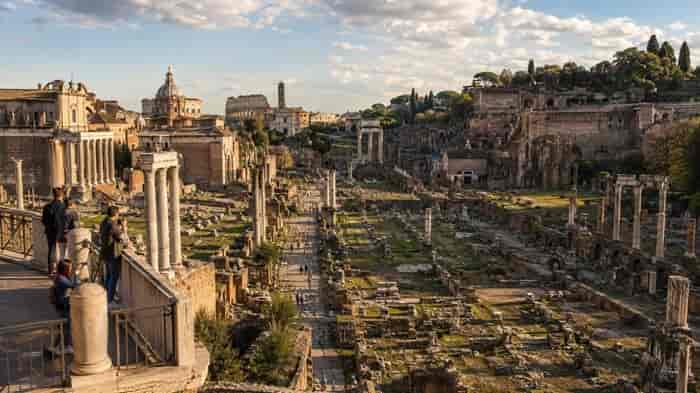
Start on the Capitoline Hill. Walk around the rear of the Palazzo Senatorio and find the terraces that face the Forum. From here, the whole valley opens below. You can see temples, arches, roads and huge brick ruins in one sweep.
This free view is the finest first lesson in the area. It shows that the Forum was not a park filled with grand monuments. It was Rome’s busy civic centre. Politics, law, faith, trade and public life were packed into a tight space. The official archaeological park describes it as the centre of Roman public life for more than a millennium.
Stand there for five minutes before going down. It will save you from spending an hour at ground level wondering whether the Romans had mislaid the street plan.
Four landmarks that unlock the Forum
Begin with the Curia Iulia. It is the plain brick hall near the north-west side of the Forum. Julius Caesar began this new senate house after an earlier building was damaged by fire. It later became the Church of Sant’Adriano. That change helped protect it while many nearby ruins were stripped for stone.
Next, find the Via Sacra. This was the great road through the Forum. It formed part of the route that led towards the Capitoline Hill. Victorious generals, troops, senators, priests and prisoners once moved through this ceremonial heart of Rome.
Once you see the Via Sacra as a real street, the Forum starts to make sense. The ruins no longer float in a field. They face a shared route through the centre of public life.
Near the middle are the remains of the Temple of Divus Julius. It was approved after the murder of Julius Caesar and became a lasting monument to his deification under Augustus. Visitors still leave flowers near its remains. It is a small act, but it gives the site a rare human warmth.
Then walk to the Arch of Titus. Emperor Domitian built it to honour his dead brother Titus. Inside are carved scenes tied to Rome’s victory in the Jewish War. One panel shows Roman soldiers carrying spoils from the Temple in Jerusalem, including the seven-branched menorah.
These four points give the Forum a clear frame: the Curia, Via Sacra, Temple of Divus Julius and Arch of Titus. After that, the Temple of Saturn, House of the Vestals and Basilica of Maxentius become easier to place.
The Forum is still a puzzle, of course. It is simply a puzzle with the corner pieces now in position.
Climb the Palatine, birthplace of the palace
The Palatine Hill rises above the south side of the Forum. It feels calmer and greener, which is welcome after the heat and crowds below.
Rome’s legends link the hill with the city’s birth. Later, it became the favoured address of emperors. They built vast homes, halls, gardens and courts across its slopes. The link was so strong that Palatium gave rise to words such as palace, palazzo and palais.
In other words, every palace owes a debt to this hill.
Today, visitors walk through the remains of the Houses of Augustus and Livia, the Domus Tiberiana and the huge Flavian palace. Much of the marble is gone. What remains is brick, stone, corridors, arches and open courts. The Domus Tiberiana, built on the hill’s north-western slope, is regarded as Rome’s first true imperial palace.
Even so, the scale is clear. These were not normal homes with a slightly better view. They were centres of rule. The emperor lived, received guests and ran state affairs within one vast setting.
Walk to the southern edge for the view over the Circus Maximus. The ancient racecourse stretched about 600 metres through the valley. It was Rome’s greatest home of chariot racing and mass sport.
From the Palatine, its long shape becomes clear. You can also grasp the scale of the crowds that once filled it. Rome understood a basic truth of public life: give the people a race, a hero and a rival, and they will discuss little else until Monday.
The Colosseum demands a plan
The Colosseum is next door, but it should not be treated as a casual extra.
Many tickets use fixed times and names. Some visits also involve identity checks. There are different products for standard entry, the arena, underground areas, the attic and added sites in the Forum and Palatine.
There is also a Forum Pass SUPER that does not include the Colosseum. Read the details before buying. Nothing takes the shine off a Roman holiday quite like reaching the world’s most famous arena with a ticket for somewhere else.
Opening hours change with the season. Parts of the site can also close for works or special events. Check the official Parco archeologico del Colosseo website before your visit and use its authorised ticket channel.
Ancient Rome still lives in modern streets
The fenced ruins are only half the story. Some of the best ancient sites are woven into the streets of modern Rome.
The Pantheon is the great survivor. Its concrete dome spans just over 43 metres. The height inside is close to the same measure, giving the room its famous balance. At the top, the open oculus lets in sun, rain and a moving beam of light.
The building survived in large part because it became a church. It still works as both a place of worship and one of the finest rooms ever built.
A short walk away, Largo di Torre Argentina holds four temples from the Roman Republic. The ruins were found during demolition work between 1926 and 1929. The wider complex is tied to the site where Julius Caesar was killed in 44 BC.
Public walkways now let visitors enter the archaeological area instead of merely peering down from the street. The cats remain. They carry themselves with the calm pride of officials who know that no election can remove them.
Near the River Tiber stands the Theatre of Marcellus. It began as a Roman theatre, later became a fortress and then gained a grand palace above its ancient arches. Baldassarre Peruzzi designed that upper level for the Savelli family in the 16th century. It later passed to the Orsini family.
The result is pure Rome: an ancient theatre below, a noble home above and a modern city flowing around both.
Take the Appian Way out of town
To see how Rome reached beyond its walls, follow the Via Appia Antica.
Work on the road began in 312 BC. It grew into one of Rome’s most important military and trade routes. In 2024, UNESCO added Via Appia. Regina Viarum to the World Heritage List. The listed route extends for more than 800 kilometres.
The section near Rome is best seen as a long landscape. Beyond the busy first stretch, the road passes tombs, villas, churches, fields and old estates. The official archaeological park describes a long, well-preserved section beginning near the church of Domine Quo Vadis and continuing past hundreds of ancient monuments.
Parts of the dark basalt road are still visible. In some places, the surface carries marks left by long use.
Key stops include the Mausoleum of Cecilia Metella and the Villa of Maxentius. Yet the space between the monuments matters just as much. This is where the city falls away, and the old road becomes the main event.
Walking gives you time to notice the details. Cycling lets you cover more ground. The park recommends arriving on foot, by bike or by public transport where possible.
Sunday often feels quieter, but road access and closures can change. Check official notices before you leave, especially when works or public events are underway.
A good guide can rebuild what has vanished
Ancient Rome makes a strong case for hiring an expert guide.
The hard part is not finding ruins. The hard part is knowing what is old, what has been rebuilt and what is missing. A guide can point to a low wall and explain the temple that once stood above it. They can show how a road, drain, doorway or layer of brick changed over time.
That skill turns broken stone into a working city.
Operators such as Through Eternity offer small-group and private tours of the Colosseum, Forum and Palatine. Some advertised itineraries are led by archaeologists or expert historical guides. Before booking, compare group size, length, ticket areas, access needs and cancellation rules.
A cheap tour may not feel cheap when 30 guests are trying to pair their headsets while the Forum bakes around them.
How to plan the day
Heat is the main foe in summer. The Forum has little shade, and the stone throws warmth back at you with interest.
Go near opening time or later in the day. Wear good shoes. Carry water. Use Rome’s public drinking fountains when available. A hat is not a defeat. It is evidence of sound command.
Do not force the Colosseum, Forum, Palatine, Pantheon, Largo Argentina and Appian Way into one day. Even the Romans paused for meals.
Give one long session to the Colosseum, Forum and Palatine. Use another walk for the Pantheon, Largo Argentina and Theatre of Marcellus. Keep a separate morning for the Appian Way.
Most of all, begin with context. See the Forum from the Capitoline terraces. Find the Via Sacra. Climb the Palatine before your legs object. Step inside the Pantheon and watch the light. Walk far enough along the Appian Way for the city noise to fade.
Ancient Rome has waited almost two thousand years to be read. The stones still know the story. Travellers need only the right order, a little patience and a sensible hat.
By: Bridget Gomez – © 2026.
Read Time: 8 minutes.
Author Bio:
 Bridget has never been built for stillness. Of Portuguese heritage, she began as a nurse, tending veterans at the Repatriation Hospital, listening to stories as colourful as the life she was yet to live. It was worthy, steady work, but wanderlust, as always, proved louder than routine.
So, she traded starch for a backpack and disappeared for a year, chasing trains, sunsets and the occasional regrettable glass of wine. She wrote everything down: the dust, the laughter, the missteps, the magic. Those notebooks became a travel blog, then a habit, then a calling.
Eventually she found Global Travel Media, or perhaps it found her.
Today Bridget writes with heart, humour and a dash of mischief, still travelling, just now with words.











