

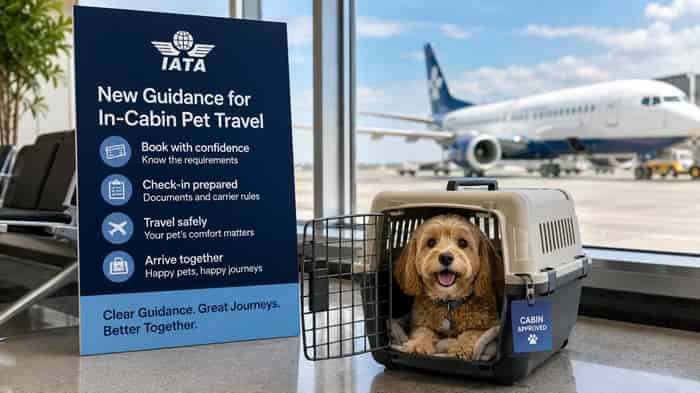
Flying with a family pet has long been one of air travel’s grey areas. Rules can differ by airline, route and aircraft. Paperwork can also pile up fast. The smallest carrier may soon become the most important item of cabin baggage.
The new IATA pet travel guidance aims to make that journey easier to understand. It gives airlines a clear path from booking and check-in to boarding, the flight and arrival. Safety, animal welfare and smooth operations remain at the centre of the plan.
Passengers want clearer pet travel rules
IATA’s 2025 Global Passenger Survey found that about one in four people had travelled, or would consider travelling, with a pet. Among that group, 41 per cent were unsure whether their pet could fly. Another 36 per cent did not understand airline policy, while 34 per cent were unclear about the whole process.
That is a large pack of passengers hunting for firm answers before departure.
“A pet is a much-loved member of the family. People traveling with their pets need clear guidance on what to expect at every step of the journey. That’s important because well-prepared travelers and industry-wide best practices enable airlines to deliver a safe, consistent, and efficient experience for those traveling with their pets,” said Brendan Sullivan, IATA’s Global Head of Cargo.
The new guidelines also follow IATA’s guidance on travelling with service dogs. Together, they show a wider push for safer and more consistent animal travel by air.
What pet owners should do before flying
Preparation is still the golden rule. Travellers should check the airline’s policy before booking. They should also confirm the rules for every country on the trip, including transit stops. Health papers, vaccines, permits and carrier sizes may differ.
IATA also advises against sedating a dog or cat for cabin travel unless a vet directs it. The pet should be used to its carrier well before the flight. That carrier must be secure, leak-proof and large enough for the animal to stand, turn and lie down in a natural position. It should stay closed during the flight.
The message is simple: check early, confirm every detail and never assume that all pet-friendly flights use the same rules.
For airlines, a shared framework should mean fewer disputes at check-in, better staff advice and smoother boarding. For passengers, it should remove much of the guesswork. IATA says clearer processes can also reduce service problems and improve operational consistency.
That is welcome progress. Aviation already has enough moving parts without the family terrier becoming an unscheduled operational event.
By: Susan Ng – © 2026.
Read Time: 2 minutes.
Author Bio:
 With the polish of an international hotel professional and the instincts of a born storyteller, Susan Ng learned hospitality where it truly lives behind reception desks, in banquet halls, beside linen carts. She understands that excellence isn’t announced; it’s felt, in the small, quiet gestures that linger long after checkout.
Away from the bustle, her curiosity found a new front desk: the blank page. Her blog, candid and gently wry, drew readers who recognised truth when they saw it. She wrote about grace and imperfection with the steady eye of someone who had lived both.
Today, at Global Travel Media, Susan brings that same warmth and insight to her stories. Expect writing that is polished, generous, and reassuring like the perfect welcome after a long journey.











