

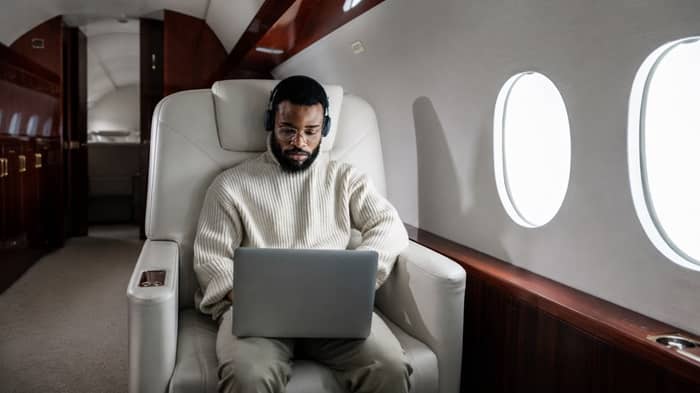
Fast Wi-Fi is becoming the new test of luxury in private aviation. Once, a fine cabin, soft leather and good Champagne did most of the talking. Now, one blunt question can settle the matter: will the video call work?
Starlink is helping to put that question at the centre of the charter market. The SpaceX service uses satellites in low-Earth orbit. It is built to support fast internet, live calls, streaming and online work while an aircraft is in flight.
The pace of growth is hard to miss. Reuters reported on 9 June 2026 that Starlink had signed 11 new airline clients that year. It added 22 in 2025. The company also held deals covering more than 7,000 aircraft. Fast Wi-Fi is no longer a small perk tucked away in the brochure. It is becoming part of what flyers expect.
That shift now reaches every part of the market. Frontier Airlines said in July that it would start fitting Starlink to its fleet in early 2027. Other airlines are also using better Wi-Fi to win higher-value customers. The cost can be steep. Even so, many carriers now see it as a tool to sell seats and build loyalty.
Long-Haul Demand Leads the Charge
Private aviation may feel the change even more. Its clients often fly because time matters. They may need to call staff, approve a deal or join a live meeting. On a long trip, a working link can turn dead time into useful time.
This is also changing the way clients choose an aircraft. Range still matters. So do cabin size, bags, route, timing and service. Yet Wi-Fi is now joining that list. On a long flight, several hours offline can feel less like calm and more like commercial exile.
“People have become used to being always connected. As more scheduled airlines offer onboard connectivity, clients increasingly expect the same level of service when flying privately,” said Claudia Krajhanzl, Vice President Passenger – IMEA at Chapman Freeborn.
Her message is clear. A private jet cannot promise a smooth, high-end trip and then leave its guests staring at a spinning wheel.
“For now, high-speed connectivity is not yet available across every private aircraft, but it is fast moving towards becoming an expected standard, especially on long-haul flights. Demand is currently stronger on long-haul flights than on shorter regional sectors, where connectivity may be less decisive.”
Aircraft Choice Gets a Digital Test
That gap between short and long trips is important. A client may accept weak Wi-Fi on a quick hop. It is a different story on a flight that lasts eight or ten hours. Business guests may need to speak with teams, sign off work or track a live issue. Families and leisure flyers may simply want to stream, chat or browse.
The service will not reach every jet at once. Each aircraft needs the right kit. It also needs checks, approval and time in the hangar. Cost and fleet plans will shape the pace. Clients should therefore ask which system is fitted before they book. Reuters notes that aircraft must be taken out of service for installation and that onboard equipment is generally tied to the chosen provider.
Starlink says its aviation service is made for business jets, airlines and charter firms. Its list of supported and certified aircraft types continues to grow. That makes a clear check before departure vital, mainly when Wi-Fi is central to the trip.
For charter firms such as Chapman Freeborn, the job is now wider. They must know what the client needs. They must then find a jet that can meet it. They should also explain any limits before the aircraft leaves the ground.
Connected Skies, Careful Checks
Private aviation has always sold time, privacy and control. Fast Wi-Fi adds one more promise: the day can keep moving.
The boardroom may now sit at 41,000 feet. The coffee may arrive in fine china. But the Wi-Fi had better work.
By: My Thanh Pham – © 2026.
Read Time: 3 minutes.
Author Bio:
 My Thanh Pham has lived more of a life of travel than most people ever do. After studying tourism, she went straight into building journeys across South-East Asia: temples, beaches, night trains, and all, quietly fixing the messy bits so others could enjoy the ride.
She was never meant to stay behind a desk. Airline life followed, dividing her days between reservations and the airport floor, right where travel shows its true colours. Missed flights, tight hugs, frayed tempers, sudden joy – she saw it all, close up.
Now at Global Travel Media, My Thanh has traded ticket stubs for a keyboard. She writes the way she once worked: steady, clear-eyed and respectful of the road’s unpredictable rhythm, guiding readers through a world she knows from the inside.











