

The world’s airlines have produced another year of big numbers, sharp contrasts and enough route data to keep an aviation analyst busy until the next timetable change.
The International Air Transport Association has released its 2025 World Air Transport Statistics (WATS). The report offers a clear view of demand, supply and airline performance.
The annual dataset draws on IATA’s collection of 1,315 airlines. More than 250 international carriers add detailed operational and financial data.
That reach matters. Aviation is fond of forecasts, but WATS is based on what airlines report. It covers passenger demand, fleets, top routes, jobs, costs and revenue. Put simply, it is aviation’s annual report card only with more airport codes and fewer excuses.
Premium cabins keep climbing
International business- and first-class travel grew again in 2025. Premium passenger numbers reached 109.7 million, up 4.5 per cent on 2024. These travellers made up 5.5 per cent of all international passengers.
Latin America delivered the biggest jump. Premium traffic rose 22.1 per cent to 4.0 million passengers. Europe remained the largest premium market, with 39.7 million people travelling in the front cabins.
North America and the Middle East had the highest premium shares in their international markets. Premium passengers made up 10.4 per cent of North American traffic and 9.5 per cent of Middle Eastern traffic.
The message for airlines is plain. Travellers still watch the fare. Yet more of them will pay for space, service and a little less combat over the armrest.
Asia Pacific owns the busiest routes
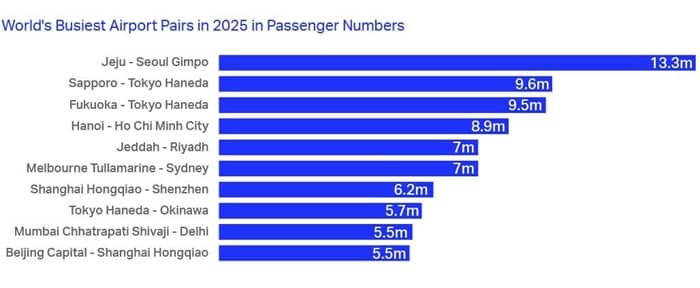
Asia Pacific again ruled the world’s busiest airport-pair rankings. Jeju–Seoul Gimpo kept the global crown, carrying 13.3 million passengers in 2025.
Nine of the top 10 airport pairs were in Asia-Pacific. The only outsider was Jeddah–Riyadh in Saudi Arabia. Every route in the top 10 was domestic.
That is a useful reality check. The largest traffic flows are not always long-haul glamour runs. Often, they are short and vital links flown many times each day.
Cape Town–Johannesburg was Africa’s busiest airport pair, with 3.4 million passengers. Bogotá–Medellín led Latin America with 3.5 million.
Barcelona–Palma de Mallorca remained Europe’s busiest pair at 2.1 million passengers. Stockholm Arlanda–Malmö posted Europe’s fastest growth. Traffic rose 85 per cent to 271,031 passengers.
In North America, New York JFK–Los Angeles was the busiest domestic pair, with 2.2 million passengers. JFK–London Heathrow led the region’s international pairs with 2.1 million.
The United States leads as growth moves east
The United States remained the world’s largest passenger market in 2025. It recorded 890.1 million passengers arriving and departing.
Yet growth was only 1.6 per cent. That was the slowest rate among the world’s top 10 markets.
China ranked second with 776.1 million passengers, up 4.8 per cent. The gap is still large, but the growth rates show the race is hardly parked at the gate.
Some of the strongest gains came from Central Asia. Kazakhstan’s market surged 40 per cent to 18.1 million passengers. Uzbekistan rose 16.9 per cent to 12.5 million.
Vietnam also moved quickly. It recorded 80.9 million passengers, up 14.8 per cent year-on-year.
The figures point to stronger regional links and rising demand beyond aviation’s old power centres. They also show where airlines may find their next wave of customers.
The 2025 WATS results do more than rank routes and countries. They show where people are spending, where networks are growing and where new demand is taking shape.
For airlines, airports and travel sellers, the report is far more than a heavy book of figures. It is a map of where the world is flying and where it may fly next.
By: Anne Keam – © 2026.
Read Time: 3 minutes.
Author Bio:
 Anne Keam’s story begins in Queensland, on a grain farm in the state’s wide western reaches, where the days were long and the lessons simple: work hard, look after your own, and don’t make a fuss. Those early years left their mark.
She later studied Arts at the University of Queensland, before doing what felt natural at the time, heading back home to the family property. But the world was calling. Anne packed a backpack and went looking, spending years on the road and finding herself most alive in South America. She wrote everything down along the way. Those notebooks, full of dust, colour, and curiosity, eventually became her blog, a quiet, personal record of seeing the world and learning from it.











