

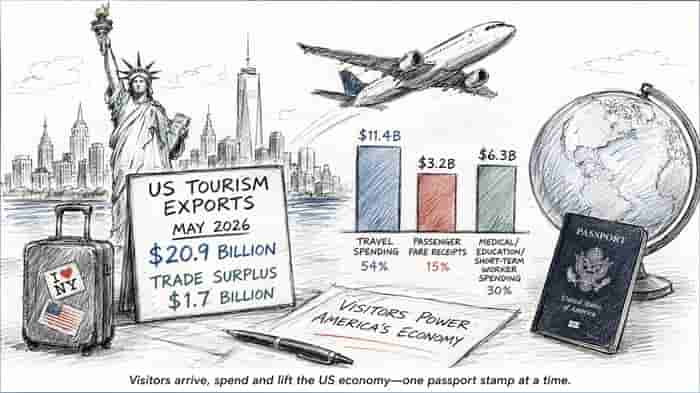
America’s visitor economy banked US$20.937 billion from overseas travellers in May 2026. It was a welcome lift for the tourism trade and a handy win for the wider economy.
The latest National Travel and Tourism Office data show US tourism exports rose 1.4 per cent from May 2025. At the same time, Americans spent US$19.201 billion abroad, down 0.8 per cent. The result was a US$1.736 billion travel trade surplus.
In plain English, foreign visitors spent more in the United States than Americans spent overseas. For an industry fond of departures, that is one arrival worth applauding.
Airline receipts provide the altitude
The standout result came from passenger fare receipts. US airlines collected US$3.235 billion from international visitors, up 13.5 per cent year on year.
That sharp rise made up 15 per cent of May’s tourism exports. It also points to solid demand for international air travel. Higher fares, added seats, or a mix of both may have helped.
For airlines, airports and travel sellers, the message is positive. International visitors are still willing to pay to reach the United States. Other parts of the visitor economy, however, are moving at a slower pace.
Core visitor spending slips
Direct travel spending reached US$11.387 billion in May. This covered hotels, meals, shows, shopping, leisure and local transport.
The figure was 1.2 per cent below May 2025. Even so, it made up 54 per cent of total US tourism exports. It remains the largest slice of the pie — and, unlike an airline meal, it is a pie worth taking seriously.
The softer result should keep tourism operators alert. Strong airline income does not mean every hotel, attraction, restaurant or shop is enjoying the same gains. NTTO defines travel receipts as purchases that include food, lodging, recreation, gifts, entertainment and local transport.
Education and medical travel hold firm
Medical, education and short-term worker spending totalled US$6.315 billion. That was 0.5 per cent higher than in May 2025. The category made up 30 per cent of tourism exports.
The figures show that the visitor economy is about more than holidays and business trips. Overseas students, patients and short-term workers also support housing, schools, health care and daily services.
The reported shares total 99 per cent due to rounding. No billion-dollar suitcase has gone missing.
A solid month, but no victory parade
From January to May, overseas visitors spent US$103.446 billion in the United States. That was 0.9 per cent below the same period in 2025. Even so, they added about US$685 million to the economy each day.
May delivered a good result, but it did not erase the softer trend so far this year. The United States remains a major tourism market. Yet the data show two speeds: airline receipts are rising quickly, while core visitor spending remains under strain.
That matters because the broader US goods and services trade deficit rose to US$77.6 billion in May. Against that backdrop, tourism’s US$1.736 billion surplus is more than a pleasant statistic. It is a real export win — passport stamps, hotel keys and all.
Source note: The National Travel and Tourism Office’s International Travel Receipts and Payments Program obtains its datasets from the US Bureau of Economic Analysis. The exact May figures were checked against NTTO’s downloadable monthly trade workbook.
By: Jason Smith – © 2026.
Read Time: 2 minutes.
Author Bio:
 Jason Smith didn’t learn travel from textbooks. He learned it in airports, taxis and hotel lobbies, watching the business unfold long before he played his own part. Half American, half Asian, he grew up around the quiet workings of tourism, where people come and go, and stories rarely stand still.
Bangkok came first, then formal study, then a career that carried him through Singapore, Malaysia and Vietnam. Each place left something behind. In the end, Thailand felt like home, and I took on a senior role in hotel sales.
Then everything stopped. Borders shut, planes grounded, and Jason found himself back in America with time to reflect.
Now at Global Travel Media, he writes travel as it really is, not polished, not perfect, but human, and all the better for it.











