

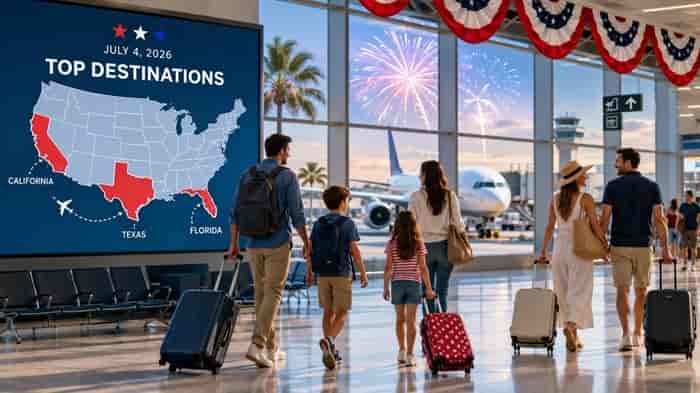
America does not do July 4 quietly. It brings flags, fireworks, family lunches, airport queues and a national talent for turning a long weekend into a full-blown production. In 2026, the holiday comes with extra polish on the brass.
The United States is marking #America250, the 250th anniversary of the Declaration of Independence. That gives this year’s Independence Day break a bigger brief than usual. It is not only a holiday. It is a national stage.
New analysis from The Data Appeal Company / Almaviva Group, powered by Data Appeal Mabrian, shows domestic flight reservations for travel between July 2 and July 6, 2026, are up 8.1 per cent year on year. Data Appeal and Mabrian operate within a unified data-intelligence brand family focused on helping destinations make better use of travel insight.
That is not a wild gold rush. It is the sort of steady lift that destination chiefs like best. It fills planes, rooms, restaurants and tills without making the whole machine wobble.
The figures arrive ahead of the Destinations International Annual Convention in Portland, Oregon, from July 21 to 23, 2026. The convention will gather destination leaders at a time when travel demand is healthy, but not carefree. Consumers still want the trip. They just want the bill to behave itself.
The national setting is hard to miss. America250 is the official commemoration of the 250th anniversary of the signing of the Declaration of Independence on July 4, 1776. For destinations that turn a familiar holiday into a rare chance to blend history, civic pride, and visitor spending into one neat, star-spangled package.
The leaders in holiday demand are no shock. Florida tops the lodging table with 11.2 per cent of recorded domestic stays. California follows with 10.4 per cent. Texas takes third place with 7.5 per cent. New York, Tennessee and Georgia are also among the leading states for the July 4 period.
This is the classic American leisure mix. There are beaches, theme parks, big cities, music towns, road trips and family reunions. It is not a fancy theory. It is the old travel trade truth: give people a reason to go, make it easy to get there, and they will come.
Family travel is doing much of the heavy lifting. Families account for 42.5 per cent of travellers. Couples make up another 38.7 per cent. Together, they represent more than four in five travellers across the period. That is a very clear message for hotels, attractions and visitor bureaux. July 4 is not just about beds sold. It is about memories made, queues managed, and children fed before the wheels fall off.
The booking pattern shows a more careful consumer. Flight reservations grew in early January, then cooled through parts of March and April. In the final week of May, they jumped again. The trip was still wanted. The timing was simply more cautious.
Maria Pradissitto, North America Market Manager at Data Appeal, said the pause “reflects a period of uncertainty as consumers weighed the impact of higher fuel prices and inflation on discretionary spending,” but the later recovery showed that “consumers adapted and bookings reactivated as the travel date comes closer.”
That line tells the story. Travellers did not give up. They waited, watched and then booked. The July 4 trip stayed on the fridge door. It was just held there with a stronger magnet and a sharper eye on the household budget.
Convenience still counts. Nonstop flights make up 73.7 per cent of all domestic bookings. No great mystery there. Most people prefer one flight, one seat and one chance for their suitcase to arrive in the same city.
Yet value is pushing harder. Bookings for flights with stopovers rose 3.2 per cent year on year. One-stop trips now account for 25.5 per cent of bookings. Two-stop journeys make up 0.9 per cent. As a Data Appeal expert explains, “demand for lower-cost alternatives is growing”.
That is the modern travel equation. People want ease, but they will trade a little comfort to protect the holiday. A cheaper fare, a longer route or a shorter stay can be the difference between going and staying home. The average length of stay fell 1.7 per cent year on year to 5.9 days.
The analysis says “U.S. travelers are adapting to higher travel costs by exploring alternatives that allow them to preserve their holiday travel plans without significantly increasing their budgets.” That may be the most useful sentence in the whole report. It is the 2026 traveller in plain clothes: keen, careful and still packing.
The #America250 event picture adds more spice. More than 66 per cent of potential tourism spending tied to the anniversary celebrations is expected to be concentrated in just five states. Washington leads with 23.9 per cent. Massachusetts follows with 21.7 per cent. California takes 8.4 per cent, Texas 7.3 per cent and Tennessee 4.8 per cent.
The surprise is not the list. It is the leverage. Washington accounts for only 2.4 per cent of listed July 4 events, yet is projected to capture 20.7 per cent of attendance and 23.9 per cent of spending. Massachusetts hosts just 1.6 per cent of events, but accounts for 19.9 per cent of attendance and 21.7 per cent of spending.
That is where flagship events earn their keep. On a per-capita basis, Washington and Massachusetts are tipped to generate US$22.8 and US$23.3 per resident, respectively. The national average is US$2.3. By contrast, Texas and California host the largest shares of July 4 events, at 10.4 per cent and 8.5 per cent, but account for a smaller share of spending.
In other words, more events do not always mean more money. The winners are the events with pull. They have a clear story, strong access and enough scale to make visitors cross a border, book a bed and buy dinner.
“The July 4 holiday has always been one of America’s most important travel periods, and in 2026 it carries even greater significance as communities across the country celebrate the nation’s 250th anniversary,” said Don Welsh, president & CEO of Destinations International. “These travel trends demonstrate the enduring appeal of travel and the important role destination organizations play in creating memorable experiences that connect visitors with America’s history, culture and sense of place.”
For destination organisations, the brief is plain. Make the trip easy. Make the event worth travelling for. Make value visible. And make history feel alive, not laminated.
America may be 250, but its domestic travel market is not settling into a rocking chair. It is moving, adjusting and spending. It is also doing what July 4 has always done rather well: making noise, drawing crowds and reminding the travel trade that sentiment still sells.
By: Christine Nguyen – © 2026.
Read Time: 5 minutes.
Author Bio:
 Christine’s story is one of quiet courage, told without fuss and lived with remarkable grace. She arrived in Australia as a young refugee from Vietnam, carrying little more than hope, family, and a curiosity that refused to be extinguished. Sydney became home, built patiently, brick by careful brick.
She studied Tourism at TAFE and soon found her place in inbound travel, working with one of the city’s leading destination companies. Christine loved showing visitors the Australia that lives beyond postcards, warmer, truer, and far more interesting.
When the sea began to whisper, and life asked for a gentler rhythm, she listened. Designing brochures, writing blogs, she discovered storytelling waiting quietly inside her.
Today, at Global Travel Media, Christine writes with warmth and wisdom, reminding us, softly and persuasively, why travel still matters.











