

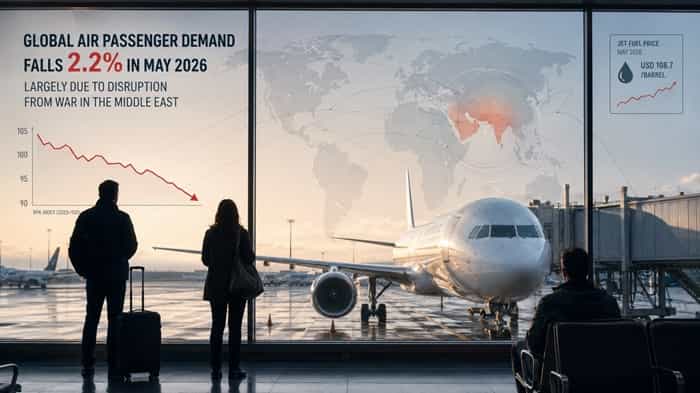
Global air travel took a rare step backwards in May. Yet this was no industry fainting spell. The cabins were still full. The demand was still there. The trouble was the map.
New figures from the International Air Transport Association (IATA) show total passenger demand fell 2.2 per cent year-on-year in May 2026. The fall was driven mainly by the war in the Middle East. Excluding the region, global demand still rose 0.7 per cent.
That detail matters. It tells travel agents, airlines and corporate buyers that the market has not lost its nerve. It has hit turbulence. There is a difference, as anyone who has clutched an armrest over the Arabian Gulf will confirm.
IATA measures demand in revenue passenger kilometres, or RPKs. This shows how far paying passengers actually travelled. Capacity, measured in available seat kilometres, fell 2.3 per cent. The passenger load factor rose to 83.5 per cent, a record for May. In plain English, airlines flew fewer seats, but filled more of them.
IATA Director General Willie Walsh said: “Air passenger demand was down 2.2% year-on-year in May on the impact of war in the Middle East.” He said the 28.4 per cent fall among Middle Eastern carriers was “a significant improvement” on April’s 46.6 per cent drop. That is still a rough landing, but at least the nose has lifted.
International demand fell 1.6 per cent compared with May 2025. Excluding the Middle East, it rose 3.1 per cent. Capacity fell 2.4 per cent, while the international load factor reached 83.7 per cent. The message is clear. When airlines can operate workable schedules, passengers are still boarding.
The regional split was stark. Middle Eastern carriers saw international demand fall 28.8 per cent. Capacity dropped 24.3 per cent and load factor fell to 76.1 per cent. The year-on-year comparison remains harsh. Even so, IATA said the month-to-month hit was less severe than in April. That suggests the first shock is easing, though nobody in aviation will be ordering bunting just yet.
Europe had a stronger month. Its carriers posted a 3.8 per cent rise in international demand, while load factor climbed to 85.4 per cent. IATA also noted a 15 per cent rise in direct traffic to Asia. That points to a continued shift towards direct services between the two regions. Travellers, it seems, still prefer the old virtues: fewer detours, fewer queues, and fewer chances for a suitcase to develop a life of its own.
Asia-Pacific carriers lifted international demand by 1.3 per cent, even as capacity fell 1.1 per cent. Load factor rose two points to 85.3 per cent. The region had its bruises. In Vietnam, tighter jet fuel import limits forced short-haul capacity cuts and weakened intra-Asia traffic during the month.
Latin America and Africa offered the brighter news. Latin American airlines posted a 10.5 per cent rise in international demand. African carriers rose 8.9 per cent. These figures show that where fuel supply and geopolitics are less disruptive, the appetite for travel remains strong.
Domestic markets were weaker. Domestic RPKs fell 3.1 per cent year-on-year. China recorded the largest decline among the reported domestic markets, down 6.2 per cent. IATA said this may be linked to higher fares and the Dragon Boat Festival falling in June this year. The United States also softened, down 1.9 per cent.
Australia was steady rather than spectacular. Domestic demand eased just 0.1 per cent, while capacity fell 0.3 per cent. Load factor stood at 79.1 per cent. For local agents, that is not a bad result. In a month like May, flat is not a failure. It is the industry equivalent of keeping one’s hat on in a southerly.
The real pressure point is fuel. Walsh warned that a sharp drop in oil prices was welcome, but the benefits may take time to flow through to “normalized” jet fuel prices. He also warned that oil supply through the Strait of Hormuz remains uncertain. With airlines operating on margins around 2.0 per cent, there is little room to absorb higher costs.
That is where the fair question bites. Passengers still want to travel. Airlines still want to fly them. But aircraft do not run on optimism, loyalty points and half a cheese sandwich. If fuel stays high, fares will keep testing demand.
May’s IATA figures tell a disciplined story. Demand fell, but it did not vanish. The Middle East remains the heavy drag. Europe, Latin America, Africa and parts of Asia showed resilience. China and the US need to be watched. Australia is holding its line.
For the travel trade, the practical lesson is simple. Watch capacity. Watch fuel. Watch fares. Above all, remember that a full aircraft does not always mean an easy profit. Aviation is still flying, but the weather ahead remains unsettled.
By: Soo James – © 2026.
Read Time: 4 minutes.
Author Bio:
 There’s nothing rehearsed about Soo James, and that’s precisely the point. Malaysian by heritage, Sydney-schooled, she arrived at UNSW to study Arts, then took a left turn into IT, not out of ambition but out of curiosity. Somewhere among systems and schedules, she worked out what really held her attention: people, language, and the quiet spaces between them.
Writing followed naturally. Travel and lifestyle gave her room to observe, to listen, to notice the details others rush past. Soo writes the way good travellers move, watching the room before admiring the view, catching the gesture before chasing the headline.
At Global Travel Media, her stories don’t shout or sell. They linger. They slow you down, open a door, and gently suggest there’s more to see if you’re willing to look.











