

If you’ve worked in travel for more than five minutes, you’ll know one thing with absolute certainty.
The only constant in this industry is change.
Just when you think you’ve finally mastered the latest booking system, along comes a pandemic, a geopolitical crisis, an airline collapse, a social media influencer with 12 million followers or now, apparently, an artificial intelligence agent keen to help sell a holiday to Bali.
No wonder some travel professionals occasionally stare wistfully at retirement brochures.
Yet, according to a new report from RateHawk and research giant Phocuswright, the next decade could make the past few years look almost sedate.
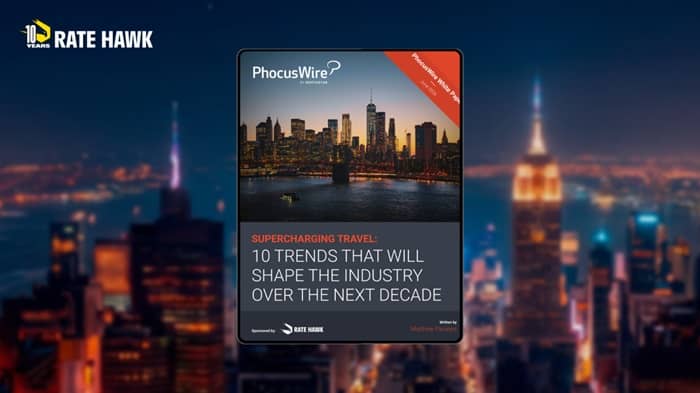
Released during the RateHawk Futurecast online event this week, the report identifies ten major trends likely to shape travel distribution through to 2036. The findings suggest that travel businesses that embrace technology, diversify their products and stay nimble will flourish.
Those who don’t may discover that nostalgia, while comforting, rarely pays the electricity bill.
“We created this report as a practical guide to help travel businesses navigate the industry’s fast-changing environment,” said Astrid Kastberg, Managing Director of RateHawk.
“It explores key shifts across the most important parts of the travel ecosystem, including the broader market landscape, traveller behaviour, and technological adoption, and is designed to help travel professionals identify the most important actions needed to stay competitive over the next decade.”
The report draws on extensive research from both organisations, supplemented by interviews with industry leaders from across the travel landscape.
At the heart of the study sits an increasingly elusive creature: the modern traveller.
Today’s travellers don’t simply want a holiday. They want their holiday.
One wants a luxury wellness retreat in Thailand with yoga at sunrise and organic smoothies by the infinity pool. Another wants to chase the Northern Lights from a converted fishing boat somewhere north of civilisation. Their travelling companion simply wants reliable Wi-Fi and a decent coffee.
Good luck packaging all that neatly into a brochure.
Traveller behaviour is becoming increasingly fragmented, driven heavily by social media and digital channels. A single viral video can send bookings soaring overnight. Equally, one poorly handled customer experience can ricochet around the internet before breakfast.
The travel advisor’s role, therefore, is not disappearing. Far from it.
It is evolving.
Experience, trusted relationships and genuine expertise may become more valuable than ever as travellers seek guidance through an increasingly crowded digital marketplace.
Then there’s the small matter of global uncertainty.
Geopolitical tensions, economic pressures and fluctuating consumer confidence are making travellers more cautious and considerably more price-sensitive.
Booking windows are shrinking. Spontaneous decisions are growing.
The old industry adage of “book early and save” is increasingly competing with “wait and see what happens next Tuesday.”
For travel businesses, resilience has become much more than another conference buzzword.
Diversified supply, strong partnerships and flexible technology platforms are rapidly becoming essential survival tools.
Reliable API connectivity, hardly the sexiest phrase ever uttered in tourism, is now one of the industry’s unsung heroes. When disruption strikes, businesses able to pivot quickly will inevitably fare best.
And then, of course, there’s artificial intelligence.
Love it, fear it or simply pretend it doesn’t exist, AI has arrived.
According to RateHawk’s research, 57 per cent of travel professionals surveyed globally this year hold a positive view of AI in the workplace.
The report predicts growing adoption of so-called “agentic workflows”, allowing AI systems to perform repetitive operational tasks independently.
Before anyone starts barricading the office door, the report is not forecasting the extinction of travel advisors.
Quite the opposite.
Technology is expected to remove much of the administrative heavy lifting, allowing consultants to spend more time doing what they do exceptionally well: listening, advising, reassuring and occasionally performing miracles when volcanic ash clouds appear at precisely the wrong moment.
However, the report offers one important warning.
Artificial intelligence is only as good as the information it receives.
Messy, inconsistent or poor-quality data could quickly become the industry’s Achilles heel.
As autonomous systems become more widespread, investment in clean data, modern infrastructure and trusted technology partnerships will become critical.
Kastberg said RateHawk sees its future role as helping partners grow faster and operate smarter during a period of rapid industry transformation.
“Amid rapid industry transformation and the many challenges ahead, one thing remains constant: travel professionals need powerful, intelligent tools to stay ahead,” she said.
Travel has always rewarded those prepared to adapt.
The destinations may change. The technology certainly will.
But one thing seems certain.
By 2036, the industry’s next great disruption is probably already boarding.
And, knowing travel, it’s almost certainly running slightly behind schedule.
For those interested in peering into travel’s future, the full report can be downloaded free via PhocusWire.
Download the report: https://www.phocuswire.com/partner-content/emerging-travel-ratehawk-10-trends-shape-travel-industry-next-decade.
By: Christine Nguyen – © 2026.
Read Time: 4 minutes.
Author Bio:
 Christine’s story is one of quiet courage, told without fuss and lived with remarkable grace. She arrived in Australia as a young refugee from Vietnam, carrying little more than hope, family, and a curiosity that refused to be extinguished. Sydney became home, built patiently, brick by careful brick.
She studied Tourism at TAFE and soon found her place in inbound travel, working with one of the city’s leading destination companies. Christine loved showing visitors the Australia that lives beyond postcards, warmer, truer, and far more interesting.
When the sea began to whisper, and life asked for a gentler rhythm, she listened. Designing brochures, writing blogs, she discovered storytelling waiting quietly inside her.
Today, at Global Travel Media, Christine writes with warmth and wisdom, reminding us, softly and persuasively, why travel still matters.











