

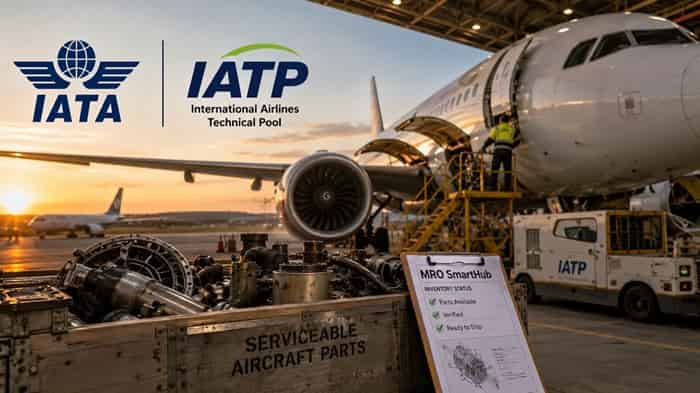
If airline engineers had a wish list in 2026, somewhere between “more aircraft” and “fewer delays” would sit one rather pressing request: please send parts.
For the past few years, carriers across the globe have found themselves caught in what can only be described as aviation’s never-ending game of hide-and-seek. The problem? Everyone’s looking for the same aircraft components, and far too often, nobody can find them.
Now, in a move likely to be warmly welcomed from Sydney to Singapore and from Dallas to Dubai, the International Air Transport Association (IATA) and the International Airlines Technical Pool (IATP) have agreed to work together to help airlines find, share and access aircraft parts more efficiently.
And frankly, it couldn’t come soon enough.
Aircraft grounded while waiting for parts have become an all-too-familiar sight at airports worldwide. For airlines already battling higher costs, delivery delays and wafer-thin margins, every idle aircraft is an expensive ornament.
Recognising the growing strain, the two organisations are combining forces to improve airlines’ visibility of available aircraft materials and expand access to shared technical resources.
Stuart Fox, IATA’s Director of Flight and Technical Operations, said the industry needed practical solutions rather than more discussion papers gathering dust on office shelves.
“Supply chain constraints continue to create operational and financial pressure for airlines. Addressing these challenges requires practical cooperation across the industry. By combining IATP’s technical pooling expertise with IATA’s technical expertise, we can help airlines access serviceable materials and strengthen maintenance resilience,” Fox said.
At the heart of the collaboration sits a simple proposition: if airlines can see where parts are and share resources more effectively, fewer aircraft will be left languishing on the ground.
IATP has been doing exactly that for decades.
Its global technical pooling network already provides member airlines with access to more than 6,600 aircraft parts across 350 stations worldwide. Members can also tap into line maintenance support at more than 900 locations, as well as worldwide aircraft recovery assistance.
In today’s supply-constrained environment, that network is proving more valuable than ever.
“For decades, IATP has enabled airlines to share critical technical resources through pooling. The validity of the IATP pool model is even more evident during the current critical situation. This cooperation with IATA recognizes that pooling and digital materials visibility are complementary tools, helping airlines access the parts and support they need to maintain operations during supply chain disruption,” said IATP CEO Giorgio Pietra.
The partnership will also shine a brighter spotlight on IATA’s upgraded MRO SmartHub platform.
Launched in 2019 and recently enhanced, the digital platform provides airlines with deeper intelligence on parts availability, shortages, usage patterns and serviceable inventory held by accredited suppliers.
Think of it as a matchmaking service for aircraft components, although admittedly with fewer awkward first dates and considerably more paperwork.
Importantly, IATA is opening the core functions of MRO SmartHub free of charge to eligible airlines participating through industry associations, including IATA, IATP and ALTA.
Fox believes wider access will strengthen operational resilience throughout the sector.
“Improving visibility of available aircraft materials is essential to helping airlines manage today’s supply chain challenges. Broader access to MRO SmartHub will help airlines identify serviceable parts more efficiently, support better materials management, and complement existing industry pooling programs,” he said.
Beyond parts sharing, both organisations have also committed to deeper cooperation on safety, quality assurance and technical best practice.
That includes greater engagement with industry programmes such as the IATA Operational Safety Audit (IOSA) and the IATA Safety Connect platform.
For airlines, the message is straightforward: collaboration is becoming less of a competitive advantage and more of a survival strategy.
Because in an industry where a missing component can sideline a multimillion-dollar aircraft, sharing may no longer simply be caring.
It may just be essential.
Airlines interested in joining the MRO SmartHub initiative can contact [email protected], while information on IATP membership is available via [email protected].
For more information, visit: https://www.iata.org or https://www.iatp.com.
By: Prae Lee – © 2026.
Read Time: 4 minutes.
Author Bio:
 You can tell a great deal about a person by how they meet a Bangkok morning. Prae Lee doesn’t charge into it; she glides, unhurried, as if time itself has agreed to behave. There is a calm assurance about her, the sort earned by knowing both your roots and your destination.
A graduate of Chulalongkorn University, she earned her business degree with quiet pride, then further honed it in Singapore and Australia. Travel didn’t change her. It refined what was already there: curiosity, discipline, grace.
Back in Bangkok, she slipped modern life into the family business, mastering social media with an instinct for listening and selling with Thai gentleness.
Prae never seeks attention, yet everything she touches grows brighter.
Now with Global Travel Media, she writes with authenticity, drawing on culture, travel and a rare, steady confidence.











