

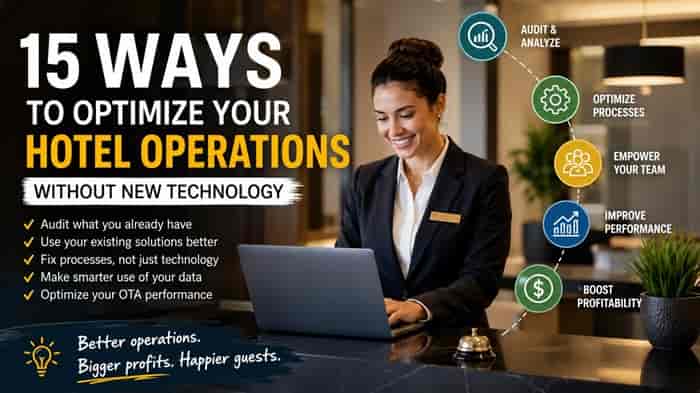
Over the years, I’ve seen many hotels invest huge budgets in new technology in the hope that it will solve an operational, marketing, or revenue challenge. Of course, having the right operational technology to support your property’s needs is fundamental to its success, but that doesn’t mean you need to buy a new solution every time you encounter a new problem. In fact, some of the biggest opportunities to improve your operations can be found by optimising your property’s tech stack, operational processes, and team’s expertise.
To find out how, I asked a group of Lobby‘s hospitality industry experts – who work with hotels every day to solve operational, commercial, and technology challenges – to share the strategies they most frequently recommend to clients looking to improve performance without adding new technology.
Audit What You Already Have
Víctor Gonzalez, CEO, MysterTech Asesores SL
“The quality of your data determines the quality of every decision your technology makes, which is why I always suggest starting with a data cleanse. Duplicate guest profiles are common in hotel systems and often lead to fragmented stay histories, reduced personalisation, and inaccurate reporting.
I also recommend reconnecting with your existing technology vendors. Features that didn’t exist when a property went live a year or two ago may now be available at no additional cost, yet many hotels never revisit their configuration after implementation.”
Alexandre Hervens, Founder, Groom Consulting
“Before investing in new technology, always review your rate architecture. Over time, hotels add new rate plans, packages, restrictions, and promotional offers to support specific business needs, resulting in an increasingly complex commercial setup which can work against your long-term profitability. The goal should be to identify and remove unnecessary complexity, improve consistency across your distribution channels, and create a stronger foundation for pricing and distribution decisions.”
Matea Šragalj, Marketing Strategist, Honest Marketing
“Before making decisions based on website or marketing performance data, make sure your analytics and conversion tracking are working correctly. I’ve worked with hotels that were investing time and budget into marketing campaigns without realising that booking engine transactions, form submissions, campaign attribution, or other key events weren’t being tracked properly. If your tracking is incomplete or inaccurate, every decision you make about marketing spend, channel performance, or website optimisation becomes less accurate and less likely to drive revenue.”
Make Better Use of Your Existing Solutions
Michael Reynolds, Founder, Distinctive Hospitality
“Many hotels already have a basic tech stack in place, but many only use a fraction of the functionality available through the solutions. Before investing in another platform, I recommend reviewing whether teams using manual processes that could be automated, whether integrations are working properly, and are there opportunities to improve staff training on features that they already have access to solve the operational problems. Finally, you should also keep the workflows, automations, and reporting processes in your solutions up to date as your business’ needs evolve to ensure you are always getting the full value from your pre-existing solutions.”
Gabriel Freire, Digital Marketing Expert
“Optimisation is about using your existing stack with more intention. When evaluating your own operation, look for repetitive tasks, duplicate data entry, and information that employees constantly need to search for; these are signs that existing tools could be configured differently to save time and improve efficiency.
Here’s an example: I once worked with a hotel that avoided investing in a CRM, SOP platform, and automation software by making better use of its existing Google Workspace tools. We created workflows to capture guest preferences, automate follow-up communications, centralise SOPs, and streamline maintenance and housekeeping requests. Today, with tools like Gemini and NotebookLM included in the ecosystem, hotels can also summarise guest feedback, draft communications, and create training materials without adding another subscription or any extra costs.”
Fix Processes, Not Just Technology
Amjad Nashashibi, Digital Hospitality Solutions
“Hotels should map how information moves across the entire guest journey, from pricing and distribution through to reservations, operations, guest communication, and reporting. This exercise often identifies bottlenecks, places where systems are not communicating effectively, and unnecessary manual workarounds that have crept into daily operations. It can also reveal blind spots where important guest, operational, or commercial information exists somewhere in the text stack, but never actually reaches the people who could actually act on it.”
Bruno Fallegger, Co-Founder & CEO, BPN Solutions
“Operational inefficiencies are often caused by the way information is shared across internal teams and disparate systems. Trace how guest information flows across your PMS, CRM, housekeeping, and messaging tools to identify where it slows down, gets duplicated, or disappears entirely. It’s also worth regularly reviewing integrations that are no longer used or maintained, as they can introduce unnecessary complexity over time.
If guest requests, maintenance issues, VIP arrivals, and operational updates require staff to constantly switch between systems or chase information across multiple systems, your operations are not as efficient as they should be. The goal should be to create a single source of operational truth where all your internal departments have access to the same, up-to-date information, whenever they need it.”
Manuel Kuckenberger, Hotel Tech Fixer
“My best tip is simple: be your own guest. Literally.
Walk through the entire guest journey, from finding the hotel online and making a booking to check-in, add-ons, guest messaging, payment, invoice, and post-stay communication. For every issue you find, ask yourself if your staff can fix this with the tools you already have. If the answer is yes, make sure they have access to vendor help sites, learning resources, support, and paid time to start using them; if not, ask yourself if that operational step is really necessary.
Then implement a new team-by-team routine: ask each department to document one recurring workaround, one broken handover, and one thing guests keep asking because the system or process does not address it clearly. Fix what is fixable. Remove what isn’t necessary.”
Optimise the Channels You Already Pay For
Jo Micklewright, Founder, Saisei
“Before adding anything new, audit what your existing OTA channels are already telling you. Booking.com, Airbnb, and Expedia all have built-in optimisation tools, content scores, visibility boosters, demand calendars, rate intelligence, and conversion benchmarks, yet many hoteliers rarely revisit their settings and metrics after the initial setup. As you are paying significant commissions to these channels, first review your OTA extranet to identify where you’re losing visibility, how your conversion rates compare to your comp set, and which recommendations your OTA partners are already providing to identify solutions to your biggest distribution challenges. Fix your listing positioning and act on the demand signals that are right in front of you.”
Craig Webb, Director, Webb Marketing Services Ltd.
“Many hotels spend considerable time trying to grow social media engagement while overlooking a free platform that can have a direct impact on discoverability and bookings: Google Business Profile (GBP). By posting regularly, you are signalling that your business is active and relevant, so you will be surfaced more prominently in map search results. Using GBP can also increase your visibility in AI search results when travellers are searching for hotels for their next trip. Replying to every review within 24 hours, whether positive or negative, is very important because Google considers replies to be fresh content and, as a result, will boost your visibility.
The goal is to post once a week, rotating between a guest story, a local recommendation, a seasonal offer, and a reminder for satisfied guests to leave a review.”
Put Your Data to Work
Sarah Stahl, Co-Founder & CMO, Market Movers LLC
“Most hotels’ PMS, website analytics, email platform, social channels, and guest communication tools are often already holding the answers to operational challenges, but the data is disconnected, mislabeled, or ignored. The best way to address this is by creating a weekly “reality check” using the solutions you already have in place. Look at where bookings are coming from, where guests are dropping out of the booking journey, what questions they ask before they book, what content they engage with, and which past guests are most likely to return. Then use that data to make one operational or marketing fix each week.”
Emily Johnson, Founder & CEO, Elevate Hospitality Collective
“Many hotels focus heavily on ADR but don’t fully connect the systems that track how guests spend across the rest of the property. By bringing together data from accommodation, food and beverage, wellness, retail, and other revenue-generating outlets, hotels can start measuring total guest value rather than room revenue alone. It provides a much clearer picture of guest behaviour and where additional revenue opportunities exist.
One of the easiest places to put those insights into action is through pre-arrival communications. Most hotels already have automated emails in place, but many aren’t using them to gather guest preferences, promote upgrades, or encourage wellness and ancillary bookings before arrival.”
Mikhail Volodin, Hotel Tech & OTA Specialist
“When an AI gets a visual answer wrong, you spot it instantly. When an automated system quietly miscalculates a number, you don’t. And those numbers are the basis for every operational decision you make, including pricing, marketing, staffing, strategy, etc. That’s why I encourage hoteliers to challenge the assumption that a polished dashboard automatically means accurate data.
Cross-check key metrics across systems, periodically validate reports against raw data, and pay attention to spreadsheets, messaging groups, and workarounds that emerge outside official processes. They’re often telling you something important about inefficiencies in the operation that can be improved.”
Bring Technology Into Business Decisions
Ishan Gangakhedkar, Founder & CEO, Strategy Cues
“Many operators don’t realise how much flexibility already exists within the systems they already use. Pricing controls, length-of-stay restrictions, discount structures, cancellation policies, and automation settings can often be adjusted to respond to changing market conditions without introducing new technology. When demand shifts, occupancy softens, or booking patterns change, the first answer should always be to see if you can make better use of the controls you already have in your pre-existing solutions.”
Juan Pablo Esquivel, Senior Operations and Project Management Specialist
“I encourage hotel leaders to consider their IT teams as strategic partners, rather than simply technical support. Too often, IT is only consulted after a problem has already been identified or a purchasing decision has already been made. When IT is proactively involved in operational discussions and business planning, they can identify opportunities to reduce manual work, improve system integrations, eliminate duplicate processes, make better use of pre-existing technology, and avoid unnecessary technology investments.”
By: Benjamin Verot, Founder of HotelMinder – © 2026.
Read Time: 6 minutes.











