

Airlines have spent decades searching for a magic formula.
Not the one that keeps aircraft in the air. They’ve largely mastered that.
The elusive prize has always been something far more difficult: keeping passengers happy while simultaneously reducing costs, increasing revenue, improving efficiency and somehow convincing shareholders that all of this can be achieved before next quarter’s earnings call.
Now, according to a major new report from Amadeus, that long search may be entering an entirely new chapter.
And no, this isn’t another round of technology executives promising that artificial intelligence will solve everything short of finding your lost luggage in Terminal 3.
This time, the aviation industry appears genuinely interested.
The report, produced by Amadeus with support from Microsoft, suggests airlines are approaching what might politely be called a tipping point and what less polite executives might call a “move now or get left behind” moment.
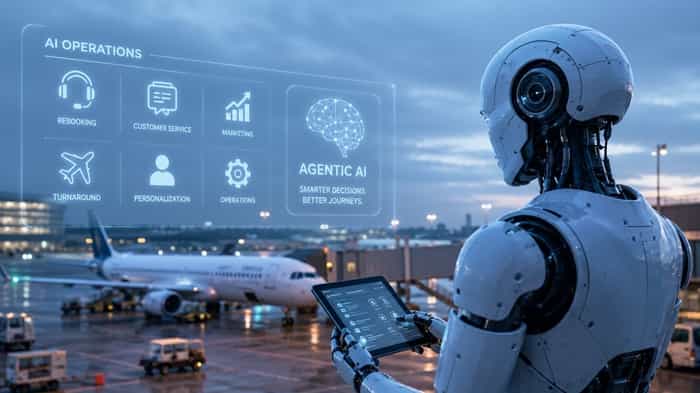
The focus is on agentic AI, a term currently enjoying celebrity status in boardrooms around the world.
Strip away the fashionable terminology, and the concept is surprisingly straightforward.
Instead of waiting to be told what to do, AI agents can analyse information, make decisions and complete tasks on their own.
For airlines, that could change almost everything.
Think about the last time severe weather swept through a major airport.
Flights were cancelled.
Call centres exploded.
Passengers spent hours staring at departure boards while hold music became the soundtrack of their misery.
According to Amadeus, AI agents can already identify a booking, understand a traveller’s spoken request, search alternatives, explain fare differences and process payment during a natural voice conversation.
In plain English, the machine can rebook your flight while you’re still trying to remember where you left your passport.
More importantly, it can do it for thousands of passengers simultaneously.
For airlines, that’s not just innovation.
That’s survival.
Every major disruption creates a race against time. Customers want answers immediately. Airlines need solutions at scale.
Historically, those two requirements have not always enjoyed a happy marriage.
The report suggests that the relationship may finally be improving.
The opportunities extend well beyond customer service.
Airlines have become extraordinarily sophisticated retailers over the past decade.
They no longer simply sell seats.
They sell bags, meals, upgrades, lounge access, Wi-Fi, carbon offsets and increasingly personalised experiences.
Agentic AI promises to become the ultimate salesperson.
Imagine a digital assistant that understands a traveller’s preferences, builds an itinerary, recommends ancillary products and manages the booking from start to finish.
That future is no longer theoretical.
It is rapidly moving into commercial reality.
Marketing departments may also find themselves gaining a very intelligent new colleague.
One of the use cases highlighted by the report involves AI agents identifying weak-performing routes, designing campaigns, creating advertising content, allocating budgets and measuring results.
That’s enough work to keep an entire marketing team busy for weeks.
The AI does it in hours.
Perhaps the most intriguing development is occurring behind the scenes.
While passengers notice check-in queues and delayed departures, airline executives obsess over something else entirely: aircraft turnaround times.
Every minute a plane sits on the ground costs money.
Every unnecessary delay ripples through an airline’s network.
The report outlines how multiple AI agents can coordinate information from maintenance teams, flight crews, refuelling operations and ground handlers to build an integrated operational picture.
It’s the aviation equivalent of having a thousand-piece jigsaw puzzle that suddenly starts assembling itself.
Not surprisingly, airlines including Icelandair and Southwest Airlines are already exploring how AI-assisted decision-making can improve planning and operational performance.
The potential rewards are significant.
So are the risks.
Amadeus is careful not to present AI as some miraculous cure-all.
In fact, one of the report’s strongest messages is refreshingly old-fashioned.
Good data matters.
A lot.
No matter how clever the algorithm, poor-quality information will still produce poor-quality outcomes.
Technology may be evolving at breathtaking speed, but the old principle remains stubbornly true: rubbish in, rubbish out.
The report, therefore, urges airlines to strengthen data foundations before chasing ambitious AI projects.
That advice may lack the glamour of futuristic demonstrations, but it is likely to be far more valuable.
Cyril Tetaz, Executive Vice President Airline Solutions at Amadeus, believes the impact will eventually reach almost every corner of the airline business.
“We expect agentic AI to improve almost every airline workflow, from network planning to customer service. And for Amadeus, I see great opportunities for AI to reinforce our applications and introduce new capabilities. Also, as a trusted system-of-record in travel, we facilitate travel industry connectivity and orchestration at scale, and this new technology will help us accelerate progress toward a smoother, more connected journey.”
Microsoft shares that optimism.
Julie Shainock, Global Managing Director for Travel, Transport and Logistics at Microsoft, says the next 18 months will be decisive.
“2026 will be a defining year for agentic AI in aviation. Over the next 18 months, most airlines will move from exploration to real-world deployment embedding agents across the traveller journey and core operations”.
That prediction may prove conservative.
Airlines have historically adopted new technology more cautiously than Silicon Valley would like.
Yet competitive pressure is changing the equation.
When one airline improves customer response times, increases efficiency and delivers better personalisation, rivals rarely sit still.
The industry tends to move together.
Slowly at first.
Then all at once.
For travel advisors, travellers and airline executives alike, the message emerging from the Amadeus report is clear.
The conversation is no longer about whether AI belongs in aviation.
That argument is effectively over.
The real question is which airlines will learn to use it best.
Because while aircraft still require pilots, the next generation of airline decision-making may increasingly have a digital co-pilot sitting quietly in the cockpit.
And unlike some human colleagues, this one never asks for annual leave.
Download the report: Airlines in the Agentic Age: Use Cases and Ideas for Getting Started with AI.
By: Michelle Warner – © 2026.
Read Time: 6 minutes.
About the Author.
 Michelle Warner has always carried stories the way others carry passports lightly, faithfully, and with purpose. She learned her craft in newsrooms, shaping sentences with care, before swapping deadlines for departures as a flight attendant with some of the world’s great airlines. Years aloft sharpened her eye for character and deepened her fondness for the small, dignified rituals of travel, the quiet kindness of strangers, the poetry of arrival, the patience learned between time zones.
Now grounded by choice, Michelle has come home to writing with the same calm authority she once brought to turbulent cabins. Her prose blends an editor’s discipline with a traveller’s wonder, tinged with humour and reverence for the golden age of travel. Each piece feels like a handwritten boarding pass, gracious, observant, and unmistakably alive.











