


There are few topics guaranteed to fill a room with corporate travel professionals faster than a discussion about airline distribution.
Mention NDC, servicing challenges and changing booking channels, and suddenly, everyone has an opinion, usually delivered with the enthusiasm of someone who’s spent three hours trying to fix a ticket exchange on a Friday afternoon.
So it was no surprise that the Association of Travel Management Companies (ATMC) attracted strong industry interest when it partnered with Qantas to host a corporate travel forum at the airline’s Mascot headquarters last week.
The gathering brought together travel management companies, corporate travel buyers and senior Qantas executives for a refreshingly candid conversation about some of the issues currently keeping travel managers awake at night.
And, to Qantas’ credit, there was no shortage of senior leadership in the room.
Representatives, including Kathryn Robertson, Alexandra O’Connor, Peter Ross, Renee Brooks and other airline leaders, fronted attendees to discuss servicing priorities, distribution strategy and the future direction of New Distribution Capability (NDC), the technology framework that continues to reshape how airlines sell and service their products.
For an industry that has occasionally felt like it was receiving major distribution updates via carrier announcements and industry gossip in equal measure, the forum represented something valuable: direct access.
That matters.
While airlines see NDC as the future of modern retailing, agencies are often more concerned about what happens after the booking is made.
The industry’s favourite question remains remarkably simple.
“Who fixes it when something goes wrong?”
Whether it’s schedule changes, ticket exchanges, disruptions or traveller support, servicing remains the issue that consistently rises to the top whenever agencies discuss the future of airline distribution.
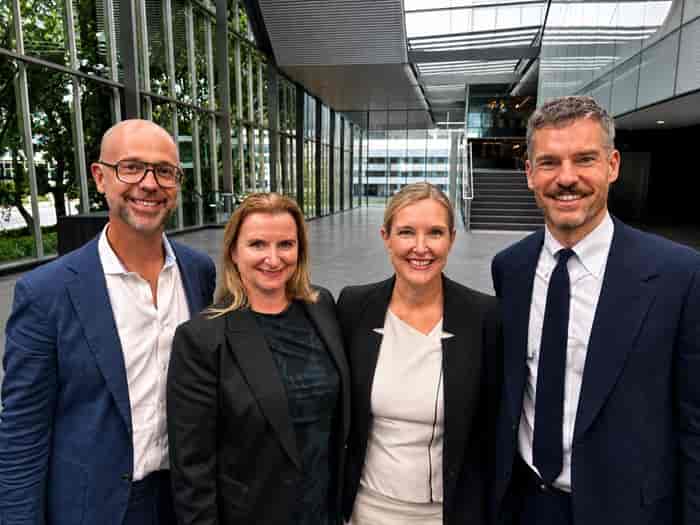
David Goldman, ATMC Chairperson; Kellie Stanbury, ATMC Board Member; Alexandra O’Connor, Qantas Head of Sales Channels, and Peter Ross, Qantas Agency Partnerships – Corporate, at the Qantas Campus in Mascot.
The encouraging takeaway from the Mascot forum was that these concerns were not avoided.
Instead, attendees were given greater visibility into Qantas’ thinking, including a clearer view of the carrier’s NDC roadmap and the practical steps being taken as adoption expands.
One of the forum’s most significant announcements was the creation of a new advisory council that will include representation from both travel management companies and leisure agencies.
The move provides the industry with a formal consultation mechanism and creates a pathway for feedback to flow directly into future planning and decision-making.
In travel industry terms, that is considerably more useful than shouting into the void.
ATMC Chairperson David Goldman welcomed the development and said the forum highlighted the importance of collaboration during a period of significant change.
“The corporate travel sector is navigating significant change, particularly around servicing, distribution and technology, and forums like this are critical in ensuring our members have clarity, visibility and a seat at the table,” Goldman said.
“We were particularly encouraged by Qantas’ commitment to greater transparency around its NDC roadmap and the establishment of an industry advisory council, which reinforces the importance of collaboration in shaping better outcomes for the travel ecosystem.”
His comments reflect a broader mood across the sector.
Few industry participants dispute that change is coming.
The debate has largely shifted from whether NDC will become mainstream to how quickly it will happen and how smoothly agencies, technology providers and airlines can navigate the transition together.
That distinction is important.
Travel buyers care about traveller outcomes.
Travel management companies care about efficiency and service.
Airlines care about modern retailing, product differentiation and customer engagement.
The challenge, as always, lies in ensuring those priorities align.
Forums such as this won’t solve every problem overnight.
No one left Mascot believing the industry’s distribution debates had suddenly disappeared.
But there was a noticeable sense that progress is easier when conversations happen face-to-face rather than through press releases, conference presentations or LinkedIn comment sections.
The Australian corporate travel sector has spent the past few years rebuilding, reinventing and adapting to constant change.
Technology continues to evolve. Traveller expectations continue to rise. Distribution models continue to shift.
Against that backdrop, the willingness of industry stakeholders to sit down together, ask difficult questions and listen to the answers may prove just as important as the technology itself.
While NDC is changing how travel is sold, collaboration remains what keeps the industry moving.
And judging by the discussions at Mascot last week, there is finally a growing appetite to make sure both travel together.
By Bridget Gomez – © 2026.
Read Time: 4 Minutes.
About the Author.
 Bridget has never been built for stillness. Of Portuguese heritage, she began as a nurse, tending veterans at the Repatriation Hospital, listening to stories as colourful as the life she was yet to live. It was worthy, steady work, but wanderlust, as always, proved louder than routine.
So, she traded starch for a backpack and disappeared for a year, chasing trains, sunsets and the occasional regrettable glass of wine. She wrote everything down: the dust, the laughter, the missteps, the magic. Those notebooks became a travel blog, then a habit, then a calling.
Eventually, she found Global Travel Media, or perhaps it found her.
Today Bridget writes with heart, humour and a dash of mischief, still travelling, just now with words.











