

For decades, airline disruption has been aviation’s equivalent of bad weather at a backyard barbecue: everyone knows it’s coming, nobody wants it, and somebody always ends up paying for the mess.
Now, aviation technology giant SITA believes it has found a way to turn one of the industry’s most stubborn headaches into a major competitive advantage.
The company has acquired Big Blue Analytics, the developer behind OCC Assistant Manager (OCCam), a sophisticated AI-enabled disruption optimisation platform that has already proven its worth inside live airline operations. The move positions SITA to roll out the technology globally, giving airlines access to a system capable of reducing disruption costs by up to 30 per cent.
In an industry where every delayed departure, misplaced crew member and disrupted passenger itinerary carries a financial consequence, that figure is enough to make airline chief executives sit up straighter in their boardroom chairs.
Disruption remains one of aviation’s most expensive unresolved challenges. Industry-wide, airlines lose tens of billions of dollars every year managing irregular operations caused by weather events, technical faults, staffing issues, airspace congestion and a growing list of operational complexities.
For a mid-sized airline operating slightly more than 100 aircraft, those costs can climb to between US$70 million and US$80 million annually.
Trim that by 25 to 30 per cent and suddenly airlines are talking about savings worth US$20 million to US$30 million every year.
That is precisely the opportunity SITA believes OCCam delivers.
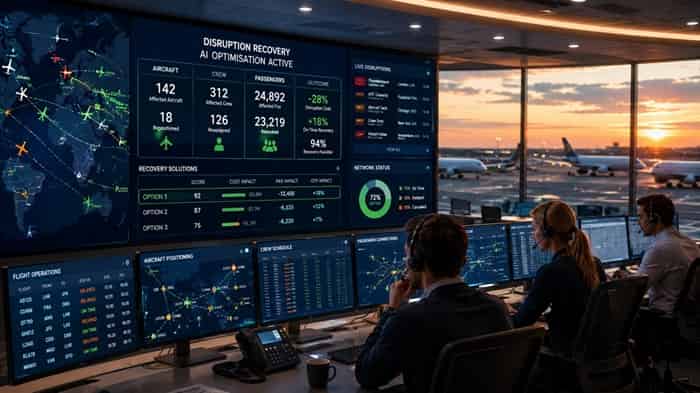
Unlike traditional disruption-management systems, which tackle operational challenges sequentially, OCCam evaluates all moving parts simultaneously. Aircraft availability, crew legality, passenger itineraries, maintenance requirements and operational priorities are assessed together before the platform generates a ranked recovery plan within minutes.
The result is faster decision-making, fewer cascading operational problems and greater confidence for operations control teams facing real-time pressure.
As anyone who has spent time inside an airline operations centre knows, disruption rarely arrives politely. One delayed aircraft can trigger a domino effect that ripples through an entire network. Controllers are often forced to make rapid decisions with incomplete information while balancing competing priorities.
Most existing systems address problems one step at a time.
First comes the aircraft assignment.
Then the crew.
Then the passenger rebooking exercise.
By the time each stage is completed, circumstances have often changed again.
OCCam approaches the challenge differently.
Its AI engine assesses every operational variable simultaneously, delivering recovery options that consider cost, compliance, passenger impact and schedule performance in a single decision framework.
Just as importantly, the platform measures outcomes.
Every decision and operational adjustment is tracked, allowing airlines to quantify financial savings, assess performance improvements and demonstrate return on investment with hard data rather than educated guesswork.
According to SITA Chief Executive Officer David Lavorel, the industry has reached a point where disruption can no longer be viewed as simply another unavoidable operating expense.
“Airlines have traditionally treated disruption as a fixed cost of doing business, but there is a clear opportunity to approach it differently. In an increasingly volatile and fast-moving environment, the ability to recover with the same agility becomes critical. The airlines that act on this first will recover faster, fly more, and protect more revenue than those that wait, and AI-enabled tools like OCCam are making that possible,” said Lavorel.
The acquisition is not a leap into unfamiliar territory for SITA.
The company already provides operational technologies to more than 100 airline Operations Control Centres globally through solutions such as Mission Watch, helping carriers monitor network performance and operational efficiency.
SITA has also demonstrated its ability to scale artificial intelligence products across global aviation markets of successfully deploying OptiFlight, a solution designed to improve fuel efficiency and operational performance.
The OCCam acquisition builds upon that momentum.
More significantly, it provides the foundation for what SITA describes as a future Intelligent Operations Control Centre, a next-generation environment in which planning, monitoring, disruption management, and recovery operate as a single, integrated ecosystem.
Yann Cabaret, CEO of SITA for Aircraft, believes the acquisition marks the beginning of a much broader transformation across airline operations.
“This is the first step towards a much bigger Intelligent Operations Control Center vision, one where planning, monitoring, and recovery come together in a single system. AI allows us to handle multiple constraints at once and tailor decisions to each airline in a way that was not possible before,” said Cabaret.
The long-term vision extends beyond disruption recovery.
SITA is already developing advanced AI capabilities incorporating large language models and agent-based systems. Combined with OCCam’s optimisation engine, future systems could predict disruptions before they occur, automate routine recovery processes and simplify interactions between operational staff and highly complex airline networks.
For Big Blue Analytics founder Pau Collellmir, the partnership opens the door to broader adoption of technology that has already demonstrated measurable operational value.
“With SITA, we can take what we have built further. Reaching more airlines, faster, and turning advanced optimization into practical tools that help operations teams work smarter every day,” said Collellmir.
As airlines face growing operational complexity, rising passenger expectations and relentless pressure to improve profitability, artificial intelligence is rapidly shifting from an experimental curiosity to a boardroom priority.
For SITA, the acquisition is more than a technology purchase.
It is a strategic wager that the future of airline operations will belong not to those who avoid disruption but to those who recover from it faster than others.
And in aviation, where minutes matter, and margins remain notoriously thin, that may have turned out to be an intelligent bet indeed.
By Michelle Warner – © 2026.
Read Time: 4 Minutes.
About the Author.
 Michelle Warner has always carried stories the way others carry passports lightly, faithfully, and with purpose. She learned her craft in newsrooms, shaping sentences with care, before swapping deadlines for departures as a flight attendant with some of the world’s great airlines. Years aloft sharpened her eye for character and deepened her fondness for the small, dignified rituals of travel, the quiet kindness of strangers, the poetry of arrival, the patience learned between time zones.
Now grounded by choice, Michelle has come home to writing with the same calm authority she once brought to turbulent cabins. Her prose blends an editor’s discipline with a traveller’s wonder, tinged with humour and reverence for the golden age of travel. Each piece feels like a handwritten boarding pass, gracious, observant, and unmistakably alive.











