The world’s travellers haven’t stopped travelling.
They’re simply becoming far more ruthless about where they’ll spend their holiday dollars.
A fresh survey from Global Rescue has revealed a striking shift in travel behaviour for 2026, with travellers increasingly crossing destinations off their wish lists as conflict, political instability and security concerns dominate headlines and dinner-table conversations alike.
The findings paint a fascinating picture of a travel industry entering a new era in which destination appeal is no longer measured solely by beaches, bucket-list attractions, or bargain airfares. Safety has become the silent travel influencer sitting at the head of the table.
And for some destinations, that influencer is proving brutally persuasive.
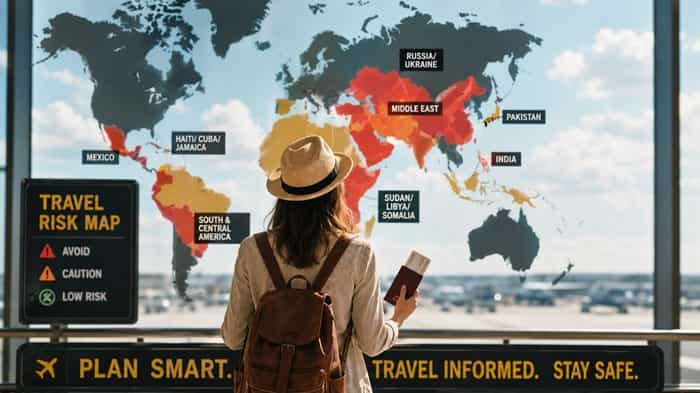
According to the Global Rescue Spring 2026 Traveller Sentiment and Safety Survey, nearly three-quarters of international travellers are actively avoiding countries in the Middle East situated near the ongoing tensions involving Israel, Syria and Iran.
Pakistan remains firmly in travellers’ crosshairs, while large swathes of Africa continue to suffer from the unfortunate reality that proximity to trouble can be almost as damaging as trouble itself. Nations near flashpoints such as Sudan, Libya and Somalia are finding themselves on the wrong side of holiday planning, regardless of whether tourists ever intended to venture anywhere near the conflict.
Meanwhile, countries situated near the Russia-Ukraine conflict continue to feel the ripple effects of geopolitical uncertainty, despite being hundreds of kilometres removed from active fighting.
For travel advisors, the findings confirm what many have already been hearing from clients.
The questions have changed.
Travellers are no longer asking only, “What’s the weather like?” or “How much does it cost?”
Increasingly, they’re asking: “Is it safe?”
And they’re asking it before they’ve even looked at a brochure.
Dan Richards, CEO of The Global Rescue Companies, said the survey highlights a growing sophistication among modern travellers.
“These results indicate that travellers are not retreating from international travel; they’re becoming more selective and risk-aware. Active conflicts and geopolitical instability are directly influencing where people are willing to go.”
The keyword is selective.
This isn’t a retreat from global tourism. It is a recalibration.
Travellers are still eager to explore the world. They simply have less appetite for uncertainty.
That presents a challenge for destinations battling negative perceptions, even when the reality on the ground may be far more nuanced.
Tourism has always been vulnerable to headlines. In today’s hyper-connected world, a single image, social media post or breaking news alert can undo years of destination marketing in a matter of hours.
Some destinations are discovering that reality the hard way.
The survey found that approximately one-third of respondents are avoiding Mexico, while almost the same proportion are steering clear of parts of Central and South America linked in travellers’ minds with security concerns.
Several Caribbean destinations are also feeling the impact of perception-driven decision-making.
India, one of the world’s fastest-growing tourism powerhouses, appears on the avoidance list of one in five respondents.
By contrast, Australia and New Zealand remain among the safest bets in global tourism.
Fewer than two per cent of travellers surveyed said they would avoid visiting either destination.
For tourism operators on this side of the Tasman, that’s the sort of statistic that deserves framing.
It reinforces what international visitors have long believed: Australia and New Zealand continue to enjoy one of the strongest safety reputations anywhere in the world.
Perhaps the most intriguing aspect of the survey, however, lies in the differences between men and women.
Female travellers consistently reported higher levels of caution than their male counterparts across almost every geopolitical hotspot measured.
Women were significantly more likely to avoid destinations affected by conflict or instability, particularly in the Middle East, Eastern Europe and parts of Latin America.
Richards believes the findings align with broader behavioural trends.
“Women are demonstrating heightened sensitivity to geopolitical and regional instability, particularly where conflicts are active or evolving. That aligns with broader trends in risk perception and travel planning behaviour.”
The results won’t surprise many travel consultants.
Female travellers, whether travelling solo, with family or in groups, have increasingly become some of the most diligent consumers of destination safety information.
Travel planning is no longer just about inspiration.
It’s also about reassurance.
The survey uncovered another fascinating divide: geography itself appears to shape risk perception.
Americans and non-Americans often see the world through very different lenses.
US-based respondents were significantly more likely to avoid Mexico, Pakistan, India and several African nations.
Yet the biggest surprise emerged when participants were asked about the United States itself.
Almost one-third of non-US respondents indicated they would avoid travelling to America.
Among Americans, that figure was effectively zero.
That dramatic gap reveals how familiarity shapes confidence.
What feels normal to one traveller can feel uncertain to another.
Richards summed it up neatly.
“This is a clear example of how risk perception is shaped by perspective and proximity. What feels familiar to one group may feel uncertain or risky to another.”
For the travel industry, an important lesson is hidden within the data.
The winners in tourism over the next decade may not necessarily be the destinations spending the most money on marketing.
They may be the destinations that do the best job communicating safety, stability and trust.
Traveller confidence has become a currency in its own right.
And unlike exchange rates, confidence can take years to build and mere moments to lose.
The industry’s challenge now is not convincing people to travel.
That battle has largely been won.
The challenge is convincing travellers where they should travel.
In 2026, that decision will increasingly start with risk.
Everything else comes afterwards.
For further information, visit Global Rescue: https://www.globalrescue.com.
By Jason Smith – © 2026.
Read Time: 5 Minutes.
About the Author.
 Jason Smith didn’t learn travel from textbooks. He learned it in airports, taxis and hotel lobbies, watching the business unfold long before he played his own part. Half American, half Asian, he grew up around the quiet workings of tourism, where people come and go, and stories rarely stand still.
Bangkok came first, then formal study, then a career that carried him through Singapore, Malaysia and Vietnam. Each place left something behind. In the end, Thailand felt like home, and I took on a senior role in hotel sales.
Then everything stopped. Borders shut, planes grounded, and Jason found himself back in America with time to reflect.
Now at Global Travel Media, he writes travel as it really is, not polished, not perfect, but human, and all the better for it.