

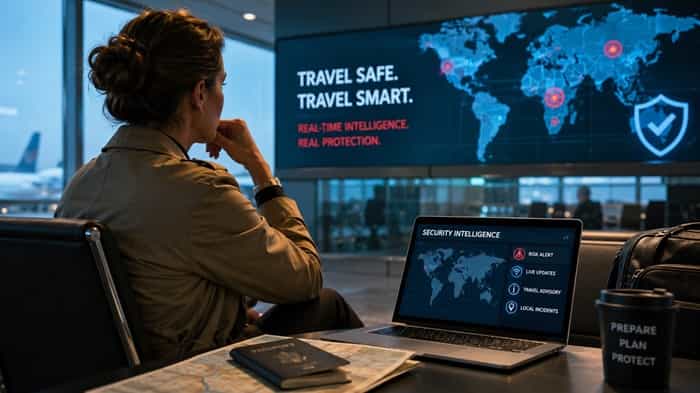
There was a time when “travel security” meant keeping your passport dry, your wallet close, and perhaps steering clear of dimly lit alleyways after midnight. Sensible, yes. Sophisticated? Not quite.
Today’s traveller, it seems, has moved on.
According to fresh data from the Global Rescue Spring 2026 Traveller Sentiment and Safety Survey, the modern international traveller is no longer content with advice and a reassuring smile. They want something far more concrete, something that can pull them out when things go sideways.
And they’re quite prepared to pay for it.
From Peace of Mind to Extraction on Demand
A hefty 77 per cent of respondents now rate security extraction services as important when travelling abroad, with 44 per cent going a step further and calling them “very important”.
That’s not a marginal shift. That’s a redefinition of expectations.
As Dan Richards of Global Rescue put it, “Extraction is no longer viewed as an extreme or niche capability; it’s becoming a baseline expectation for serious international travellers.”
In plain English, travellers no longer want a phone number to call; they want a plan that actually works.
Women Are Reading the Room Louder Than Most
The survey reveals a noticeable divide in how risk is perceived, and it’s women who are setting the tone.
More than half (53 per cent) of female respondents rate extraction services as “very important”, compared to 38 per cent of men. That’s not just a statistical quirk, it’s a signal.
Women, quite sensibly, are assessing the world as it is, not as brochures would prefer it. The industry might consider catching up.
Curiously, that same group also shows a split personality when it comes to reassurance. While more likely to value real-time intelligence, women are also more likely to say it won’t necessarily sway them. In other words, they want the information, but they’ll still make up their own minds.
A refreshing bit of independence, one might say.
Geography Shapes Nerves
There’s also a subtle but telling difference between US and non-US travellers.
Half of those based outside the United States (50 per cent) consider extraction services “very important”, compared to 43 per cent of US respondents.
It’s not a dramatic gulf, but it suggests that travellers operating beyond the relative comfort of the American bubble may have a sharper sense of how unpredictable international travel can be.
Experience, as ever, is the best teacher.
Intelligence Is the New Travel Companion
If extraction is the safety net, real-time intelligence is the advanced warning system.
More than 81 per cent of respondents say access to live security information would make them more willing to travel to foreign or remote destinations. Over half (54 per cent) say they would be very likely or entirely willing to travel with that intelligence in hand.
That’s not just helpful; that’s enabling.
It’s also telling that travellers aren’t simply looking for guidance, they’re looking for clarity. They want to know what’s happening, where it’s happening, and whether it’s likely to affect them before they’ve even finished their morning coffee.
When Trouble Hits, Advice Won’t Cut It
When asked what matters most in a crisis, travellers were blunt.
Physical extraction in response to a direct threat topped the list at 62 per cent, comfortably ahead of every other service.
Support for kidnapping, extortion, and violent crime followed at 47 per cent, with expert-led incident response at 41 per cent. Advisory services, meanwhile, trailed behind at 33 per cent.
It’s a neat little hierarchy of priorities: act first, explain later.
Training and preparedness? Useful, no doubt, but clearly not what keeps travellers awake at night.
Risk Is About Where, Not Who
Perhaps the most grounded insight from the survey is what actually prompts travellers to seek security services in the first place.
Top of the list: heading somewhere considered high-risk (31 per cent). Among non-US travellers, that figure rises to 36 per cent.
Other triggers include spikes in threats against foreigners (20 per cent) and destinations with patchy emergency infrastructure (17 per cent).
In short, travellers aren’t acting out of paranoia. They’re responding to context.
Or, as Richards neatly summarised, it’s less about who you are and more about where you’re going and what’s unfolding when you get there.
The Industry’s Quiet Turning Point
All of this is translating into action. Global Rescue reports a 30 per cent jump in security memberships compared to the same period last year.
That’s not noise. That’s momentum.
For the travel industry, the message is straightforward: safety is no longer a footnote. It’s part of the product.
Travellers are still chasing sunsets, culture, and a decent glass of something local, but they’re doing so with a sharper eye and a stronger preference for backup plans that actually work.
And frankly, you can’t blame them.
For more information, visit Global Rescue.












