

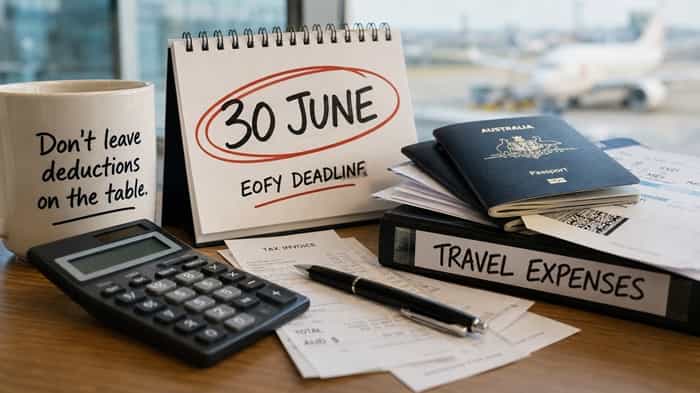
There’s always a moment, sometime in mid-June, when the optimism of the Federal Budget gives way to the reality of receipts.
It usually arrives quietly somewhere between a missing taxi docket and a corporate card statement that doesn’t quite add up. This year, that moment is landing earlier, and with a little more bite.
The 2026–27 Federal Budget has been widely pitched as a win for workers. Tax cuts are coming. A tidy $1,000 instant deduction is on the horizon. Canberra, in short, has done its bit.
But for businesses, particularly those that live on planes, in hotels, and somewhere between airport lounges, there’s a different story unfolding.
And it’s not nearly as forgiving.
Relief in theory, pressure in practice
The numbers look reassuring enough. The 16 per cent tax rate will fall to 15 per cent from July 2026, then to 14 per cent the year after. For millions of Australians, that’s real money back in the pocket.
Business incentives have also been given a nudge, R&D sweeteners, venture capital support, and a reworked loss carry-back regime.
Yet none of that alters the stubborn reality facing companies that rely on travel: it’s getting more expensive to move.
Fuel prices, still tethered to global tensions, particularly the Iran-linked oil disruptions, remain volatile. The government’s temporary 26.3 cents-per-litre excise cut is welcome, but it’s hardly a long-term solution.
Throw in inflation that refuses to behave and the ever-watchful eye of the Reserve Bank, and the cost base for business travel starts to look less like a line item and more like a pressure point.
The expense nobody quite gets right
If there’s one thing tax professionals agree on, usually with a sigh, it’s that travel expenses are consistently underclaimed.
Not exaggerated. Not abused. Simply… missed.
Matt Atkinson, General Manager at Moneywise Australia, has seen it often enough to call it a pattern rather than an exception.
“Incidental expenses that were never captured, GST credits that went unrecorded, client entertainment that wasn’t correctly categorised for FBT, they’re small on their own, but together they’re significant,” he said.
It’s the sort of leakage that doesn’t trigger alarms but quietly erodes margins.
Flights, hotels, meals, and ground transport are all legitimate deductions when tied to genuine business travel. GST credits apply. The rules are clear enough.
The problem, as always, is proof.
The Australian Taxation Office expects documentation: receipts, dates, and purpose. Miss any one of those, and what looked like a perfectly reasonable claim begins to unravel.
June: the great reconstruction
In theory, expense management is a year-round discipline.
In practice, many businesses treat June as a forensic exercise, rebuilding months of travel activity from whatever records they can find.
Tom Walley, Global Managing Director at Corporate Traveller, doesn’t sugar-coat it.
“The businesses that avoid the end-of-year scramble are the ones capturing expenses as they happen, not trying to piece them together in June,” he said.
It’s hardly revolutionary advice, but it’s remarkable how often it’s ignored.
The essentials, as EOFY approaches, are almost painfully familiar:
- Reconcile every outstanding travel expense
- Match receipts to corporate card transactions
- Identify FBT exposure, particularly around client entertainment
- Apply consistent exchange rates to international spend
- Get all expense reports finalised before the books close
Simple. Necessary. Frequently left too late.
The July habit that separates good from great
If June exposes the gaps, July offers a chance to close them properly.
Moneywise is urging businesses to treat the new financial year not as a theoretical reset, but in practice.
Start with travel policies. Many haven’t kept pace with rising costs. Accommodation caps and meal allowances set in calmer economic times now sit awkwardly below reality. Aligning them with the ATO’s current guidance isn’t optional; it’s overdue.
Then there’s the question of control.
Decentralised booking staff making arrangements wherever it suits creates fragmented data, inconsistent pricing, and, inevitably, reconciliation headaches. Centralised systems, particularly those that tie payment directly to reporting, bring order to what is otherwise a scattered process.
Finally, integration.
When travel expenses are managed outside accounting platforms like Xero or MYOB, finance teams are left to bridge the gap manually. It’s slow, error-prone, and entirely avoidable.
Modern systems don’t just record spend, they connect it automatically.
A quiet reckoning
There’s a temptation to view the Federal Budget as the main event. In truth, it’s what follows that tends to matter more.
This year, the message is clear enough.
Yes, there is tax relief. Yes, there are incentives.
But for businesses that travel, and that’s most of them in one way or another, the real work sits in the weeks leading up to 30 June.
Get it right, and there’s money to be recovered, margins to be protected, and fewer headaches come audit time.
Get it wrong, and those missing receipts won’t just be an inconvenience.
They’ll be expensive.
by May Parclay – (c) 2026.
Read Time: 5 minutes.
About the Author.
 May Marclay’s career hasn’t followed a straight line, and she’s better for it. She began in real estate, then moved into hospitality, finding her rhythm with Centara in the Maldives. There, she worked the Asian markets the old-fashioned way: building trust, closing deals, and turning conversations into lasting business.
The UAE sharpened its focus. At IHG, supporting an Area General Manager, she saw the machinery of a major travel hub from the inside, no gloss, just how things actually get done.
Now, with her sights set on healthcare, May brings a broader lens than most. She speaks three languages, reads widely, travels with intent, and writes with the calm assurance of someone who understands both the detail and the bigger picture without needing to say so too loudly.











