

For years, the digital marketing trade has dined out on a simple promise: climb the Google rankings and the rest will take care of itself. It was never entirely true, but it was comfortable. Predictable. Measurable.
Now, it looks increasingly like yesterday’s thinking.
Bangkok-based agency Primal has thrown a rather large stone into that pond with its ElevateSEO™ model, an approach that assumes the real gatekeepers are no longer just search engines but the artificial intelligence systems quietly shaping decision-making.
And if the early numbers are anything to go by, the theory has legs.
Working with a newly launched international medical website is hardly a forgiving arena. Primal reports a 1,037 per cent jump in conversions and a 207 per cent rise in organic traffic in just 90 days. In an industry often described as a “red ocean”, where competition is dense and patience thinner still, that’s not incremental improvement. That’s a step change.
More intriguing is where the revenue is being attributed. According to the agency, individual transactions exceeding 500,000 THB were driven via AI platforms such as ChatGPT. In other words, customers aren’t just searching, they’re asking, comparing, and deciding with AI sitting at the table.
That shift matters.
Primal’s CEO Mark McDowell doesn’t bother dressing it up. “In an era where AI has become a primary decision-making assistant for humans, traditional SEO, which focuses solely on Google rankings, is no longer sufficient,” he says. “Brands must now establish ‘Digital Authority’ robust enough for AI systems to trust and recommend them.”
Strip away the jargon, and the message is straightforward: it’s no longer about being found; it’s about being believed.
The agency’s answer is what it calls “Search Everywhere Optimisation,” a strategy designed to ensure a brand shows up consistently, credibly and convincingly across the expanding web of AI-driven discovery points.
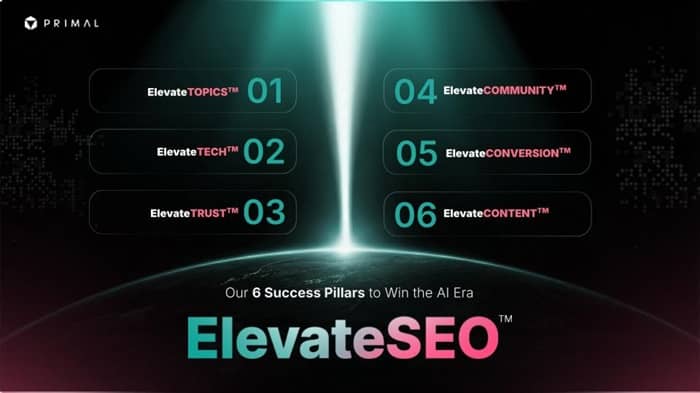
To do that, ElevateSEO™ leans on six pillars. Not revolutionary in isolation, perhaps, but disciplined in combination.
There’s a renewed focus on subject depth, covering what people actually ask, rather than what marketers think they should search. There’s technical housekeeping, ensuring sites are structured cleanly enough for both humans and machines to navigate without friction. And then there’s trust, anchored firmly in Google E-E-A-T principles, which have quietly become the industry’s moral compass.
The remaining elements, community signals, layered content, and conversion design, round out the picture. Social proof is no longer optional; it’s evidence. Content isn’t filler; it’s explanation. And traffic, as ever, is only useful if it turns into something tangible at the end of the journey.
None of this is especially glamorous. In fact, much of it feels reassuringly old-fashioned: do the fundamentals properly, earn your reputation, make it easy for customers to say yes. The twist is that the audience now includes algorithms trained to think like people and, increasingly, to decide on their behalf.
For businesses across Australia and the broader region, this presents both a challenge and an opportunity. The barriers to entry are lower than they’ve ever been, but so too is the margin for mediocrity. AI doesn’t reward noise; it rewards clarity, consistency and credibility.
Primal’s case study suggests that, handled well, even a newcomer can cut through.
Those curious to explore the framework in more detail can do so via Primal’s official website, where the agency outlines how ElevateSEO™ is being applied across sectors beyond healthcare.
Whether this marks a permanent shift or simply the next phase in digital marketing’s long evolution remains to be seen. But one thing is already clear: the rules have changed, and quietly ignoring that fact is no longer a strategy.












