

There’s a particular stillness that arrives just before dawn on Anzac Day. Not silence exactly, but a shared understanding. You feel it whether you’re standing on a suburban street in Australia or halfway across the world on a windswept ridge above the Aegean.
For a growing number of Australians, that dawn is no longer observed at home. It’s experienced where the story began.
And in 2026, Mat McLachlan Battlefield Tours once again carried travellers into those places where history is not behind glass, but under your feet and, occasionally, sitting heavily on your shoulders.
This wasn’t tourism in the conventional sense. It rarely is.
Gallipoli: Where It Always Starts
Gallipoli has a habit of stripping things back. No theatrics required. The landscape does the work, scrubby ridgelines, narrow beaches, and that deceptively calm stretch of water the Anzacs crossed in the dark.
Eight days on the peninsula is enough to understand one thing clearly: nothing about this campaign was simple.
For John Barry, the journey wasn’t academic. His great-uncle, Allan Hayes, fell on the very first day.
“My journey to Gallipoli was a heartfelt pilgrimage to honour my mother’s family legacy and her uncle’s courageous service. Every step was a poignant reminder of the ultimate sacrifice made by too many.”
There’s no embellishing that. Nor should there be.
Nearby, Dianne and William Brisbin traced the short and brutal story of Lowry Brisbin, who survived the landing only to be killed days later.
“We’ll cherish the memories… a highly organised tour. Many thanks for this unforgettable journey into history.”
You hear that word often journey. It’s doing a lot of heavy lifting.
Because standing at Anzac Cove isn’t about imagining the past. It’s about realising how little imagination is required.
France and Belgium: The Long Shadow of War
If Gallipoli is sharp and immediate, the Western Front lingers.
It stretches across northern France and Belgium in a patchwork of fields that look, at first glance, entirely ordinary. Then you notice the cemeteries. Then the names.
Lots of names.
The Mat McLachlan tours moved through Ypres, the Somme and Villers-Bretonneux with the sort of measured pace that allows the weight of those places to settle properly.
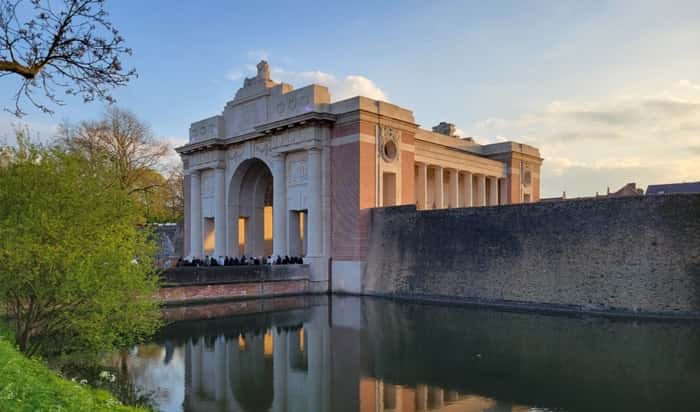
At the Menin Gate, the Last Post sounds each evening at 8 pm not as a performance, but as a promise kept.
Brisbane traveller David Wood arrived with only a recently uncovered family story. He left with something far more tangible.
“Finding his grave among the thousands of fellow combatants was a very moving and humbling experience.”
Humbling is the right word. The Western Front has a way of reducing everything to scale.
Kurt Simmel’s story carried a different thread: two relatives lost at Flers, another who survived but left part of himself behind at Fromelles.
“The chance to visit where they served… and to take part in the Dawn Service… was incredibly moving.”
Then there are moments you can’t quite prepare for.
Heather Campbell found one at Polygon Wood.
“The Dawn Service… was surreal so silent in the pre-dawn forest… as though all the lost souls were there with us.”
It’s the kind of observation that would sound overdone anywhere else. Not there.
Hellfire Pass: A Different Kind of Silence
If the First World War sites carry a sense of distance, Hellfire Pass removes it entirely.
Cut by hand through solid rock in Thailand’s Kanchanaburi Province, it remains one of the starkest physical reminders of what men can be made to endure.
No wide horizons here. Just stone walls closing in, and heat that feels personal.
Paul and Denis O’Bryan walked the railway line; their relative, James O’Bryan, never left.
“It was an incredible journey, a must-do experience.”
There’s restraint in that description, and it suits the place.
Hellfire Pass doesn’t reward dramatic language. It sits with you regardless.
Why These Journeys Matter Now
Travel has changed. Or perhaps travellers have.
There’s less appetite for the superficial and more interest in experiences that mean something, even if that meaning arrives quietly.
Mat McLachlan Battlefield Tours has built its reputation on understanding that distinction. The logistics are tight, the historians know their ground, but more importantly, there’s an awareness of when to speak and when not to.
In places like these, silence often does a better job.
Looking Ahead: 2027 Opens a New Chapter
Next year brings something new, though, importantly, not something diluted.
For the first time, travellers will be able to mark Anzac Day aboard a dedicated European river journey with AmaWaterways, tracing history through Holland and Belgium.
It’s an eight-day round trip from Amsterdam, timed with tulip season, a softer setting, perhaps, but no less significant.
The itinerary reaches into three defining conflicts: Waterloo, the Ypres Salient, and Operation Market Garden. And on Anzac Day, guests will stand beneath the Menin Gate, the same ceremony, the same notes, the same quiet.
Just approached differently.
It’s a thoughtful addition. Not a reinvention, but an expansion.
The Practicalities Because They Matter Too
Anzac Day tours are not something you leave to chance.
Places are limited, particularly at Gallipoli and Villers-Bretonneux, and demand rarely softens. For 2027 departures, Earlybird savings of up to $400 per couple are available for bookings made before 30 June 2026.
That’s the practical incentive.
The real one is harder to quantify.
A Final Thought
You don’t return from these trips unchanged. Not dramatically, not overnight, but something shifts.
Perhaps it’s a perspective. Perhaps it’s gratitude. More often, it’s simply a clearer sense of where you fit in a much longer story.
And that, in the end, is the point.
To secure your place on an Anzac Day 2027 tour, visit Mat McLachlan Battlefield Tours at www.battlefields.com.au or call 1300 880 340.
by Anne Keam – (c) 2026.
Read Time: 6 minutes.
About the Author.
 Anne Keam’s story begins in Queensland, on a grain farm in the state’s wide western reaches, where the days were long and the lessons simple: work hard, look after your own, and don’t make a fuss. Those early years left their mark.
She later studied Arts at the University of Queensland, before doing what felt natural at the time, heading back home to the family property. But the world was calling. Anne packed a backpack and went looking, spending years on the road and finding herself most alive in South America. She wrote everything down along the way. Those notebooks, full of dust, colour, and curiosity, eventually became her blog, a quiet, personal record of seeing the world and learning from it.











