

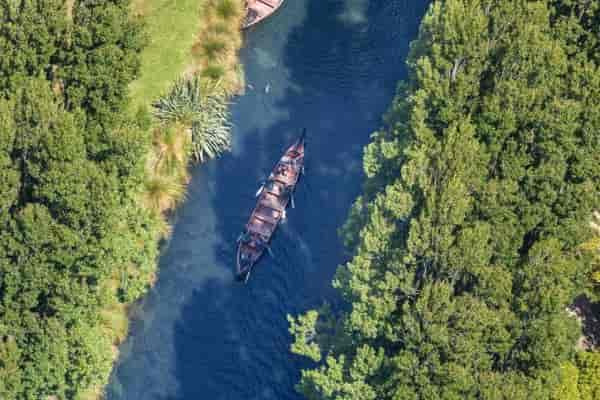
If you’ve spent any time in Christchurch, you’ll know it’s a city that doesn’t rush to impress you.
It never really has.
There’s a restraint about the place, an unspoken understanding that not everything needs to be turned up to eleven. And right through its centre, almost as if it’s in on the secret, runs the Ōtakaro Avon River. Calm, unhurried, and carrying stories most visitors glide straight past without ever quite realising it.
That, in many ways, is what Waka on Avon has been quietly correcting.
For years now, the operation has offered something rare in modern tourism: an experience that doesn’t try too hard. No overblown theatrics. No forced “wow” moments. Just a waka, a river, and stories told properly.
Now, with the introduction of Mahika Kai, they’ve decided wisely, it must be said, not to reinvent the wheel, but to deepen it.
The new 90-minute journey, set for formal unveiling at TRENZ 2026, adds a layer that feels both natural and overdue: food, yes, but more importantly, meaning.
It begins with a mihi whakatau. And if you’ve ever experienced a genuine welcome rather than a token one, you’ll know the difference immediately. This isn’t a tick-box exercise. It’s a moment that asks you, gently but firmly, to leave the outside world where it belongs.
From there, it’s only a short walk from Te Pae Christchurch Convention Centre to the water’s edge. And then, quite suddenly, the city recedes.
Not physically, perhaps. But emotionally, certainly.
You step into the waka, and the pace changes. Conversations soften. The mind, which had been darting about as minds tend to do, begins to settle. It’s not dramatic. It’s something better than that. It’s real.
As the waka moves along the Avon, the storytelling begins not as a performance, but as a conversation that’s been going on for generations. The focus is mahinga kai, the Māori practice of gathering and sharing food, though calling it “practice” feels a little inadequate.
It’s more a way of seeing the world.
You begin to understand, almost without noticing it, that this isn’t just about what was eaten, or how it was gathered. It’s about relationships between people, between communities, and between humans and the environment that sustains them.
There’s a line, often used in tourism, about “bringing history to life”. Most of the time, it’s nonsense.
Here, it actually happens.
Along the riverbanks, small, carefully considered re-enactments of traditional fishing and harvesting appear not staged in the usual sense, but woven into the landscape so naturally that you find yourself leaning in rather than stepping back. There’s no need for commentary overload. The scene speaks for itself.
And then, just as you begin to feel you’ve settled into the rhythm of it all, the journey turns quietly, almost politely, towards its conclusion.
At the Rotunda, the experience shifts from listening to tasting. And this is where Mahika Kai could have easily lost its way. Food, in tourism, is often treated as a flourish, a pleasant add-on.
Not here.
The dishes kaimoana, seasonal vegetables, and rēwena bread arrive with stories attached. Real ones. Not the sort dreamt up in a marketing meeting, but explanations grounded in memory, in place, in whakapapa. A Kaituna kai introduces each element with the kind of understated confidence that comes from knowing exactly what you’re talking about.
You find yourself slowing again. Eating differently. Paying attention.
Even the presentation of the harakeke baskets, the pāua shells, feels less like styling and more like continuity. As though the past hasn’t been revived, but simply carried forward.
From a trade perspective, there’s a quiet strength to Mahika Kai that shouldn’t be underestimated. Experiential travel has been the industry’s favourite phrase for years now, but too often it’s delivered with a heavy hand.
This isn’t that.
This is an experience that trusts the traveller to meet it halfway.
And in doing so, it taps into something more enduring than novelty. It offers understanding. Not all of it, of course, that would be impossible, but enough to leave an impression that lingers long after the river is out of sight.
Christchurch, for its part, seems increasingly comfortable in its own skin. No longer trying to compete with louder destinations, it’s leaning into what it does best: thoughtfulness, space, and a certain quiet confidence.
Mahika Kai fits that mould perfectly.
It doesn’t demand your attention.
It earns it.
by My Thanh Pham – (c) 2026.
Read Time: 4 minutes.
About the Author.
 My Thanh Pham has lived more of a life of travel than most people ever do. After studying tourism, she went straight into the work of building journeys across South-East Asia, temples, beaches, night trains, and all, quietly fixing the messy bits so others could enjoy the ride.
She was never meant to stay behind a desk. Airline life followed, dividing her days between reservations and the airport floor, right where travel shows its true colours. Missed flights, tight hugs, frayed tempers, sudden joy, she saw it all, close up.
Now at Global Travel Media, My Thanh has traded ticket stubs for a keyboard. She writes the way she once worked: steady, clear-eyed and respectful of the road’s unpredictable rhythm, guiding readers through a world she knows from the inside.











