

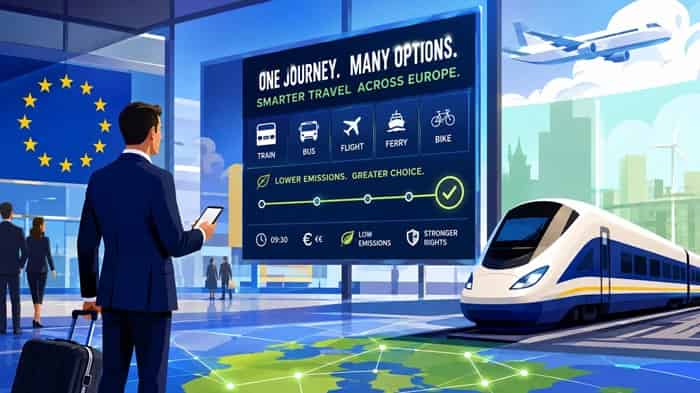
There are few things more guaranteed to test the patience of a seasoned business traveller than a journey stitched together from mismatched tickets, patchy information and a prayer that the next train is, in fact, still running. The European Union, it seems, has finally taken note.
The latest move comes in the form of the European Commission’s freshly minted Passenger Package, a suite of legislative proposals that aims to bring Europe’s travel experience into the modern age. And if you ask the Global Business Travel Association, it’s a step very much in the right direction.
At its core, the Package tackles a long-standing irritation: fragmentation. For years, travellers, particularly those moving for business, have had to navigate a patchwork of booking platforms, limited rail visibility and inconsistent ticketing options. Add multiple transport modes into the mix, and the process can quickly become less “seamless journey” and more “logistical endurance test.”
The European Commission now proposes a more unified system, one that allows journeys involving trains, planes, and other transport modes to be searched, compared and booked with far greater ease. It’s not quite a magic wand, but it edges closer to the sort of simplicity travellers have long taken for granted in other parts of the world.
For the business travel sector, this matters and not just for convenience. Inefficient booking systems don’t merely waste time; they nudge travellers toward less sustainable choices. When rail options are buried or difficult to compare, the plane ticket often wins by default. The new rules aim to change that equation.
Among the more practical measures is the push towards integrated ticketing. In plain terms, that means the ability to combine multiple legs of a journey, say, a train to a regional airport, followed by a short-haul flight, into a single, coherent booking. No more juggling separate confirmations or wondering which operator is responsible when something inevitably goes awry.
There’s also a notable nod to sustainability. Travellers would be able to sort options by greenhouse gas emissions, putting environmental impact alongside price and duration in the decision-making process. It’s a subtle shift, but an important one, particularly for companies under increasing pressure to demonstrate greener travel policies.
Fulvio Origo, GBTA’s Senior Director for Europe, Middle East and Africa, didn’t mince words in his assessment. The Package, he said, marks “an important step towards a more connected, transparent and traveller-focused European transport system.”
He went on to emphasise what frequent travellers have known for years: confidence is everything. Being able to “find, compare and book the right journey with confidence” hinges on clear information, fair access to transport data, and, crucially, solid passenger protections when things go pear-shaped.
And pear-shaped they do, with admirable regularity.
That brings us to another key pillar of the Package: strengthened rail passenger rights. Anyone who has spent time stranded on a platform in a foreign country will appreciate the value of clear, consistent rules. The proposals aim to ensure travellers know exactly what they’re entitled to when disruptions occur, whether that’s timely information, assistance, refunds or rerouting.
For corporate travellers operating on tight schedules, that clarity isn’t a luxury; it’s essential.
From an industry perspective, the implications run deeper still. Better access to transport data levels the playing field, encouraging competition among providers and improving transparency for intermediaries such as travel management companies and booking platforms. In theory, at least, it should make it easier for businesses to choose the most efficient and, increasingly, the most sustainable option.
Of course, as with all good intentions in Brussels, the devil will be in the details. Legislation is one thing; practical implementation is another. GBTA has been quick to encourage policymakers to ensure the final rules are workable, competitive and genuinely useful for the business travel community.
There’s also an implicit recognition that collaboration will be key. Transport operators, technology providers and travel managers will all need to pull in the same direction if the Package is to deliver on its promise.
Still, for an industry that has spent years navigating complexity with a stiff upper lip and a well-thumbed itinerary, this feels like progress worth noting.
In a region where crossing borders is routine but booking across them often isn’t, the European Commission’s Passenger Package offers something refreshingly straightforward: the prospect of travel that works as it should.
And for the weary road warrior, that may be the most welcome development of all.
by Susan Ng – (c) 2026.
Read Time: 3 minutes.
About the Author.
 With the polish of an international hotel professional and the instincts of a born storyteller, Susan Ng learned hospitality where it truly lives behind reception desks, in banquet halls, beside linen carts. She understands that excellence isn’t announced; it’s felt, in the small, quiet gestures that linger long after checkout.
Away from the bustle, her curiosity found a new front desk: the blank page. Her blog, candid and gently wry, drew readers who recognised truth when they saw it. She wrote about grace and imperfection with the steady eye of someone who had lived both.
Today, at Global Travel Media, Susan brings that same warmth and insight to her stories. Expect writing that is polished, generous, and reassuring, like the perfect welcome after a long journey.











