

There’s a certain romance to booking travel, the glossy images, the promise of faraway places, the quiet thrill of departure. But behind the brochures and booking portals, the Australian travel industry is delivering a far less romantic message this week: check who you’re dealing with, or risk paying for a holiday that never quite takes off.
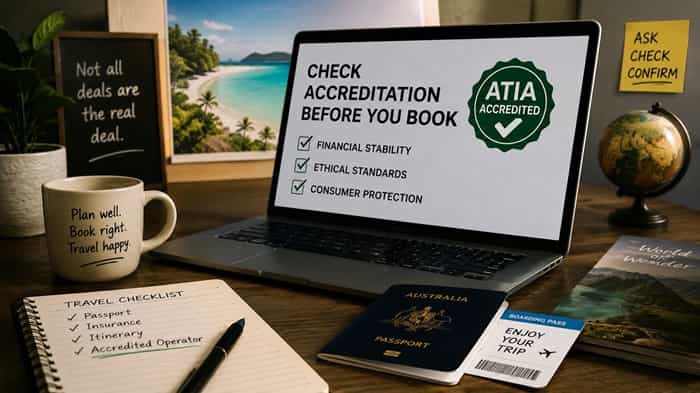
The Australian Travel Industry Association (ATIA) has stepped in with a timely reminder that accreditation is not a formality; it’s a safeguard. And when it’s missing, so too can the protections travellers assume are there be.
The warning follows ongoing concerns surrounding Melbourne-based AVG Travels, formerly Asia Vacation Group, which had its ATIA accreditation cancelled back on 22 August 2022. The reason? A failure to meet the financial and ethical standards expected under the scheme. Yet, in a move that raises more than a few eyebrows, the business continued trading and selling travel packages long after losing that accreditation.
It’s the sort of detail that tends to slip past the average traveller. After all, a website can look perfectly legitimate, a deal can appear compelling, and a booking confirmation can arrive with reassuring efficiency. What isn’t always visible is whether that operator is subject to any meaningful oversight.
ATIA’s scheme, it should be said, is no rubber stamp. Last year alone, 22 per cent of applicants were knocked back, hardly the behaviour of an organisation handing out approvals like frequent flyer points. Accreditation demands financial stability, ethical conduct and ongoing compliance, and when those standards aren’t met, the consequences are swift.
ATIA CEO Dean Long didn’t mince words: “The message to consumers is clear – always check that your travel agent or tour operator is accredited by ATIA. We had a 22% rejection rate of applications last year. We take pride in the people that we removed from the scheme for not meeting our standards.”
There’s a quiet confidence in that statement and perhaps a touch of old-school industry discipline that has, at times, been missing in a rapidly evolving travel landscape.
More importantly for consumers, accreditation comes with something far more valuable than a logo: recourse. Should things go awry while travelling, they occasionally do, and customers of accredited businesses have access to a formal complaints-and-dispute-resolution process. In plain terms, someone independent is there to hear your case.
Long again: “ATIA Accreditation is the highest benchmark in the travel industry. It comes with an excellent consumer complaint processing process, which means even if something goes wrong, you have an independent umpire to help you settle any disputes.”
That “independent umpire” might not sound glamorous, but when a trip unravels, it becomes indispensable.
There’s also a broader structural shift underway. ATIA is working towards a merger with the Council of Australian Tour Operators (CATO), a move designed to consolidate accreditation standards and create a more unified framework across the sector. It’s a sensible play one that reflects the increasing complexity of global travel distribution.
As Long noted, “This situation underscores exactly why that work matters.”
For travellers, the takeaway is refreshingly simple. Before committing to a booking, take a moment, just a moment, to verify your agent’s or operator’s accreditation status. ATIA maintains a public register of cancelled and withdrawn accreditations, and a quick check via the ATIA Accreditation Portal can make the difference between a seamless holiday and a costly lesson.
In an industry built on trust, accreditation remains one of the few hard measures of credibility. Ignore it, and you’re effectively travelling without a safety net.
And as any seasoned traveller will tell you, that’s a gamble rarely worth taking.
by Christine Nguyen – (c) 2026.
Read Time: 3 minutes.
About the Author.
 Christine’s story is one of quiet courage, told without fuss and lived with remarkable grace. She arrived in Australia as a young refugee from Vietnam, carrying little more than hope, family, and a curiosity that refused to be extinguished. Sydney became home, built patiently, brick by careful brick.
She studied Tourism at TAFE and soon found her place in inbound travel, working with one of the city’s leading destination companies. Christine loved showing visitors the Australia that lives beyond postcards, warmer, truer, and far more interesting.
When the sea began to whisper, and life asked for a gentler rhythm, she listened. Designing brochures and writing blogs, she discovered storytelling quietly waiting inside her.
Today, at Global Travel Media, Christine writes with warmth and wisdom, softly and persuasively reminding us why travel still matters.











