


The naming of Orient Express Corinthian in Saint-Nazaire sits somewhere between the two-part spectacle, part substance, and, if we’re being honest, a fairly confident nudge from France reminding the world that when it comes to style, engineering and a touch of theatre, it still knows how to put on a show.
Held at the historic Joubert graving dock, no ordinary stretch of concrete, but the very birthplace of liners that once defined ocean travel, the ceremony had all the hallmarks of an occasion. Fighter jets overhead, tricolours snapping in the Atlantic breeze, and just enough ceremony to suggest this wasn’t merely another ship slipping quietly into service.
It isn’t.
A Yacht That Doesn’t Whisper Its Intentions
At 220 metres long, Corinthian is not a vessel that arrives unnoticed. Nor is it designed to.

Champagne bottle poised, Corinthian christening honours timeless maritime tradition
Billed as the world’s largest sailing yacht, it carries a certain weight of expectation, particularly when the name Orient Express is attached. That brand, now under the watch of Accor, trades not just on heritage, but on a kind of romantic mythology that’s surprisingly difficult to replicate without drifting into parody.
Here, though, there’s enough substance to keep things grounded.
The yacht’s three towering SolidSail rigs, each the size of a respectable city block, are more than decorative nods to a bygone era. Developed by Chantiers de l’Atlantique, they represent a serious attempt to rethink propulsion at a time when the cruise sector is under increasing pressure to clean up its act.
And this isn’t theoretical. During sea trials earlier this year, the vessel managed 12 knots under sail alone in favourable conditions. For a ship of this size, that’s not just impressive, it’s quietly disruptive.
Laurent Castaing, CEO of the shipbuilder, put it plainly:
“For more than one hundred and sixty years, Chantiers de l’Atlantique has been building ships that define their era. Orient Express Corinthian is the latest proof of this.”
There’s a touch of pride there. Justified, you’d say.
Sustainability, Without the Lecture
Now, sustainability in cruise circles can sometimes feel like a well-rehearsed talking point, polished, repeated, and occasionally stretched thin.

Champagne shatters against the Corinthian hull, marking a triumphant maritime christening moment
Corinthian, to its credit, leans less on slogans and more on engineering.
Alongside its sail capability, the yacht runs on a hybrid liquefied natural gas (LNG) system, supported by a suite of energy-efficiency systems that place it comfortably ahead of most vessels in its class. Add in AI-assisted marine detection to avoid collisions, and dynamic positioning that removes the need for anchoring, and you begin to see a ship that is at least trying to address the right questions.
No grand claims of saving the oceans. Just practical steps in the right direction.
Frankly, that’s refreshing.
French Craft, Without the Fuss
Step inside, and the tone shifts from engineering to elegance, from steel to subtlety.
This is where Orient Express earns its keep.

Dignitaries gather as Orient Express Corinthian christening celebrates maritime legacy
Rather than leaning too heavily into nostalgia, the interiors overseen by architect Maxime d’Angeac take cues from the golden age of travel and reinterpret them with restraint. There’s Art Deco influence, certainly, but it’s handled with a lighter touch. Less museum, more modern salon.
Materials do the talking: leather, timber veneers, marble. Nearly 2,000 French artisans had a hand in shaping the final result, and it shows not in ostentation, but in the quiet confidence of things done properly.
Sébastien Bazin, Chairman and CEO of Accor, captured the intent neatly:
“Bringing Orient Express to the sea fits naturally within the imagination of this legendary brand… a journey rooted in discovery, unhurried time, excellence, and elegance.”
It’s a line that could easily feel rehearsed. Here, it doesn’t.
Life on Board: Civilised, Not Showy
With just 54 suites and a maximum of 110 guests, Corinthian isn’t chasing scale. It’s chasing space.

Orient Express Corinthian sails majestically, blending elegance, innovation and timeless adventure
Suites are generous ranging from 45 to 230 square metres and come with the sort of details you’d expect at this end of the market: private butlers, panoramic windows, and ceilings just that little bit higher than industry norms.
Dining is under the direction of multi-Michelin-starred chef Yannick Alléno, which should tell you everything you need to know about how seriously food is taken here.
Beyond that, the offering is quietly indulgent: a Guerlain spa, a cabaret, a speakeasy bar, even a recording studio for those who feel inspired mid-voyage. It sounds extravagant, and it is, but it stops short of tipping into excess for its own sake.
There’s a difference.
Mediterranean First, Then Further Afield
Following her departure from Saint-Nazaire on 2 May 2026, Corinthian will settle into her first Mediterranean season, tracing routes across the Riviera, Adriatic and beyond.
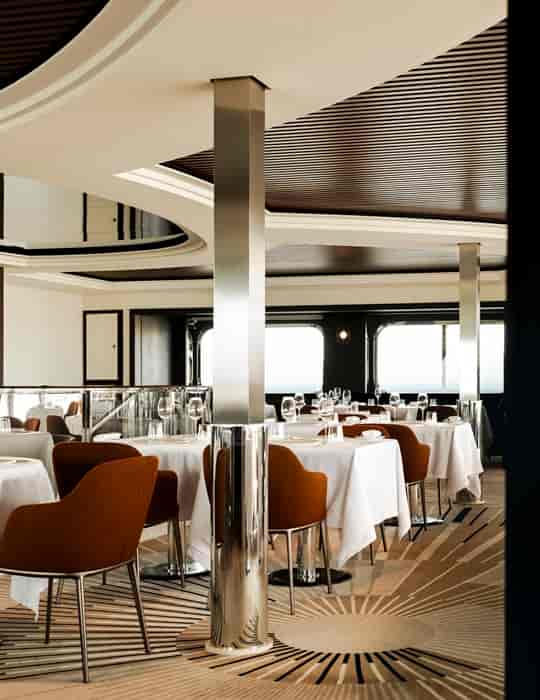
Elegant dining aboard Corinthian reflects timeless French luxury and refined craftsmanship
Short itineraries, one to four nights, offer a degree of flexibility that’s still relatively rare in luxury cruising. Guests can stitch together journeys, rather than commit to a single, fixed route.
Later in the year, the yacht will cross to the Caribbean for the winter, before expanding into Northern Europe and the eastern Mediterranean in 2027.
It’s a sensible rollout. No rush. No overreach.
A Launch That Meant Something
The ceremony itself was, predictably, French to its core, measured, elegant, and just a touch dramatic.
An aerial flypast. The formal presentation of the French ensign. A blessing. The breaking of the bottle.
And, perhaps most tellingly, a moment where the ship was formally handed over less as a transaction, more as a passing of responsibility.
“On behalf of Chantiers de l’Atlantique, it is with immense pride that I hand over to you today the ownership of Orient Express Corinthian,” Castaing said.

Plush Corinthian suite blends Art Deco elegance with modern indulgent comfort
There’s history in that dock. You could feel it.
The Verdict
So, where does Orient Express Corinthian sit in the broader scheme of things?
It’s not just another luxury ship. Nor is it a pure environmental solution. It sits in that more interesting space between where ambition meets reality and heritage is used not as decoration but as a guide.
Will it reshape the industry overnight? Unlikely.
But it does something arguably more important: it quietly nudges expectations forward, confidently, without making too much noise.
And in today’s travel landscape, that might just be the smarter play.
by May Marclay – (c) 2026.
Read Time: 6 minutes.
About the Author.
 May Marclay’s career hasn’t followed a straight line, and she’s better for it. She began in real estate, then moved into hospitality, finding her rhythm with Centara in the Maldives. There, she worked the Asian markets the old-fashioned way: building trust, closing deals, and turning conversations into lasting business.
The UAE sharpened its focus. At IHG, supporting an Area General Manager, she saw the machinery of a major travel hub from the inside, no gloss, just how things actually get done.
Now, with her sights set on healthcare, May brings a broader lens than most. She speaks three languages, reads widely, travels with intent, and writes with the calm assurance of someone who understands both the detail and the bigger picture without needing to say so too loudly.











