There’s a familiar habit in tourism: polish the prose, add a splash of green, and hope no one asks too many questions. For years, that’s been enough. Not anymore.
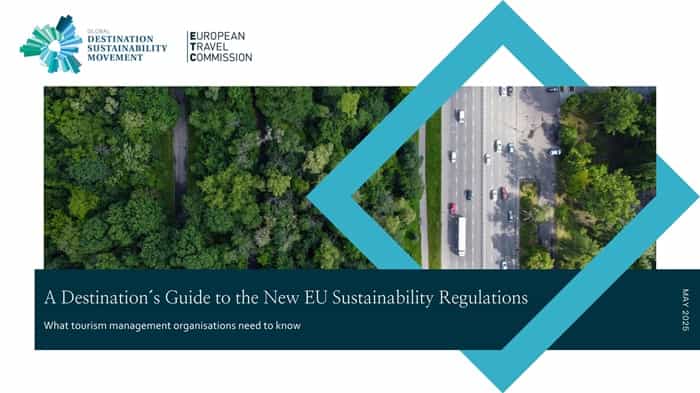
Europe has decided that the industry’s favourite adjective, “sustainable,” needs backing, not bravado. And with the release of Proof, Not Promises, a new guide from the GDS-Movement alongside the European Travel Commission and NECSTouR, the message lands with a thud rather than a whisper: if you can’t prove it, don’t say it.
This isn’t theory dressed up as policy. It’s a practical response to the EU’s Empowering Consumers for the Green Transition Directive (EU) 2024/825 legislation that, from 27 September 2026, will force destinations and tourism businesses to substantiate every environmental claim they make. Not just the big, glossy ones either. Everything. Copy, visuals, branding, the lot.
And yes, it will catch people out.
From Spin to Substance
The industry has long been fluent in the language of sustainability. It’s just been less disciplined when it comes to evidence. A rainforest image here, a carbon-neutral claim there, often well intentioned, occasionally elastic.
What the directive does is draw a line through that ambiguity.
Guy Bigwood doesn’t bother dressing it up:
“This is a defining moment for tourism and events. Sustainability is no longer just a story we tell. It is something we must prove.”
It’s the sort of line you can imagine being repeated in boardrooms with a slightly uneasy chuckle.
Because proving it is the hard part.
A Shift That Will Test the Back Office
For all the talk of marketing, the real pressure will land behind the scenes. Data systems. Internal reporting. Alignment between departments that don’t always speak the same language.
That’s where this becomes less about slogans and more about structure.
Teodora Marinska is right to frame it as an opportunity
“Evidence-based communication can strengthen trust…” but there’s a quiet caveat. Trust isn’t built overnight, and it certainly isn’t built on patchy data.
Destinations that have invested in measurement and governance will adapt quickly. Those who haven’t may find themselves scrambling.
The New Risk: Saying Too Much or Nothing at All
There’s an interesting tension running through the report. On one hand, the crackdown on overstated or misleading greenwashing claims has been a long time coming. On the other hand, there’s a growing fear of “greenhushing,” where organisations say nothing at all to avoid getting it wrong.
Neither approach works.
John Fitzgibbon puts it plainly:
“This is a shift towards more accountable and evidence-driven tourism systems.”
In practice, that means finding the confidence to speak backed by facts, not fluff.
Compliance Is Only Half the Story
It would be easy to paint this as regulatory overreach. Another set of hoops for the industry to jump through. But that misses the bigger picture.
The destinations that treat this as a box-ticking exercise will get through it, eventually. Those who treat it as a chance to sharpen their credibility will come out ahead.
Because travellers, particularly in Europe, are getting better at spotting the difference between genuine effort and marketing gloss. And once trust is lost, it’s remarkably difficult to win back.
A Slightly Old-Fashioned Idea
There’s something almost reassuring about the direction of travel here. Strip away the jargon, and the directive boils down to a simple principle: don’t claim what you can’t prove.
It’s the sort of rule that would have made perfect sense in a newsroom thirty years ago. In fact, it still does.
Tourism, for all its reinvention, is being asked to return to basics. Accuracy. Clarity. Accountability.
Not especially glamorous but undeniably necessary.
Where This Leaves the Industry
The capability gap is real. Not every destination has the systems, data, or internal discipline to meet the new standard. But the clock is ticking.
The organisations that move early, quietly building evidence, tightening processes, and aligning their messaging, won’t just avoid regulatory headaches. They’ll stand out in a market that is, frankly, a little tired of empty promises.
And that, in the end, may be the real story here.
Access the report: https://www.gds.earth/white-papers.