

There’s a familiar rhythm to this industry. Just when someone declares business travel on life support, too expensive, too complicated, too replaceable, along comes a set of numbers that politely, but firmly, says otherwise.
This time, it’s the Global Business Travel Association doing the talking. And the message is as subtle as a boarding call at full volume: Asia Pacific is back in charge, and not by a whisker.
By 2026, the region is expected to push past US$700 billion in business travel spend. Not edge toward it. Do not flirt with it. Smash straight through it.
That’s more than 40 per cent of global outbound business travel, an extraordinary share when you consider the headwinds still rattling around the global economy like loose change in an overhead locker.
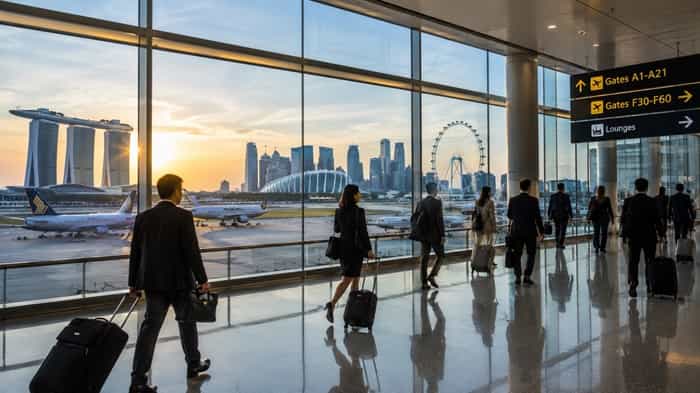
The figures were unveiled, with the usual blend of optimism and caution, at the GBTA APAC Conference 2026 in Singapore’s Marina Bay Sands, where over 1,100 delegates gathered some to learn, some to network, and a fair few to confirm what they already suspected: this sector is not going quietly.
China leads. The rest refuse to sit still.
At the centre of it all sits China, doing what China does, setting the pace. The country alone is forecast to generate US$408 billion in business travel spend in 2026. That’s not just leadership; it’s gravitational pull.
But the real story isn’t just China. It’s the supporting cast, and what a cast it is.
Japan is ticking along at double-digit growth. South Korea isn’t far behind. India continues its steady climb, powered by a domestic market that refuses to take a backward step. And Australia, never flashy, always dependable, is quietly posting near 10 per cent growth.
Together, the top five countries, China, Japan, South Korea, India and Australia, account for more than US$623 billion in spend. It’s a concentration of economic muscle that would make any other region pause for breath.
Then come the overachievers. Taiwan, for instance, is sprinting ahead with growth nudging 25 per cent. Indonesia is moving with purpose. Singapore remains, as ever, a masterclass in punching above its weight.
In short, this isn’t a one-country show. It’s a regional surge.
The inconvenient truth about “virtual everything”
“Business travel continues to demonstrate its resilience and relevance worldwide, notwithstanding geopolitical challenges, with APAC leading that momentum,” said Suzanne Neufang, CEO of GBTA.
You could almost hear the subtext: we’ve had the experiment. We tried replacing travel with screens. It worked up to a point.
But deals still get done over dinner. Partnerships still hinge on trust. And trust, stubbornly, still prefers to be built in person.
Neufang’s view is measured, but it lands cleanly: “Strategic investment in travel remains essential to achieving meaningful business and diplomatic outcomes.”
That’s corporate speak for something rather simple: if you want serious results, you still need to get on a plane.
Growth, yes. Confidence? Not quite.
And yet, for all the bullish forecasts, there’s a flicker of hesitation beneath the surface.
GBTA’s own survey work shows optimism in the region slipping from 56 per cent at the start of the year to 46 per cent by April. That’s not a collapse, but it’s nothing either.
Call it realism setting in.
Costs are rising. Geopolitics is behaving, as it often does, unpredictably. Duty-of-care obligations are becoming more complex. Travel managers are no longer just booking flights, they’re navigating risk, compliance, sustainability and, occasionally, internal scepticism.
So yes, the market is growing. But it’s doing so with its eyes open.
Singapore: a case study in getting it right
If you want a snapshot of business travel’s real-world impact, Singapore offers a neat little case study.
According to GBTA’s early economic analysis, business travel to and within the city generates US$8.1 billion annually. That includes US$1.3 billion in tax revenue and supports more than 33,000 jobs.
More telling, though, is what happens to the money once it lands. For every dollar spent, 56 cents stays in the local economy.
Hotels, restaurants, transport providers, event organisers, it all adds up. Business travel isn’t just a line item on a corporate budget. It’s an ecosystem.
And Singapore, with its efficiency and polish, has turned that ecosystem into something of an art form.
The sectors doing the heavy lifting
Interestingly, the growth story isn’t being driven by the usual suspects.
It’s not just finance or tech filling the front of the plane. The real momentum is coming from the manufacturing, construction, utilities, and administrative services industries, where physical presence still matters.
You can’t inspect a site over Zoom. You can’t negotiate a major infrastructure deal on a patchy video call. Some things still require boots on the ground.
It’s a reminder that for all the talk of digital transformation, the physical world hasn’t gone anywhere.
A conference that felt… grounded
The conference itself reflected that balance between ambition and practicality.
There was plenty of talk about AI courtesy of Dr Ayesha Khanna and the ways it might reshape travel management. There were macroeconomic insights from Taimur Baig that mapped out the shifting sands of global power.
But between the sessions, the real work happened in the corridors. Quiet conversations. Deals half-formed. Relationships nudged forward.
That’s the part no webinar ever quite captures.
The steady hands behind the scenes
There was also a nod to continuity, something this industry values more than it lets on.
Ewan Lim steps into the role of APAC Advisory Board Chair, succeeding Peter Koh. It’s not a dramatic shift, but it doesn’t need to be.
Business travel, for all its movement, is built on consistency. Relationships matter. Experience matters. Showing up, year after year, matters.
And in a region growing this quickly, that kind of steady leadership is worth its weight in gold.
So, what now?
Strip away the headlines, and the message is surprisingly straightforward.
Business travel in Asia Pacific is not just recovering, it’s evolving, expanding, and, in many cases, outperforming expectations.
Yes, there are risks. There always are. But the fundamentals remain intact.
People still need to meet. Markets still need to grow. And somewhere between the departure gate and the hotel lobby, business still gets done.
The numbers might make the headlines. But it’s that simple truth that keeps the industry moving.
by Maysa Punchanit – (c) 2026.
Read Time: 6 minutes.
About the Author.
 Maysa Punchanit has never waited for life to become easy. She’s far too practical for that. Instead, she’s built her path the way many strong women do, step by step, job by job, learning something useful everywhere she’s been.
Her working life has taken her through hospitality, sales, beauty therapy and the fast-moving world of social media, where she partnered with some of Thailand’s best-known companies. Along the way, she discovered a steady voice for blogging, warm, direct and grounded in real experience rather than marketing spin.
Being a single mother sharpened her resolve rather than slowing her stride. If anything, it gave her purpose.
Now with Destination Thailand News and Global Travel Media, Maysa arrives not as a newcomer, but as someone quietly battle-tested, resilient, capable and ready for the next chapter.











