

For years, revenue management strategies have been guided by a simple consensus: more data points lead to better pricing decisions and ultimately, more revenue.
This argument made complete sense when the revenue management system (RMS) technology was in its early stages, capable of processing and analysing complex data signals to improve pricing recommendations.
As RMS technology has evolved, solutions have improved the quality and quantity of the forward-looking data used in their algorithms, with the assumption that it would continuously improve pricing outcomes.
And for a while, it did. The shift from static pricing to dynamic, data-driven decision-making fundamentally changed how hotels approached pricing and demand strategy.
But the industry didn’t stop at enough data.
The result is that most hoteliers are now operating in environments where dashboards are fuller, forecasts are more detailed, and pricing updates happen faster than ever before. And in many cases, more isn’t helping; it often gets in the way of long-term profitability.
That’s not a data problem; it’s a prioritisation problem. And it’s not the first time that the hospitality industry has seen this pattern play out.
In recent years, the conversation has shifted toward profitability-focused metrics – rather than traditional top-line metrics such as occupancy and RevPAR – to ensure the demand that drives meaningful business outcomes is prioritised.
Revenue management has always been about making trade-offs: which demand to accept, which to reject, at what price, and at what time. And over time, general managers & revenue teams have learned that not all demand is equally valuable.
High occupancy can come at the expense of margin. Distribution costs can quietly erode what appears to be strong performance. Some demand segments generate volume while adding disproportionate operational strain.
We’re now at a point where the same discipline in decision-making needs to be applied to data.
If not all revenue is worth accepting, then not all data is equally valuable – yet the majority of the industry still behaves as if it is. When low-impact inputs are treated as meaningful, it creates the illusion of precision without increasing confidence, and pulls attention away from the data and metrics that actually drive performance.
Pricing becomes more reactive, not more strategic. Short-term fluctuations are treated with the same importance as structural demand shifts. Decisions change more frequently, but not necessarily more intelligently.
And over time, that discrepancy has negative consequences. It becomes more difficult to rationalise revenue decisions, to maintain consistency across teams, and almost impossible to replicate strategies that worked well in the past. In some cases, it can even push performance in the wrong direction.
Let’s look at an example… If a hotel’s revenue manager updates room rates reactively when a competitor offers a huge discount, the end result is that they will cannibalise the property’s own demand because the wrong data signal was prioritised.
There is an important lesson to be learned from this example: revenue management decisions should always be based on overall market dynamics and the property’s performance, rather than blindly following competitors’ pricing.
So, I’m here today to challenge the status quo…
For success in today’s market, the hotel operator mindset needs to shift from “What other data can we include?” to “What will help us accomplish the outcomes we want to achieve (and what won’t)?”
It sounds simple, but it requires discipline to implement.
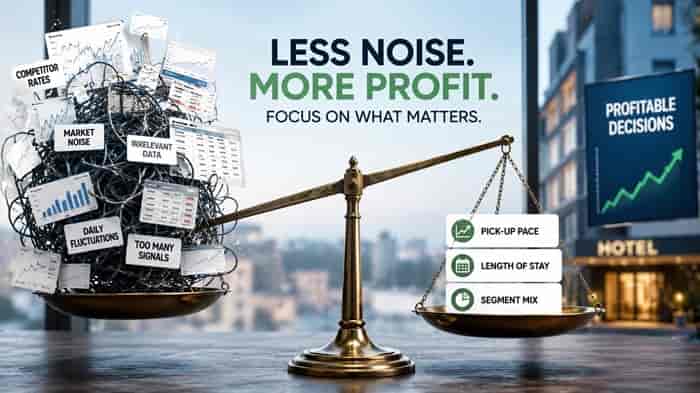
It requires prioritising signals that directly influence profitable demand – rather than reacting to every market fluctuation – and deprioritising those that don’t. It means aligning data interpretation with the business outcomes that actually matter, rather than defaulting to legacy metrics.
Today, forward-thinking revenue leaders are already adopting this mindset and, as a result, are becoming far more selective in their use of data.
They are asking harder questions about which signals genuinely influence profitable outcomes, which ones simply create distraction, and which should carry more weight in decision-making. They are increasingly focused on building consistent, explainable frameworks aligned with profitability to ensure pricing decisions are driven by relevance, not just availability.
In practice, that often means stepping back from constant optimisation; instead, they focus on the signals that truly matter and build proactive strategies that are easier to execute, rather than reacting to every minor market change.
The goal isn’t to reduce the role of data; it’s to restore its quality and usefulness.
Because in today’s environment, a property’s competitive advantage doesn’t come from having access to more information. It comes from knowing what data to trust, and having the discipline to question the rest.
In a highly dynamic marketplace, clarity – not volume – is what ultimately drives performance.
As such, the best strategic revenue management decision you will make all year will be which data you choose to prioritise and which you choose to ignore.
Here’s where you should start…
Audit your data inputs against your actual pricing decisions
Pick three recent rate changes and trace them back to their triggers. Were they driven by your own pick-up pace, demand shifts, or a competitor’s discount? If a competitor consistently steers your decisions, the wrong data is being used to set prices.
For groups and chains, run this same audit at the brand level because what looks like destination-specific market behaviour can often be a system-wide reactive pricing habit in disguise.
Define your “primary signals” in writing
Agree on the two or three data points that most consistently correlate with profitable outcomes; pick-up pace against forecast, length-of-stay patterns, and segment mix are strong starting points. Once defined, use them as your decision-making filter: if a signal isn’t on the list, it shouldn’t be the catalyst for a rate change.
For multi-property operators, it’s important that they’re interpreted consistently across properties so pricing decisions are comparable and strategies are scalable.
Integrate profitability metrics into your strategy
Integrating profitability metrics – such as GOPPAR or net RevPAR – will identify demand that appears strong but erodes margins due to distribution costs or operational load.
For chains, this is most powerful done comparatively between properties because the same occupancy across two similar properties can tell very different profitability stories.
Schedule a monthly data audit
Review the data sources your team engaged with most frequently each month to identify which signals informed decisions that improved outcomes and which prompted reactions with negative results. Use that distinction to continuously refine your primary signals list, amplifying what is working and eliminating what isn’t.
For multi-property operators, a monthly data audit also flags when individual properties are shifting off-strategy and creates a natural touchpoint to tighten decision-making frameworks across the portfolio.
None of these steps requires a complete overhaul of how you work, but collectively they will fundamentally sharpen your approach to pricing. Get this right, and you won’t just make better pricing decisions; you’ll make decisions that are actually reflected in your bottom line.
By Chas Scarantino, CEO of RoomPriceGenie – (c) 2026.
Read Time: 5 minutes.











