There are airline earnings seasons, and then there are airline earnings seasons with geopolitical fireworks, oil market jitters, and enough uncertainty to give even seasoned aviation executives indigestion.
Yet somehow, amid all the turbulence swirling through global energy markets and Middle Eastern shipping routes, Air Canada has managed to produce a first-quarter result sturdy enough to make shareholders loosen their ties and smile politely into their double espressos.
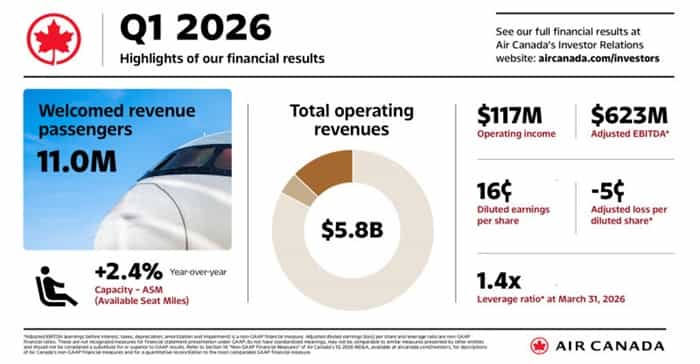
The Montréal-based carrier delivered record first-quarter operating revenues of C$5.8 billion, an 11 per cent leap from the same period last year, while adjusted EBITDA surged 61 per cent to a record C$623 million. Not bad for an industry that traditionally regards the first quarter the way beachgoers regard Canadian winters.
Air Canada also posted operating income of C$117 million, a positive swing of C$225 million year-on-year, while generating a hefty C$1.8 billion in operating cash flow and C$1.6 billion in free cash flow.
In airline terms, that is the equivalent of finding clear skies over Heathrow.
Air Canada President and Chief Executive Officer Michael Rousseau was understandably buoyant.
“In the first quarter, Air Canada built on the momentum of our best-ever fourth quarter to launch strongly into 2026,” Rousseau said.
“These results show the efficacy of our strategy and the dedication of our employees, whom I thank for their hard work.”
For an airline sector that spent years lurching between pandemic chaos, staffing shortages, supply chain meltdowns and aircraft delivery headaches, the numbers suggest Air Canada has rediscovered something the aviation industry treasures almost as much as cheap jet fuel: stability.
Well… partial stability.
Because while passengers continue to book flights with admirable enthusiasm, the airline’s accountants are nervously watching fuel markets the way tourists watch baggage carousels in Rome with caution, suspicion and occasional despair.
Fuel Prices Crash the Party
Despite the blockbuster quarter, Air Canada suspended its full-year 2026 guidance due to escalating uncertainty surrounding fuel costs.
That decision did not emerge from corporate pessimism. It emerged from reality.
The continuing instability in the Middle East, disruption around the Strait of Hormuz, and volatility in global oil markets have made forecasting second-half fuel costs about as reliable as predicting airline boarding times.
Air Canada currently expects jet fuel prices to average approximately C$1.28 per litre during the second quarter, including hedging gains of C$0.21 per litre.
The airline also believes it can offset between 50 and 60 per cent of higher fuel costs through commercial adjustments and internal cost controls.
That is corporate language for: “We’ll squeeze efficiencies wherever we can without frightening passengers.”
Still, the airline insists demand remains remarkably resilient.
And that may be the most significant story buried within the financial tables.
Travellers Keep Flying
Despite inflation pressures, geopolitical instability and widespread economic caution, travellers continue to prioritise flying.
International demand remains strong across Air Canada’s network, and forward bookings for the latter half of 2026 are reportedly healthy.
That matters enormously.
Airlines can usually survive high fuel costs if aircraft remain full. Empty seats, however, have historically turned airline balance sheets into crime scenes.
Air Canada’s ASM capacity, Available Seat Miles, is expected to increase between 0.5 and 1 per cent in the second quarter compared with 2025, indicating the airline still sees room for careful expansion rather than retrenchment.
Rousseau reinforced that confidence.
“We continue to see strong demand across the network and throughout the booking window for the latter half of the year.”
It is an important signal for the broader aviation sector, particularly across North America, where airlines are balancing growth ambitions against rising operational costs.
Investors Receive a Friendly Nod
Air Canada’s quarter was not merely about revenue growth.
The airline also repurchased more than C$140 million worth of shares during the quarter, demonstrating confidence in its balance sheet and long-term strategy.
That will not go unnoticed by institutional investors who spent much of the past decade watching airlines burn through cash faster than airport coffee budgets.
Long-term debt and lease liabilities stood at C$12.3 billion, while the airline’s net leverage ratio remained manageable at 1.4x.
Those figures matter because the aviation industry has become increasingly obsessed with balance-sheet discipline following the pandemic years, when debt piles ballooned across the sector.
Today’s airline investors are less interested in grandiose expansion fantasies and far more interested in sustainable profitability, controlled capital spending and disciplined fleet management.
Air Canada appears keenly aware of that shift.
The Big Ambition: $30 Billion Revenue
Perhaps the boldest element of the announcement was Air Canada’s continued confidence in its long-term ambitions.
The carrier reaffirmed its 2028 targets and 2030 aspirations, which include achieving approximately C$30 billion in operating revenue by 2028 and exceeding that figure by 2030.
It also aims to achieve an adjusted EBITDA margin of 18-20 per cent by 2030, an impressive target for a global airline operating in notoriously volatile conditions.
The airline further intends to keep capital expenditure below 12 per cent of operating revenue while maintaining strong free cash flow margins.
In simpler terms, Air Canada wants to grow without becoming reckless.
That may sound obvious, but aviation history is littered with airlines that forgot the difference between ambition and overconfidence.
Aviation’s New Reality
The broader airline industry will be watching Air Canada’s strategy carefully because its current balancing act reflects the new reality facing global aviation.
Demand is healthy. In many markets, it is exceptionally healthy.
But airlines now operate in a permanent pressure cooker of fuel volatility, labour costs, supply chain disruptions, sustainability targets, geopolitical instability, and unpredictable consumer confidence.
In previous decades, airlines largely worried about competition and recessions.
Now they must also navigate wars, climate events, shipping disruptions, oil shocks and aircraft manufacturing delays often simultaneously.
And yet travellers keep flying.
That remains the enduring paradox of modern aviation.
Whether for business, leisure, family reunions, or sheer wanderlust, passengers continue to fill aircraft at levels that would have seemed improbable during the darkest pandemic years.
For Air Canada, that demand has created a financial runway sturdy enough to weather at least some of the turbulence ahead.
A Strong Quarter, But Eyes on the Horizon
None of this means Air Canada is immune to trouble.
Fuel remains the industry’s great uncontrollable variable, and any prolonged escalation in Middle Eastern tensions could quickly reshape airline economics globally.
The airline acknowledged precisely that in its cautious guidance update.
Still, the first quarter numbers reveal an airline operating with considerably more confidence than many expected only a few years ago.
Record revenues. Record adjusted EBITDA. Strong cash flow. Solid demand.
Those are not the metrics of an airline merely surviving.
They are the metrics of an airline attempting to position itself for the next decade of global aviation growth, even while oil traders, geopolitical strategists and nervous CFOs continue chewing their fingernails in unison.
And perhaps that is the most telling signal of all.
The aviation industry has always been cyclical. Turbulence is part of the business model.
But Air Canada’s latest performance suggests that, for now at least, passengers remain eager to fly and airlines are prepared to profit from it.
Even if the fuel bill keeps everyone awake at night.