

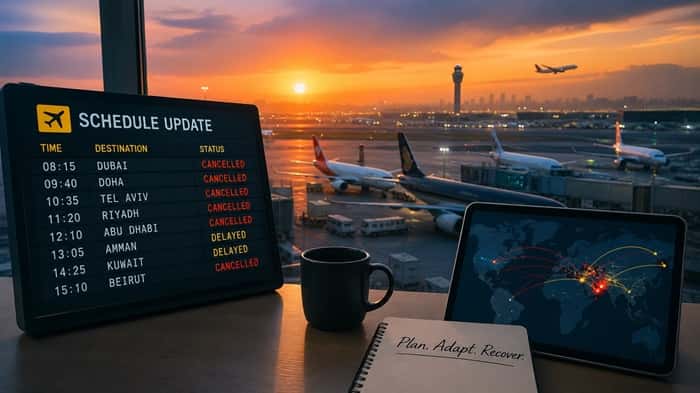
There are few industries as finely tuned or as instantly exposed as aviation. When geopolitics shifts, airlines don’t merely adjust; they pivot, often overnight. And right now, the global airline industry is doing exactly that, recalibrating its flight schedules with the precision of a watchmaker under pressure.
As the Northern Hemisphere’s peak summer travel season edges closer, airlines find themselves operating in a landscape where certainty is in short supply. The ongoing Middle East conflict has sent ripples, no, shockwaves through global capacity planning. Even with a ceasefire tentatively in place, the numbers tell a story of caution, resilience, and a touch of guarded optimism.
Drawing on the latest data from OAG, comparing April 2026 filed schedules against February’s baseline, the picture that emerges is one of a sector trimming its sails rather than abandoning the voyage.
A Market Hit Hard and Fast
Unsurprisingly, the Middle East sits squarely at the epicentre of the disruption. Capacity across the region has plunged by a staggering 34.7 per cent in May, wiping out more than a third of originally planned seats. It’s the sort of contraction that would normally take years, not weeks, to unfold.
Yet airlines, ever pragmatic, are not retreating entirely. By June, the decline moderates to -9.9 per cent, and by July, a comparatively modest -5.0 per cent. It’s a clear signal: carriers are hedging their bets, keeping aircraft and options on standby.
The logic is simple. In aviation, standing still is not an option. Airlines must remain poised to restore capacity at a moment’s notice should conditions improve.
The Ripple Effect: No Region Is Immune
What happens in the Middle East rarely stays in the Middle East, at least in aviation terms. The interconnected nature of global air networks means disruption travels swiftly.
Eastern Europe, for instance, has felt the pinch, with capacity down 18.3 per cent in May. Much of this is driven by Middle Eastern carriers pulling back services. Airlines such as Air Arabia and flydubai have made substantial cuts, removing approximately 100,000 and 167,000 seats, respectively, from their original plans.
Further afield, the effects are more subtle but still significant. South Asia is down 9.3 per cent, while South East Asia trails with an 8.3 per cent reduction. Even the usually resilient Western European market dips by 3.7 per cent.
Closer to home, the Southwest Pacific, Australia’s backyard, records a 3.5 per cent decline, a modest figure on paper but one that underscores how far-reaching the disruption has become.
A Lone Bright Spot
Amid the gloom, Central Asia stands out as something of an outlier and perhaps a glimpse of opportunity. Capacity in the region is up nearly 10 per cent in May, climbing even higher in subsequent months.
Driving much of this growth is IndiGo, which has added close to 85,000 seats as part of its ongoing expansion strategy. While others retrench, IndiGo is advancing a reminder that in aviation, one carrier’s turbulence can be another’s tailwind.
The Six-Week Strategy
Perhaps the most telling insight from the data is not the scale of the cuts, but the timeframe in which airlines are making decisions.
Across the board, carriers appear to be working within a six-week planning window. It’s a tactical approach short enough to remain flexible, yet long enough to maintain operational coherence.
By June, only three regions, North Africa, Central Asia, and North-East Asia, are expected to show growth against February levels. But by July, the tide begins to turn, with ten regions anticipating capacity increases.
In industry terms, that’s not just a recovery, it’s a calculated re-entry.
Airlines Under Pressure, But Not Grounded
The biggest capacity reductions are, predictably, among Middle Eastern carriers. Qatar Airways leads the list with a 32.4 per cent cut in May, followed closely by Air Arabia at 34.3 per cent.
Others, including Etihad Airways and Emirates, have also scaled back, though to a lesser degree.
Yet there is a notable resilience here. Even at their lowest ebb, these airlines are still operating at least two-thirds of their original capacity. In other words, they’re bending, not breaking.
And that distinction matters. It speaks to an industry that has learned, perhaps the hard way, how to navigate sustained disruption.
Beyond Conflict: Other Forces at Play
It would be convenient to attribute all capacity changes to the situation in the Middle East. But aviation, as ever, is more nuanced.
Take Spirit Airlines, which has recorded a dramatic 40.2 per cent reduction in May capacity. This, however, has little to do with geopolitics and everything to do with internal restructuring.
Similarly, VietJet Air has cut capacity by 29 per cent, partly due to fuel shortages as it conserves supply. The likely outcome? Fuller aircraft and higher yields.
These examples serve as a timely reminder: while conflict may dominate headlines, airlines are juggling multiple variables at any given moment.
The Bigger Picture
So, what does all this tell us?
At its core, the data reflects an industry operating in a state of controlled uncertainty. Airlines are not retreating; they are recalibrating, adjusting capacity, redeploying aircraft, and refining schedules in near real-time.
The six-week planning horizon offers a crucial buffer, allowing carriers to respond swiftly to changing conditions. Should stability return, capacity can be restored with remarkable speed.
But therein lies the caveat. Aviation can control many things, routes, pricing, and aircraft utilisation, but geopolitics is not one of them.
A Measured Optimism
There is, however, a quiet confidence underpinning the numbers. The gradual recovery projected for June and July suggests airlines are preparing for a return to something resembling normalcy.
Whether that optimism proves justified remains to be seen. But if history has taught us anything, it is that aviation is nothing if not adaptable.
In the meantime, the industry continues to do what it does best: keep moving forward, even when the skies are less than clear.
by Michelle Warner – (c) 2026.
Read Time: 6 minutes.
About the Author.
 Michelle Warner has always carried stories the way others carry passports lightly, faithfully, and with purpose. She learned her craft in newsrooms, shaping sentences with care, before swapping deadlines for departures as a flight attendant with some of the world’s great airlines. Years aloft sharpened her eye for character and deepened her fondness for the small, dignified rituals of travel, the quiet kindness of strangers, the poetry of arrival, the patience learned between time zones.
Now grounded by choice, Michelle has come home to writing with the same calm authority she once brought to turbulent cabins. Her prose blends an editor’s discipline with a traveller’s wonder, tinged with humour and reverence for the golden age of travel. Each piece feels like a handwritten boarding pass, gracious, observant, and unmistakably alive.











