

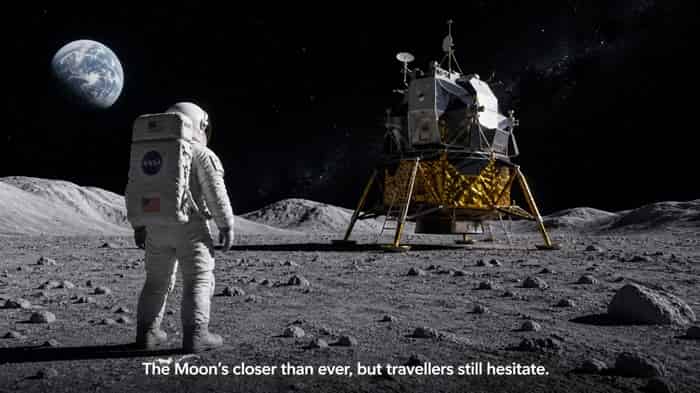
You can almost hear the applause echoing across mission control. NASA has pulled off Artemis II clean, confident, and quietly historic. Humanity, once again, has nudged closer to the Moon.
The trouble is, the travelling public hasn’t budged an inch.
Fresh numbers from Global Rescue land with the sort of thud that cuts through hype. Just 24 per cent of travellers say they’re even remotely interested in heading lunar-bound. The rest? A polite no or, in many cases, an emphatic one. Fifty-seven per cent aren’t interested at all. Not even a flicker of curiosity.
So much for the waiting list.
Dan Richards, Global Rescue CEO and a man who’s seen more than his share of travel trends come and go, doesn’t dress it up.
“The Artemis II mission proves what’s possible,” Richards said. “But traveller sentiment makes clear that possibility doesn’t equal demand, at least not yet.”
There it is. The gap between what we can do and what people are willing to pay for is still as wide as the Pacific.
The price tag that stops conversation dead
Let’s talk numbers, because this is where the dream unravels rather quickly.
A quarter-million dollars? About 10 per cent of travellers might entertain the idea. Push it towards $750,000, and interest evaporates to a rounding error—less than 2 per cent. Go north of a million, and nearly three-quarters of respondents simply shut the door.
No negotiation. No “maybe if”.
That’s not hesitation, that’s a market sending a very clear message.
Even in a world where luxury travellers think nothing of dropping six figures on Antarctic voyages or private jet itineraries, the Moon feels… different. Not aspirational. Not yet. More like a very expensive gamble with no early checkout.
Risk: not your standard travel insurance clause
And then there’s the small matter of risk.
Fifty-six per cent of travellers flagged catastrophic mission failure as their biggest concern. Not delays. Not comfort. Catastrophic failure. The sort of phrase you won’t find in a glossy brochure.
Another 17 per cent worry about being stranded hardly surprising, given there’s no roadside assistance at 384,400 kilometres. Illness or injury barely rates a mention by comparison.
Richards again, cutting straight to it:
“Space travel introduces a category of risk that most travellers have never had to evaluate. The consequences are absolute, and that heavily shapes perception.”
In other words, this isn’t a lost suitcase at Heathrow. This is existential.
Curiosity exists, but it’s cautious
There are nuances worth noting. Men show slightly more interest than women, though neither group is rushing to pack a spacesuit. International travellers appear marginally more open than their US counterparts, but not by enough to move the dial.
Yes, commercial space travel exists. SpaceX and its contemporaries have proven that orbital journeys are viable. Suborbital hops are already selling, albeit to a very specific, very well-funded audience.
But let’s not kid ourselves. A few minutes of weightlessness for hundreds of thousands of dollars is still a curiosity purchase, not a mainstream travel product. Multi-day orbital missions costing millions? That’s rarified air in every sense.
Technology is ready. Travellers are not.
Artemis II has done its job. It has restored confidence in capability. It has reminded the world that lunar travel is no longer science fiction.
What it hasn’t done is convince people they actually want to go.
And perhaps that’s the more interesting story.
Travel, for all its bravado, is built on comfort zones. Push too far beyond them financially, physically, psychologically, and demand doesn’t just soften, it disappears.
For now, the Moon remains what it has always been for most travellers: something to look at, not something to visit.
Admired. Photographed. Talked about over a drink.
But booked? Not quite.
For more details, visit Global Rescue.
by Michelle Warner – (c) 2026.
Read Time: 3 minutes.
About the Author.
 Michelle Warner has always carried stories the way others carry passports lightly, faithfully, and with purpose. She learned her craft in newsrooms, shaping sentences with care, before swapping deadlines for departures as a flight attendant with some of the world’s great airlines. Years aloft sharpened her eye for character and deepened her fondness for the small, dignified rituals of travel, the quiet kindness of strangers, the poetry of arrival, the patience learned between time zones.
Now grounded by choice, Michelle has come home to writing with the same calm authority she once brought to turbulent cabins. Her prose blends an editor’s discipline with a traveller’s wonder, tinged with humour and reverence for the golden age of travel. Each piece feels like a handwritten boarding pass, gracious, observant, and unmistakably alive.











