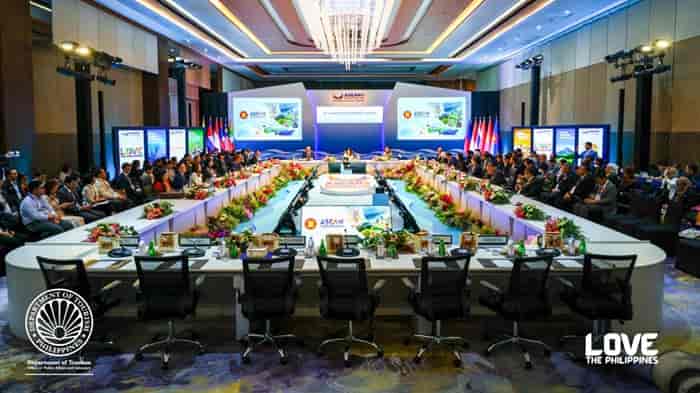
Some destinations host events. Others absorb them, shape them, and if the timing is right, leave their imprint long after the lanyards are packed away.
In Cebu, during the ASEAN Tourism Forum 2026, the latter did so.
There was no need for chest-beating. No overcooked fanfare. Instead, what unfolded from 26 to 30 January was something far more telling: a destination entirely comfortable in its own skin, quietly demonstrating that it understands both the business and the theatre of tourism and when to separate the two.
The theme, “Navigating Our Tourism Future, Together,” might have sounded familiar on paper. But in Cebu, it didn’t sit idle on banners. You could feel it in the rhythm of the week, in the way conversations moved, in the subtle sense that ASEAN tourism, for once, wasn’t just talking about alignment. It was practising it.
The Machinery Behind the Magic
If you’ve spent any time around international forums, you know the truth: success is rarely glamorous. It’s logistical. It’s layered. And it hinges on whether the people behind the curtain are speaking the same language.
Here, they were.
The Philippines’ Department of Tourism worked hand in glove with Cebu City, Lapu-Lapu City, and Mandaue City, an alignment that felt less like an obligation and more like a shared intent. No visible seams. No bureaucratic stutter.
Five thousand delegates came and went over the week. Flights landed. Transfers flowed. Sessions started on time. It all sounds terribly ordinary until it isn’t. And in this business, “ordinary” done well is often the highest compliment.
Heavyweight support added ballast. The Asian Development Bank and the US–ASEAN Business Council didn’t just lend their names; they reinforced the idea that ATF remains a forum where policy still matters and where the region occasionally pauses to take stock of where it’s heading.
In the air, Philippine Airlines and Cebu Pacific kept the arteries open, while Agoda and CNN International ensured the message travelled further than any single delegate ever could.
Where the Real Work Happens
Strip away the pleasantries, and ATF has always been about one thing: momentum.
TRAVEX hummed with quiet negotiation. Government meetings edged policy forward in increments that rarely make headlines but shape the industry nonetheless. The ASEAN Tourism Conference offered the usual mix of optimism and realism, both necessary, both earned.
And then came the moment that mattered.
The launch of the ASEAN Tourism Sectoral Plan (ATSP) 2026–2030 didn’t arrive with fireworks. It didn’t need to. Its significance sat in its intent a shared roadmap for a region that has learned, sometimes the hard way, that resilience isn’t accidental.
The Philippines, stepping into the role of Lead Country Coordinator, has effectively raised its hand and said, “We’ll help steer.” It’s a position that carries weight and scrutiny. But in Cebu, at least, it looked comfortable.
Cebu Grows Into the Role
There was a time, not so long ago, when Cebu was described as “promising.” A destination with potential. A place that might, one day, step onto the bigger stage.
That language now feels dated.
The Mactan Expo Centre handled TRAVEX with the kind of competence that rarely earns applause but always earns respect. Meanwhile, Nustar Resort played host to ASEAN Tourism Ministers with an ease that suggested this wasn’t a rehearsal, it was the real thing.
Cebu didn’t try to impress. It simply proved.
The Details You Remember
And then there were the quieter moments.
A piece of locally crafted furniture that stopped a delegate mid-stride. A glass of something distinctly Filipino that turned a polite conversation into a memorable one. A sense hard to define, harder to manufacture, that this place knows who it is.
These are the details that don’t appear in communiqués. But they’re the ones people carry home.
A Region, Briefly in Sync
By the time the final sessions closed, Cebu had done something rather rare.
It had created space not just for discussion, but for alignment. For ASEAN tourism to feel, if only briefly, like a region moving in step rather than in parallel.
No grand declarations. No overreach. Just progress, measured and real.
And in an industry that has spent the better part of a decade recalibrating, that might be the most reassuring outcome of all.
For more information, visit the official Philippine Department of Tourism website: https://tourism.gov.ph.