

Security threats have a way of reminding us how fragile normal life can be. They erupt without warning, escalate quickly and force people, governments and organisations into rapid decision-making.
Over the past year, we’ve seen cartel violence in Mexico paralysing tourism, sweeping power outages in Spain and Portugal that stunned millions, political unrest surging through Madagascar and Nepal, a UPS cargo plane crashing in Louisville and shutting down portions of the city and a short but intense war between Israel and Iran that rattled regions across the Middle East. Even travellers in Doha felt the shock when an Israeli drone strike hit the city.
Add to this the routine but no less serious threats — bomb scares, active shooter situations, wildfires, earthquakes, blizzards — and it becomes obvious that crises are no longer rare events.
They are part of the modern landscape.
Throughout my military career and now in my current role, one principle has remained unwavering: survival often hinges on recognising what type of emergency you’re facing and understanding how to respond in the earliest moments. Few directives are as misunderstood as the difference between a shelter-in-place order and a lockdown order. The terms sound similar, but they are fundamentally different and confusing one for the other can place both civilians and emergency responders in greater danger.
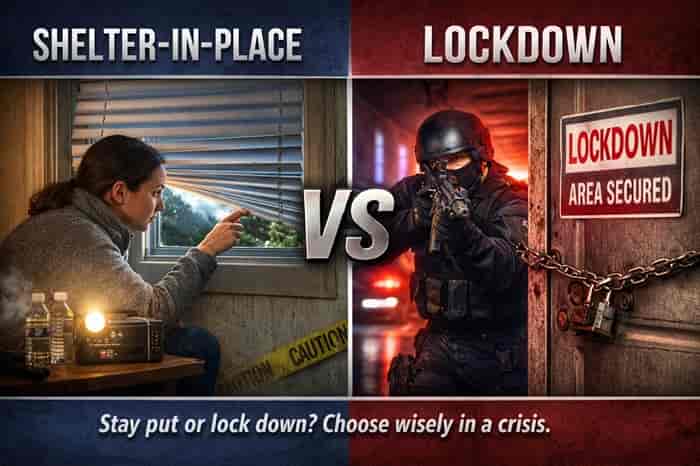
Shelter-In-Place
A shelter-in-place order is essentially a protective pause. It directs individuals to remain indoors in a safe, immediately accessible location. The goal is to reduce exposure to whatever hazard is unfolding while authorities work to stabilise the situation. During natural disasters — such as hurricanes, wildfires or storms — staying put keeps roads clear and allows emergency personnel to reach affected areas quickly. It also prevents well-intentioned people from entering unsafe zones or clogging evacuation routes that responders need to access. In many cases, the impulse to flee is strong, but the environment outside may be far more dangerous than staying in a home, office, school, hotel, or similar structure.
The recent violence in Mexico prompted the US State Department to issue a warning for US citizens to shelter in place in certain parts of Mexico after widespread violence broke out in the country in February. Sheltering in place often provides the time people need to understand what is happening, evaluate their surroundings, gather essential information, and prepare for a possible evacuation if necessary. It prevents avoidable injuries, reduces confusion and keeps civilians from interfering with critical operations. It is a measured approach—restrictive, but not extreme—designed to maintain control and situational awareness during uncertainty.
Lockdown
A lockdown, however, represents a far more severe and immediate threat. While a shelter-in-place order is about limiting movement, a lockdown is about halting it entirely. It typically applies during life-threatening events such as active shooter incidents, armed conflict or violent civil unrest. Under a lockdown, people may be ordered into hardened or reinforced shelter areas designed to minimise the dangers of blast effects, falling debris or hostile activity. Doors are secured, interior movement is restricted, and normal operations come to an abrupt stop. A lockdown also allows authorities to assess and respond without inadvertent civilian interference, helps reduce chaos, prevents people from entering danger zones, and supports controlled response operations. In some cases, lockdowns are enforced with police or military checkpoints, road closures and shutdowns of public transportation.
During the recent conflict between Israel and Iran, for example, several regions implemented strict lockdowns that closed businesses and confined residents to their homes for safety. Similar restrictions were used during periods of instability in Nepal and Madagascar. A lockdown is an unequivocal message: the threat is immediate, and remaining exactly where you are—protected, out of sight and secured—is the safest course of action. Unlike a shelter-in-place order, a lockdown often requires absolute compliance.
Instinct vs Intelligence
Despite these distinctions, many people misjudge their safest option in a crisis. The natural instinct is to escape, but evacuation without situational awareness can lead directly into danger. I’ve seen civilians flee toward gunfire, attempt to drive through areas engulfed by wildfires and unknowingly move into streets filled with violent crowds. In addition to placing themselves at risk, such actions can hinder emergency responders who must divert attention and resources to help those who acted prematurely or without information.
Another complicating factor is the lack of standardisation around emergency terminology. Different countries, and sometimes even different cities or organisations, use different languages to describe the same protocols. A traveller might encounter orders phrased differently than what they are accustomed to at home.
This is why preparation is essential. Families, schools and organisations should identify safe areas within their buildings, determine how they will communicate during an emergency and conduct periodic drills so that everyone understands what to do when a shelter-in-place or lockdown order is issued. Clarity established in advance leads to decisiveness under pressure.
The end of the immediate crisis is not the end of the event. There is always a transition period — sometimes gradual, sometimes prolonged — during which conditions stabilise, information becomes clearer, and authorities begin the process of recovery. Effective communication, patience and coordinated action are critical as communities move from response to normalcy.
Individuals and organisations need support throughout this entire cycle. They need to develop crisis plans, obtain real-time intelligence and guidance, coordinate with experts and authorities for evacuations when conditions allow and consider professional assistance with post-incident recovery efforts. The goal is simple: reduce confusion, improve safety and enable a smoother return to stability after a disruptive event.
Understanding the difference between sheltering in place and locking down is more than knowing a pair of terms — it’s understanding two distinct strategies for staying alive. Emergencies rarely unfold the way we expect, but preparation and awareness give us a powerful advantage. The more clearly we understand these protocols today, the more confidently we can act when the unexpected arrives.
By Fernando Lopez Medina – (c) 2026.
Read Time: 6 minutes.
About the Author.
 Author Bio: Fernando Lopez Medina is a former U.S. Army Special Forces Green Beret and security operations supervisor at Global Rescue, the world’s leading provider of medical, security, evacuation and travel risk management services.











