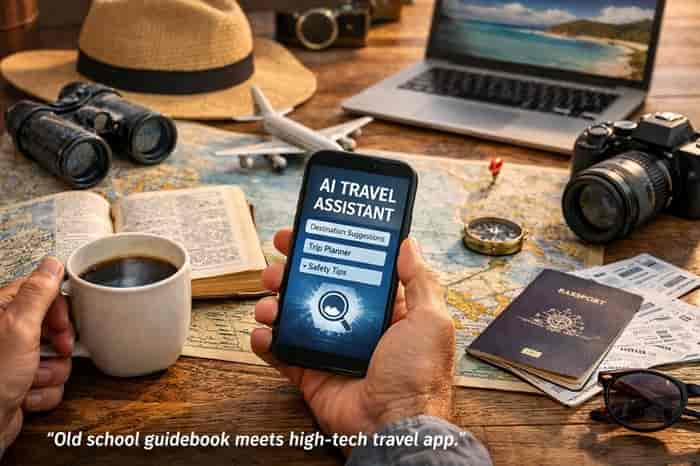
There’s something rather comforting in discovering that, despite all the breathless talk of artificial intelligence reshaping the world, travellers haven’t entirely lost their nerve or their common sense.
Yes, AI is making itself useful. It’s quick, tireless, and increasingly clever at suggesting where one might go next. But when it comes to actually deciding? Well, that’s another matter entirely.
The latest findings from The Global Rescue Companies Winter 2026 Traveller Sentiment and Safety Survey read less like a tech revolution and more like a quiet reaffirmation of human instinct.
Roughly a third of travellers, 36 per cent, say they’ll use AI in some way when planning trips in 2026. That might mean gathering ideas, comparing options, or trimming down an overwhelming list. Sensible enough.
But an equal proportion, another 36 per cent, plan to steer clear of AI altogether. Not dabble. Not an experiment. Simply opt out.
And then there’s the middle ground: 25 per cent who prefer to rely mostly on human recommendations. Advice from someone who has actually been there, seen it, and, importantly, paid for the coffee.
It’s hardly a ringing endorsement of machines taking over.
“Travelers are interested in AI, but they are not ready to hand over control,” said Dan Richards. “AI is viewed as a helpful assistant, not a trusted authority, particularly when safety, cost and risk are involved.”
You can almost hear the collective nod from seasoned travellers everywhere.
The Assistant, Not the Authority
AI, it seems, has found its place, but it’s not at the top of the food chain.
Travellers are quite happy to let it do the legwork: trawl through destinations, surface options, perhaps even suggest a hidden gem or two. But the final call? That remains firmly human territory.
And it’s not difficult to see why.
Travel decisions are rarely made on data alone. They’re shaped by instinct, by past experiences, by those small, hard-to-quantify details that never quite make it into an algorithm. A neighbourhood’s “feel”, a hotel’s atmosphere, a destination’s subtle risks, these are things travellers still prefer to assess themselves.
AI’s Big Problem: Trust
Where AI begins to stumble is when it moves from assistant to adviser.
Suggest a destination a traveller hasn’t considered, and the reaction is, more often than not, polite scepticism.
A solid 41 per cent say they would be unlikely to visit a place recommended by AI. Another 30 per cent might consider it, but only after weighing up cost and safety. A further 20 per cent would require independent verification before taking the idea seriously.
And those willing to trust AI outright? Just one per cent.
Not exactly a stampede.
“Trust and verification are essential,” Richards said. “AI may introduce travelers to new ideas, but it rarely closes the deal without human confirmation.”
It’s a telling observation and one that cuts through the industry’s more optimistic narratives.
A Slight Divide, But No Great Shift
There are, of course, nuances.
Men appear marginally more inclined to use AI as a decision-support tool, with 25 per cent saying it will help narrow options before they decide. Women, meanwhile, show a slightly stronger preference for avoiding AI altogether and leaning on human recommendations.
Geographically, the differences are less about resistance and more about approach. US travellers are somewhat more comfortable using AI to filter choices, while those outside the US show a stronger preference for human guidance.
But these are variations on a theme, not a fundamental shift.
Old Habits Die Hard And For Good Reason
Strip away the percentages, and what remains is something rather reassuring.
Travellers haven’t outsourced their judgement.
They’re curious, certainly. Willing to experiment, yes. But not prepared to surrender control, especially when safety, cost and risk are on the line.
“AI will influence how travelers discover destinations, but it will not replace human judgment,” Richards said. “For travelers focused on safety and resilience, technology must support informed decisions, not substitute for them.”
It’s a line that carries weight precisely because it feels so obvious.
Travel, after all, is not a spreadsheet exercise. It’s personal. Emotional. Occasionally unpredictable. And, at times, risky.
Which is why, for all the algorithms in the world, travellers still trust something far older and far less programmable: experience.
And perhaps that’s the quiet lesson here.
AI may help us decide where to look.
But it’s still humans who decide where to go.
For further insights, visit: globalrescue.com.