

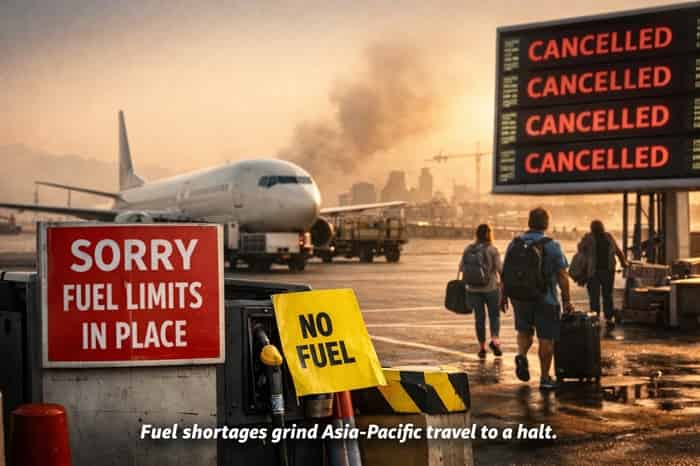
There are moments in travel when the horizon looks clear, only for a distant storm to roll in and rewrite the journey entirely. This, regrettably, is one of them.
The escalating conflict involving Iran, compounded by the closure of the Strait of Hormuz, that narrow maritime artery through which much of the world’s oil quietly flows, has sent tremors through global fuel supply chains. And as is often the case in travel, when fuel sneezes, the industry catches a rather inconvenient cold.
Across the Asia-Pacific, the consequences are no longer theoretical. They are immediate, visible, and, for many travellers, deeply inconvenient.
Airlines from nimble low-cost carriers to the world’s long-haul heavyweights are cancelling hundreds of flights. Ferries are thinning out their schedules. Public transport networks are under pressure. Even private mobility, once the dependable fallback, is beginning to falter as fuel purchase limits creep into policy.
For travellers, the romance of movement is being replaced by something far less poetic: uncertainty.
As Adam Schrader, Director of Operations at Riskline, puts it with measured clarity:
“For travellers, this could mean sudden changes to itineraries, limited mobility, or, in the worst case, being stranded at your destination.”
It is a line that lands with weight, not drama.
Governments Step In, But the Road Remains Uneven
Across the region, governments are reaching for whatever levers they can find.
Japan has loosened coal regulations, a pragmatic nod to energy security over environmental ambition. Vietnam has suspended its green tax to ease fuel costs. India, never shy of decisive fiscal manoeuvres, has trimmed excise duties on fossil fuels.
These are not long-term solutions. They are, rather, the equivalent of placing sandbags against a rising tide.
And the tide, it must be said, is still coming in.
A Patchwork of Risk Across Asia-Pacific
Riskline’s data paints a detailed, if slightly sobering, picture of the region.
Between 28 February and 13 March alone, the company issued 1,924 real-time alerts related to the Iran conflict, surpassing even the frenetic levels seen during the early days of the 2020 pandemic. A statistic that, in travel circles, raises more than a few eyebrows.
The region now presents a patchwork of risk:
- High-risk destinations such as the Philippines and Myanmar are grappling with national emergencies and flight suspensions.
- Medium-risk markets – Bangladesh, Cambodia, Indonesia, Sri Lanka, and Vietnam are feeling the sting of rising fuel prices and partial transport disruptions.
- Moderate-risk destinations, including Australia, India, Thailand, and New Zealand, are navigating limited fuel availability and the occasional operational hiccup.
In short, nowhere is entirely untouched.
Corporate Travel Faces a New Test
For corporate travellers and the travel management companies tasked with keeping them on the move, the situation is particularly delicate.
Laura Welsh, Head of Global Partnerships and Customer Success at Riskline, captures the challenge succinctly:
“Corporate clients and travel management companies are facing a highly challenging landscape. Access to real-time, reliable travel intelligence is critical to adjust itineraries, ensure staff safety, and minimise operational disruption.”
It’s a reminder that in today’s travel environment, information is not just helpful, it is operational currency.
Practical Advice in an Unpredictable Landscape
For those still packing their bags, the advice is refreshingly straightforward, if a touch old-fashioned.
Keep fuel tanks topped up where possible. Favour public transport for shorter journeys. Allow extra time, and perhaps a little extra patience, for delays. And above all, check and recheck itineraries before setting off.
Schrader offers a final note of caution:
“Travellers should think ahead and prepare for disruptions. They should not assume transport and fuel will always be available. Even short trips can be impacted, so proactive planning is critical for safety and continuity.”
It is advice that harks back to a simpler era of travel, one where preparation mattered, and assumptions were best left at home.
The Bigger Picture
If there is a lesson here, it is one the industry has learned before, albeit reluctantly: travel does not exist in isolation. It is tethered, often tightly, to geopolitics, economics, and the quiet mechanics of global supply.
When those systems strain, travel feels it first and sometimes most keenly.
For now, the Asia-Pacific region continues to move, albeit with a slight limp. Flights will resume, fuel will flow again, and the rhythm of travel will return.
But for the moment, it’s a case of keeping one eye on the itinerary… and the other on the world.
by Sandra Jones – (c) 2026.
Read Time: 4 minutes.
About the Author.
 Sandra has spent a working lifetime quietly rescuing journeys, one itinerary, one anxious caller, one impossible connection at a time. Years in Australia’s finest travel agencies taught her the art of calm, how to find a flight in a fog of cancellations, how to soothe a traveller when luggage wanders, how to turn nine frantic days in Europe into something resembling sense. Qualified, seasoned, endlessly patient, she learned that good travel advice is part logistics, part listening.
But the storyteller in her was always waiting its turn. Writing offered a new map, a way to turn experience into reflection, detail into delight. At Global Travel Media, Sandra now writes the truths only insiders know: the mishaps, the laughter, the grace found between gates and goodbyes. She reminds us that travel, for all its fuss, is still one of life’s better ideas.











