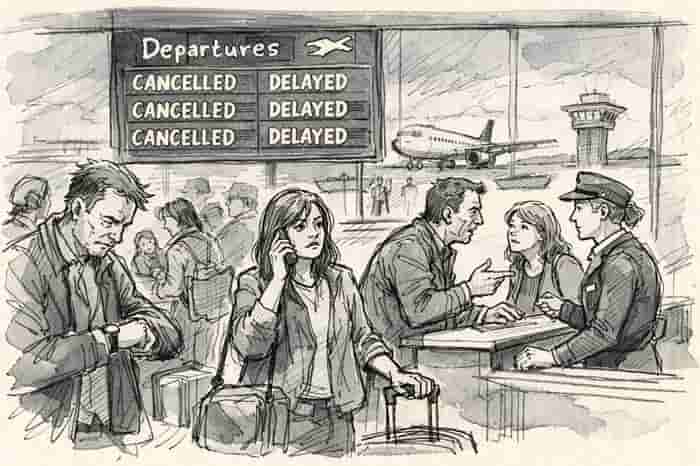
There are few places more democratic than an airport lounge when the departures board turns red. CEOs, students, and retirees are all equally stranded and equally unimpressed. And for years, when things went pear-shaped, Australian travellers have discovered a rather uncomfortable truth: getting a fair outcome from an airline could feel like chasing a tailwind in a headwind.
That may, at long last, be about to change.
The consumer watchdog CHOICE has welcomed the Federal Government’s introduction of the Aviation Consumer Protection Bill 2026 a piece of legislation that, if executed properly, could give passengers something they’ve lacked for too long: leverage.
Not noise. Not promises. Actual leverage.
At its heart, the Bill proposes three key pillars. First, an Aviation Consumer Protection Charter is essentially a rulebook that airlines are expected to follow. Second, a new regulator, the Aviation Consumer Protection Authority (ACPA), is tasked with monitoring and, crucially, acting when standards slip. And third, the headline acts as an independent Aviation Consumer Ombuds Scheme, designed to handle complaints and make binding decisions.
In plain English: somewhere to go when things go wrong and a system that doesn’t just shrug.
The Memory of COVID Still Lingers
CHOICE Director of Campaigns, Andy Kelly, has been around long enough to know that this moment didn’t arrive by accident.
“CHOICE has long campaigned for stronger travel rights and an independent travel ombuds scheme with the power to handle complaints and make binding determinations. Today’s announcement could not come soon enough, as many Australians face travel chaos due to global disruptions once again. When things go wrong, consumers need stronger protections and an independent body that will take their complaints seriously.”
He’s right to frame it that way. Because if there was ever a stress test for the aviation sector, it was COVID-19, and by most accounts, the system didn’t just creak, it buckled.
“The COVID-19 pandemic exposed significant flaws in aviation consumer protections. Consumers struggled to obtain satisfactory outcomes when flights didn’t go to plan, and were routinely given the runaround by many airlines and the industry-funded Airline Customer Advocate, which picked up a Shonky Award in 2021.”
That “runaround” became all too familiar. Refunds delayed. Credits tangled in fine print. Phone calls looping into oblivion. It wasn’t a great look for an industry that trades on trust.
A Bit More Muscle But Not the Full European Workout
The new framework, while welcome, isn’t quite a European-style overhaul. There’s no automatic compensation scheme, no cheque in the mail, simply because your flight was late.
Still, Kelly sees progress where it counts.
“As escalating global conflict and volatile fuel prices make travel plans unpredictable once again, providing consumers with an independent avenue to resolve complaints if things go wrong will be a significant step forward.”
And then, with a measured note of realism:
“While these reforms fell short of a European-style compensation scheme, these changes should force airlines to provide fair remedies for cancellations and unreasonable delays. The Framework will only be as strong as the protections contained in the Charter, and CHOICE will continue to advocate for the strongest possible protections for consumers.”
Translation: good bones, but the flesh still matters.
The Quiet Power of 32,000 Voices
It’s also worth noting that this didn’t emerge in a vacuum. More than 32,000 Australians backed CHOICE’s push for stronger travel rights, not a noisy protest, but a steady, persistent drumbeat.
“These changes will be welcomed by Australian travellers, including the 32,000 CHOICE supporters who signed the petition calling for stronger travel rights.”
And perhaps that’s the real story here. Not just policy, but pressure. Not just legislation, but lived experience is finally being acknowledged.
A System Worth Watching
Will it work? That’s the question hanging quietly over the runway.
The Charter will need teeth. The regulator will need independence. And the ombuds scheme will need to prove it’s more than a polite suggestion box.
But for once, the direction feels right.
Because in aviation, as in life, it’s not the smooth flights that define a system. It’s what happens when things go wrong.
And for Australian travellers, that moment may finally be getting the attention it deserves.