

There’s a fine line between confidence and overreach in luxury travel. Four Seasons, to its credit, has spent the better part of six decades knowing exactly where that line sits and rarely crossing it.
Now it’s decided to take that judgment offshore.
With the debut of Four Seasons I, the brand best known for crisp sheets and even crisper service, has quietly slipped into the yachting world. Not with a splashy reinvention of cruising, thankfully, but with something far more measured: a hotel at sea that behaves exactly as you’d expect a Four Seasons to behave.
Which is to say, it doesn’t try too hard.
A Launch Timed With Intent, Not Accident
The inaugural voyage, departing 20 March 2026, wasn’t plucked from a calendar at random. It marks 65 years since the first Four Seasons hotel opened its doors back in 1961.
That sort of symmetry matters in this end of the market. Guests aren’t just buying a cabin, sorry, suite, they’re buying into a story. And Four Seasons has always been rather good at telling one.
Alejandro Reynal, the group’s President and CEO, frames it in suitably measured terms:
“Four Seasons Yachts debuts on the same day that the very first Four Seasons hotel opened, 65 years ago, making this milestone even more meaningful as we celebrate the history of our company, while looking forward to the bright future ahead.”
Translation: this isn’t a side project. It’s an extension of the brand’s DNA.
Not a Cruise Ship And Keen You Know It
Let’s get one thing out of the way. Four Seasons is not calling this a cruise. And, having seen what it’s built, that distinction feels justified.
At 207 metres, Four Seasons I is large enough to matter but small enough to avoid the floating-city syndrome that plagues much of the cruise sector. There are just 95 suites onboard, each one designed to feel more like a private residence than a temporary berth.
No inside cabins. No compromises. And, crucially, no sense that you’re part of a moving crowd.
There’s also a one-to-one guest-to-staff ratio, which sounds excessive until you remember the clientele. In this bracket, invisibility is the ultimate luxury. Service should appear just before you realise you need it and disappear just as quickly.
Design That Understands Restraint
The design leans into the golden age of yachting without becoming a pastiche of it. There are nods to the legendary Christina O, but they’re more subtle, a whisper rather than a shout.
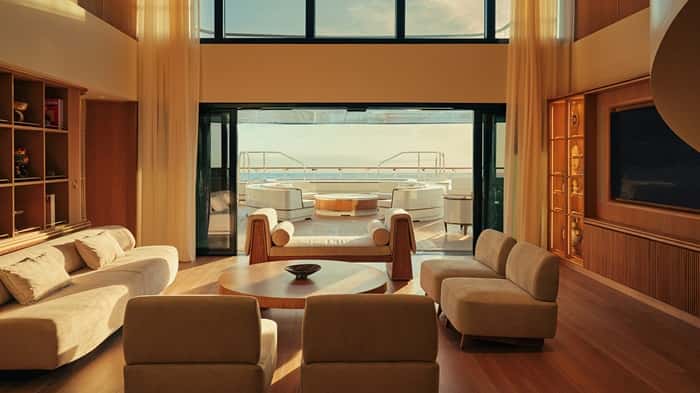
Floor-to-ceiling windows, expansive terraces, and a layout that favours space over spectacle. It’s the sort of design that doesn’t demand attention, but earns it over time.
The Funnel Suite, nearly 10,000 square feet, is the obvious headline act, perched at the prow with views that would make even seasoned travellers pause. At the other end, the Loft Suite offers a similarly generous footprint, with an aft terrace seemingly designed for long lunches that quietly turn into longer evenings.
Food That Actually Matters
Now, here’s where things get interesting.
Cruise dining has long suffered from a peculiar contradiction: endless choice, very little conviction. Four Seasons appears determined not to repeat that mistake.
There are 11 dining venues onboard, but the real story sits with Sedna and its Chef-in-Residence program. Instead of anchoring the culinary identity to a single name, Four Seasons rotates talent from its global portfolio of Michelin-starred restaurants.
Christian Le Squer from Paris, Luca Piscazzi from Athens, Guillaume Galliot from Hong Kong, this isn’t window dressing. It’s a deliberate attempt to turn dining into a reason to travel, not just something to fill the gaps between ports.
And importantly, it’s seasonal. Local. Considered. All the things luxury travellers now expect and are quick to notice when missing.
A Sensible Approach to Wellness
Wellness at sea can often feel like a tick-box exercise. A spa here, a yoga class there, and everyone pretends it’s transformative.
To its credit, Four Seasons has taken a more integrated approach.
L’Oceana Spa sits at the centre, built around the rather timeless idea that the ocean itself does half the work. Treatments range from traditional hammam rituals to more contemporary offerings like cryotherapy and infrared therapy.
But it’s the programming that feels more convincing: sunrise yoga on deck, breathwork sessions, tailored fitness plans. Nothing revolutionary, but all of it thoughtfully done.
Which, in this space, is often enough.
The Marina That Might Just Steal the Show
Perhaps the most quietly impressive feature is the transverse marina.
Instead of treating the sea as something to look at, Four Seasons I invites guests into it literally. The marina opens across both sides of the vessel, transforming it into a kind of floating beach club during designated “Marina Days”.
No queues. No whistles. Just direct access to the water, with a touch of Riviera nonchalance.
It’s the sort of detail that doesn’t shout in the brochure but lingers in the memory.
Itineraries Without the Conveyor Belt
If traditional cruising is about ticking destinations off a list, Four Seasons is attempting something a little more nuanced.
There are no fixed excursions. No herding. Instead, experiences are curated individually, shaped around each guest’s interests.
A private cultural tour in Hydra. A secluded anchorage in Montenegro. A hard-to-book table in Saint-Tropez. It’s less about where you go and more about how you arrive.
For its inaugural season, the yacht will explore the Mediterranean before shifting to the Caribbean and the Bahamas. In total, 130 destinations across more than 30 countries.
Ambitious, certainly. But not without precedent.
A Calculated Move, Not a Gamble
“Today’s luxury traveller values time, trust, and authenticity above all,” says Ben Trodd, CEO of Marc-Henry Cruise Holdings Ltd. “With the confidence our guests place in Four Seasons comes an equally high expectation for excellence.”
He’s not wrong.
The luxury segment has changed. Guests are more informed, less forgiving, and increasingly uninterested in anything that feels manufactured.
Four Seasons’ entry into yachting isn’t about chasing a trend. It’s about extending a relationship. Taking something familiar and placing it in a new setting without losing its character.
The Verdict
It would be easy to be cynical about another brand entering the cruise space. There’s been no shortage of announcements, concepts, and “game-changers” in recent years.
But this feels different.
Not because it’s louder. In fact, quite the opposite.
Four Seasons hasn’t tried to reinvent travel here. It simply applies what it already does, service, space, and a certain quiet confidence, to a new environment.
And in doing so, it may have achieved something rather rare.
A yacht that doesn’t feel like a product.
But an extension of a philosophy.
by Alison Jenkins – (c) 2026.
Read Time: 7 minutes.
About the Writer.
 Alison Jenkins has lived most of her working life in the slipstream of aviation, where timetables matter, and people matter more. In airline sales, she built a reputation the old-fashioned way: by knowing her clients, her routes, and never missing the human detail.
Quick with a smile, quicker with a solution, she made deals with warmth and kept her edge intact.
Trade shows, FAMILS, airport lounges and hotel lobbies became her second address. And somewhere along the way, notebook in hand, she began writing the journeys rather than selling them. Her reports grew lively, observant, full of the small truths only travellers notice.
That was the moment it dawned on her: she wasn’t simply travelling. She belonged in its stories.











